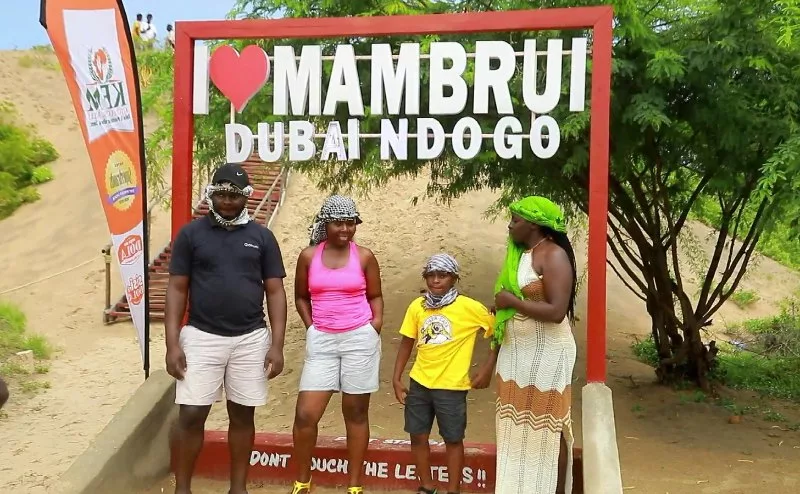
 Local tourists arrive at Mambrui sand dunes in Kilifi
Four years ago, the vast sand dunes of Mambrui in Magarini subcounty were little more than a striking landscape known mainly to the local community.
Today, the dunes are alive with the roar of quad bikes, the excitement of visitors and the ambitions of more than 150 young people who have found a new source of income in what has become one of Kilifi county’s emerging tourism attractions.
The transformation began almost by accident.
A small group of five young people started riding a quad bike hired from an Italian villa owner in the area. They recorded short videos of their adventures across the dunes and shared them on social media.
They were simply having fun. However, the videos began attracting attention.
Visitors started coming to Mambrui to experience the dunes for themselves. What began as an informal pastime gradually developed into a growing tourism enterprise.
“We started by getting less than 100 visitors every week, but our social media short videos and the few visitors we got marketed us,” says Julius Kenga, chairman of the Mambrui Dubai Ndogo Community Based Organisation (CBO).
The name Dubai Ndogo, meaning “Little Dubai”, was inspired by the growing recognition that the experience offered by the dunes could give visitors a taste of the desert adventures associated with Dubai without having to leave the Kenyan Coast.
The initiative has since grown far beyond the original group of five.
Kenga says more than 150 young people are now involved in the activity, earning income directly or indirectly from the growing number of tourists visiting the dunes.
With demand increasing, operators have been hiring quad bikes from owners and vehicles from Malindi to ferry visitors to the site.
The numbers tell the story of the attraction’s rapid rise.
From fewer than 100 visitors a week in its early days, Mambrui Dubai Ndogo now attracts an estimated 5,000 tourists every month, according to Kenga.
For a community searching for opportunities for its young people, the dunes have become more than a tourist attraction. They are becoming an economic lifeline.
However, the growth has also exposed a major challenge: the community does not own enough equipment to meet the rising demand.
Kenga is now calling on the Kilifi County Government and other partners to help the community acquire its own fleet of quad bikes.
Owning the equipment, he says, would reduce the cost of hiring and allow more of the revenue generated by tourism to remain within the community.
The rapid growth of Dubai Ndogo has caught the attention of the Kilifi County Government, which is now seeking to help transform the informal venture into a structured tourism enterprise.
Kilifi Tourism and Trade executive Raymond Ngala says the county wants to work with the community to expand the attraction, diversify its activities and put the necessary structures in place.
“We have come to join and help the community expand their trade, make their tourism business official and also diversify it,” Ngala says.
The county is also looking at ways of helping the CBO access financing.
Ngala says the community could register as a Savings and Credit Cooperative Society (Sacco), which would enable it to qualify for loans through the county’s Wezesha Funds programme.
The financing could then be used to purchase quad bikes and invest in other tourism-related activities.
“We are going to support the community, and especially the CBO, to register as a Sacco to qualify them for Wezesha Funds loans so that they can purchase their own quad bikes and diversify their trade,” he says.
For the county, however, the ambition goes beyond buying equipment.
Officials want Mambrui to develop into a properly managed tourism destination with clear operating structures, safety standards and security measures.
Ngala says the county is developing a framework for working with community-based organisations and other stakeholders involved in tourism around the site.
The proposed framework could eventually determine how the dunes are managed, how operators work and how visitors are protected.
From local attraction to tourism destination
The push to formalise Dubai Ndogo comes as authorities explore how to give the dunes a more permanent place on Kilifi’s tourism map.
Ngala says discussions have already taken place with the Senate Committee on Tourism and Trade, which recently visited the area.
Among the issues being considered is whether the land can be secured and developed as a recognised tourism destination where visitors, investors and the wider community can operate within an organised framework.
“The critical thing is how do we develop a framework so that this area becomes a tourism destination,” Ngala says.
The move could fundamentally change the future of Mambrui’s dunes.
What started as young people riding a hired quad bike and uploading videos could evolve into a formal tourism attraction, complete with organised activities, trained guides, safety systems and community-owned enterprises.
For the young people already earning from the dunes, the opportunity is significant.
Kilifi Tourism and Culture chief officer Herbert Mwachiro says the government wants to ensure the community remains at the centre of the development.
Plans are underway to open up the area and market it internationally as a unique tourism destination.
Mwachiro describes the initiative as an example of community tourism, where residents are not merely spectators to tourism but become owners and participants in the industry.
“This is a great area. We can see the CBO is taking the active part, and there are other investors here. It’s a multi-stakeholder engagement that we have here,” he says.
That community involvement could prove crucial.
Across Kenya’s coastal tourism belt, communities have often sought greater participation in an industry that attracts millions of visitors but does not always translate into enough local jobs and businesses.
In Mambrui, the dunes are offering a different possibility.
The attraction was not created by a major hotel chain or an international tourism company.
It emerged from young people experimenting with a quad bike, recording their experiences and sharing them online.
Social media did the marketing. The landscape provided the attraction. The community supplied the labour and entrepreneurial spirit.
Now, government officials are stepping in to provide the structures and financing that could take the initiative to the next level.
Visitors who once travelled thousands of kilometres to experience desert adventures could soon find their own version of Dubai much closer to home, on the Kenyan Coast, where the sand dunes of Mambrui are quietly becoming Dubai Ndogo.
INSTANT ANALYSIS
Mambrui’s Dubai Ndogo demonstrates how community initiative, social media and natural attractions can combine to create new tourism opportunities. What began with five young people and a hired quad bike has grown into an attraction drawing an estimated 5,000 visitors monthly and supporting more than 150 young people. The next challenge is turning the informal venture into a sustainable, community-owned tourism destination.