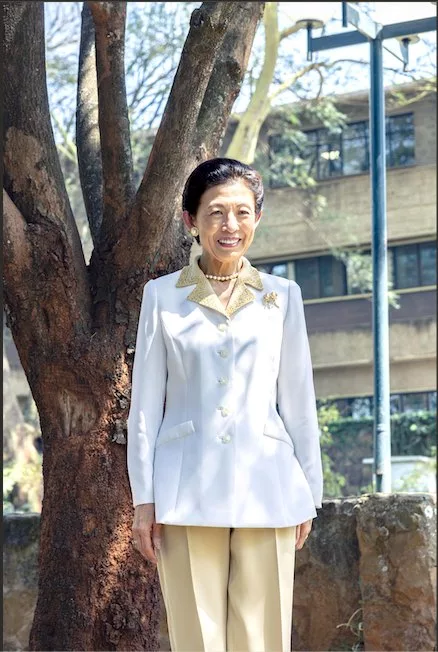
When Japan’s Princess Takamado returned to Kenya, her visit carried a strong personal dimension alongside its environmental and diplomatic significance.
Princess Takamado is a senior member of Japan’s imperial family. She is the widow of Prince Norihito of Takamado, a first cousin of Emperor Akihito and grandson of Emperor Taisho.
Notably, she has served since 2004 as honorary president of BirdLife International, which explains her recent speech in Nairobi on migratory birds and biodiversity.
She is styled Her Imperial Highness The Princess Takamado and holds numerous Japanese and foreign honours, including honorary doctorates from Canadian and Korean universities.
This was her second visit to the country since 1999, but this time, she had an unusual opportunity to reconnect with a piece of her past.
At the United Nations complex in Nairobi, she saw a tree she and her late husband, Prince Takamado Norihito, had planted during their previous visit 27 years ago — now grown into a magnificent tree.
Her latest visit, however, was focused on the future and her passion. As honorary president of BirdLife International, she came to Nairobi for the organisation’s Global Partnership Meeting and Global Flyways Summit, where she championed international cooperation to protect migratory birds and biodiversity.
Her itinerary also involved a visit to Olkaria’s geothermal facilities, Nairobi National Park, Lake Naivasha, Hell’s Gate and agricultural landscapes in Murang’a, where she observed Kenya’s efforts to balance development with conservation.
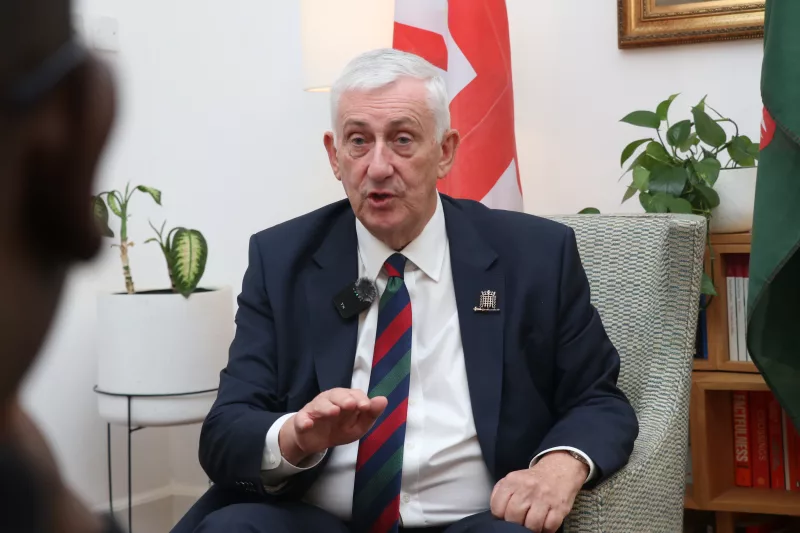
In this interview, Japan’s Ambassador to Kenya, Matsuura Hiroshi, discusses the significance of the Princess’s visit, her message to Kenyans, the environmental dimension of Kenya-Japan ties and the enduring people-to-people relationship between the two countries.
Excerpts:
You had a very important visitor from your country come to Kenya recently – Her Imperial Highness Princess Takamado. What can you tell us about the purpose of this visit?
The visit was centred on environmental cooperation. Her Imperial Highness attended BirdLife International’s Global Partnership Meeting and Global Flyways Summit in Nairobi in her capacity as honorary president, underscoring the importance of conserving migratory birds that connect Africa, Asia and Europe.
She also engaged UNEP, Kenyan conservation scientists, youth, and community groups to promote science-based policy, practical stewardship and people-to-people ties. Kenya provided an important stage for her to play significant roles in promoting international environmental cooperation.
If you were to summarise what her message to ordinary Kenyans was on this visit, what would that be?
Her core message to Kenyans was one of respect and partnership. She thanked Kenyans for safeguarding extraordinary biodiversity and stressed that migratory birds ignore borders; therefore, conserving them requires local action with global cooperation.
She highlighted the role of citizens – farmers, students, rangers, urban residents – in protecting habitats through responsible land use, community conservancies and education. Hope, evidence and solidarity were her themes: small daily choices in Kenya contribute to a healthier planet for all.
It is worth noting that this was the third visit to Kenya by Princess Takamado. She has very fond memories of the second visit 27 years ago with the late Prince Takamado Norihito. Following her special address at the United Nations on this occasion, she viewed the tree that they had planted on the grounds of the United Nations Office in Nairobi on that previous visit and was delighted to see that it had grown into a magnificent tree.
Beyond her address at UNEP, Princess Takamado visited the Olkaria geothermal station. She also visited the Nairobi National Park, Lake Naivasha, and the orchards and woodlands in Murang’a county to observe migratory and resident birds and to discuss how sustainable agriculture can coexist with biodiversity. Besides, she met Nature Kenya partners, university students and citizen scientists to learn about monitoring, wetlands restoration and community livelihoods.
The Princess, with her charming personality, gave a warm feeling to all those engaged in the bilateral relationship between Japan and Kenya throughout the visit. For example, she spent time at the Japanese School in Nairobi and met with Kenyan friends of Japan at my residence. I suppose the visit will have a lasting impact on the minds of Kenyans.
Olkaria has deep significance for Japan-Kenya cooperation. For decades Japan has supported Kenya’s geothermal development through concessional finance, technology and human resource training. Japanese companies have supplied turbines and engineering services; JICA has worked with KenGen on exploration, drilling and grid integration.
Geothermal is reliable baseload power that reduces emissions, strengthens energy security, lowers costs and supports Kenya’s industrial growth. It is a flagship example of how climate action, development and innovation can advance together through a trusted partnership.
Her Imperial Highness had the opportunity to visit three national parks, Nairobi National Park, Lake Naivasha National Park and Hell’s Gate National Park, and expressed great admiration for Kenya’s national park system and Unesco World Heritage Sites, including the Great Rift Valley lakes, which are critical stopovers for migratory birds. She recognised the vital role played by the Kenya Wildlife Service, rangers and local conservation organisations in ensuring that these globally significant landscapes are maintained and continue to thrive through their management efforts.