

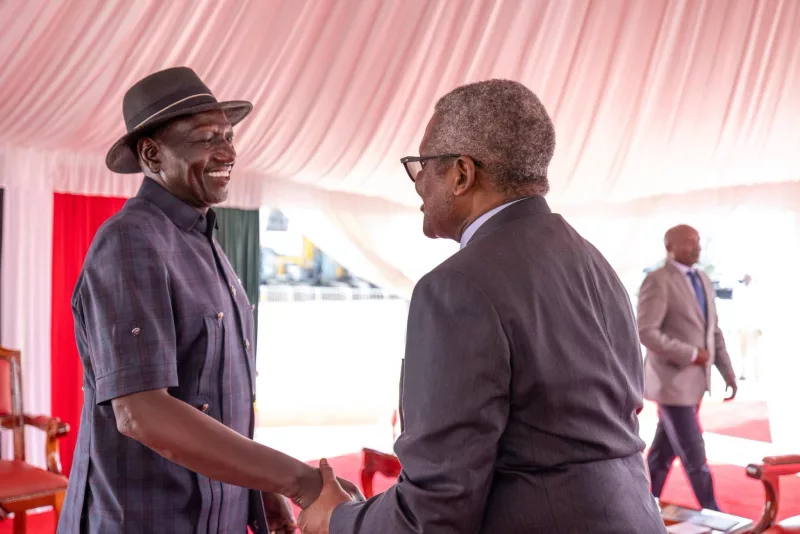
Nigerian tycoon Aliko Dangote has made good on his promise to establish a mega oil refinery off the Kenyan coast in Lamu, with the facility expected to process up to 700,000 barrels a day.
But, as might have been expected, the ambitious project has already courted controversy, with Kenya’s messy politics and competing interests beginning to rear their heads.
Some critics suggest the milestone will be exploited by President William Ruto as a reelection gimmick, while others question what benefit Dangote seeks in return after committing about Sh2.2 trillion to the country.
But away from the 2027 politics, the broader debate over the Lamu refinery can be plotted on the map of climate change politics, which has a divide of its own globally.
While there is a broad consensus about climate change, with its effects felt mostly in the Global South, politicians and industrial entrepreneurs, especially in the Global North, have turned it into a political football, painting it with a simplistic brush to win power.
Like in the chicken-and-egg situation, there are also opposing views when weighing options over whether such grand projects should be implemented.
With destabilising joblessness in African economies like Kenya, valid arguments exist as to whether, on the one hand, projects should be stalled on account of environmental concerns as well as procedural legal paradigms, and, on the other, whether the need for mass industrialisation should bear more weight to help with the economic liberation of our people.
That is the debate about fossil fuels in Western countries, especially in the United States, with President Donald Trump proving a committed champion for oil, often chanting "drill baby drill".
He has been open about his ambitions to stock millions of barrels of oil for the US, and that this ambition weighs heavily before he authorises military operations. He has openly bragged about the US intervention in Venezuela and the crusading in the Middle East, saying oil is much of the plunder he seeks.
Take his address during the 81st session of the UN General Assembly where he, as is his norm, dismissed climate change theories as pathetic and non-starters, asserting that fossil fuel is still key to wealth generation.
Renewable energy sources like wind and solar “don’t work,” he said, and that they are “more expensive than fossil fuel options.” He also criticised wind turbines as “pathetic,” “bad,” and “expensive to operate.”
“It’s [climate change] the greatest con job ever perpetrated on the world, in my opinion. The carbon footprint is a hoax made up by people with evil intentions.”
In the Dangote project case, while 2027 politics has its footprints over its controversy, there are some genuine questions about whether enough due diligence, including feasibility studies as well as environmental and social impact assessments, has been done.
There is also a question about public participation around the project; whether the local residents in Lamu have been adequately engaged to give their views as per our constitution. Then there is the question of the fossil fuel impact on the local marine and fragile ecosystem and biodiversity.
In fact, Greenpeace Africa, an international conservationist organisation, has cited perceived lapses in environmental impact assessment and the danger to the marine ecosystem as reasons for rejecting the project outright.
Sherelee Odayar, oil and gas campaigner at the organisation, claimed the "project threatens to damage one of East Africa’s most fragile coastal ecosystems while locking Kenya into a risky fossil fuel future.”
“Lamu’s mangroves, coral reefs and seagrass beds are not expendable; they support fisheries, livelihoods and coastal protection. A mega-refinery of this scale brings habitat destruction, marine degradation, oil spill risk and dangerous air pollution,” Odayar claimed on behalf of the agency.
The entity also argues that “the promise of ‘thousands of jobs’ cannot be used to hide the true cost of this investment” and that “large fossil fuel projects often create temporary jobs while undermining existing livelihoods in fishing, tourism and small-scale local economies.”
But the counterargument also makes sense, as one can assert that the parcel of land for the project is in a special economic zone that was long ago gazetted for such a kind of development initiative.
By dint of this, residents had fully engaged with the gazettement process and hence needed not to be consulted on the specific Dangote project.
Moreover, there is also the perceived pattern of general objection from certain quarters whenever projects of such magnitude happen in Africa, especially with capital not sourced from the usual “saviours.”
I think there is a need for a more balanced and nuanced approach so that initiatives that could potentially change people’s lives are not tarnished, scandalised and lost because of dogmatic ideological contests.
Also, we must watch out for politicians who have consistently taken opportunities to criticise the government for their own electoral fortunes, so as not to tarnish the project without evidence.





