

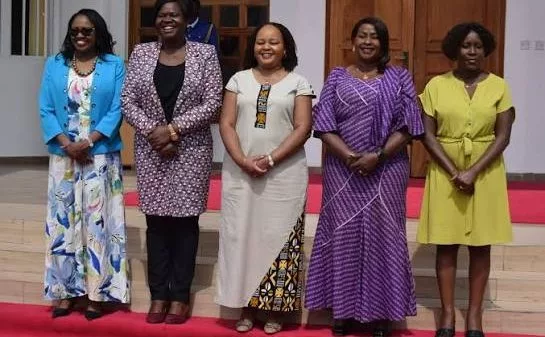
 Women governors from left; Susan Kihika (Nakuru), Gladys Wanga (Homa Bay), Anne Waiguru (Kirinyaga), Wavinya Ndeti (Machakos) and Cecil Mbarire (Embu)/ HANDOUT
For decades, Kenya’s political arena has been overwhelmingly a male preserve, the rough-and-tumble arena ruled unquestioned by men.
The language said it all. Politics revolved around “kingpins”, “strongmen”, “big men”, “political generals”, “big boys”, “old boys network”, “may the best man win.”
Women often were, and still are expected to play supporting roles — mobilising crowds, running women’s wings and providing political symbolism, tokenism.
They have faced insults and humiliation, clan curses, persistent sexism and claims of male superiority, even physical assaults and violence at their events. They also face the persistent problem of raising money because backing them has not always been seen as a sure bet. Many lack networks and must go it alone, starting by establishing concrete records at the community grassroots level.
But a new feminine force has been steadily emerging and more and more Gen Z voters are shedding prejudice, looking at women’s records, comparing them with men’s records, and electing women.
They are the lionesses.
They are women who have beaten the odds in an otherwise dirty, treacherous and male-dominated political field.
Of course, that doesn’t mean men typically play dirty and women always take the pure and high road, human nature being what it is and power being an almost irresistible intoxicant. Women who succeed must also defy stereotypes and show they can be tough when necessary.
Idealistic shrinking violets seldom make it in politics although some women consciously avoid criticising male rivals as they are likely to face ugly testosterone-fuelled attacks, cheered on by benighted males and uninformed women. Instead, they focus on policies, what they have done and intend to do.
Many don’t have established networks and power brokers, so they start from scratch, building their own at the community level, talking directly to constituents and prospective voters avoiding establishment fanfare.
They have entered some of the country’s toughest political contests, taken on powerful men and emerged victorious — in successive elections.
Now, as the 2027 general election approaches, a number of women are preparing for big battles. They have demonstrated that the country’s political battlefield is no longer exclusively a man’s arena.
Justice is on their side, but often ignored and overruled.
Former Chief Justice David Maraga's delivered an advisory opinion in 2020 calling for dissolution of Parliament over the failure to implement the constitutionally mandated two-thirds gender rule. Male MPs opposed to more women in Parliament and other bodies consistently failed to show up for the parliamentary votes, denying quorums. The CJ’s opinion was quashed by the High Court in June for being premature and skipping required constitutional procedures.
The issue hasn’t gone away, the can has just been kicked down the road.
Here are some of the successful and ambitious women:
They include Samburu West MP Naisula Lesuuda (Kanu), Kajiado nominated Senator Peris Tobiko (UDA), Suba North MP Millie Odhiambo (ODM), Isiolo Senator Fatuma Dullo (Jubilee leaning to UDA) and Embu Governor Cecily Mbarire (UDA).
Others are Kirinyaga Governor Anne Waiguru (UDA), Homa Bay Governor Gladys Wanga (ODM), Machakos Governor Wavinya Ndeti (Wiper), former Meru Governor Kawira Mwangaza (UMP), Kwale Governor Fatuma Achani (UDA), Nakuru industrialist and Senator Tabitha Karanja (UDA).
For some, the journey began with a door opened by affirmative action — nomination to Parliament.
Lesuuda was nominated to the Senate in 2013 before taking the harder route into constituency politics.
In 2017, she won Samburu West and has since retained the seat. In 2022, she secured 15,855 votes on a Kanu ticket.
“If I were probably not nominated first in my community, where it is perceived as so patriarchal, it would have been hard for me to run for a seat and win the first time,” she told the Star.
Tobiko’s story follows a similar path of persistence.
She lost her first attempt to win Kajiado East in 2007. In 2013, Maasai elders held a ceremony to curse her when she won the party primaries.
Nevertheless, she went ahead to defeat Kakuta Hamisi by just 874 votes: 23,645 against 22,771.
“The elders came and said: 'She will die ... Even those who vote for her, they will die'", she said in a recent interview.
She retained the constituency in 2017 before moving to the Senate as a nominated senator in 2022.
Now she is eyeing the Kajiado governor’s seat, where she is set to face State House Comptroller Katoo Ole Metito, Senator Lenku Seki and Deputy Governor Martin Moshisho.
Then there is Millie from Homa Bay, often referred to as the bad girl — one of the country’s most enduring political survivors.
Her political career began outside Parliament in civil society where she worked on child rights. That work gave her a voice and national platform.
In 2008, ODM nominated her to Parliament. Five years later, she moved into elective politics and won Suba North.
She has retained the constituency through successive elections and is now serving her fourth parliamentary term when her nominated and elected terms are counted.
In 2022, she retained the seat with 27,130 votes against James Akali’s 18,151.
“I am not afraid of anybody. I have even lectured the current President, despite him being my friend,” she said recently.
Political analyst Martin Andati attributes Millie’s durability partly to the public profile she built before entering elective politics and her visibility in Parliament.
“She started in civil society dealing with the issue of child rights where she did a stellar job, which then gave her a voice and platform that ultimately propelled her to the national scene,” Andati says.
But Millie eventually became a political brand in her own right.
Political risk scholar Dismus Mokua said, “Millie has survived turbulence and her brand as a ‘bad girl’ has elevated her to national status.”
In Embu, Mbarire’s route to the governor’s office was marked by rejection and rebound.
She had served as MP for four terms — twice as Runyenjes MP and twice as nominated lawmaker — before becoming governor in 2022.
In 2017, she lost the Jubilee nomination for governor to incumbent Martin Wambora, forcing her back into Parliament through nomination.
Five years later, she returned and faced former Senator Lenny Kivuti.
Mbarire won with 108,610 votes against Kivuti’s 105,246 — a margin of only 3,364 votes.
She became Embu’s first woman governor.
Mbarire has described women’s campaigns as particularly difficult, citing emotional, psychological and physical abuse.
“Women must be courageous and stand up for themselves. Campaigns for women are extremely rough,” she said.
In Homa Bay, Wanga faced a man with an impressive political resumé.
Evans Kidero had been Nairobi governor and was one of the best-known politicians in the race. Wanga had served as Homa Bay woman representative for one term.
She won overwhelmingly, securing 244,559 votes against Kidero’s 154,182. Kidero challenged the result in court, but the declared results show Wanga as the winner, and she was subsequently gazetted as governor.
Wanga is the first ever woman to be elected as governor in the Nyanza region since the advent of devolution in 2013.
Governor Ndeti offers another story of political persistence. She tried to win the governorship in 2013 and again in 2017 — but lost.
Then came 2022.
Her principal challenger was Nzioka Waita, a former State House chief of staff and head of the Presidential Delivery Service.
This time, Wavinya won decisively, securing 226,609 votes against Waita’s 129,181.
Her victory made her the first woman governor of Machakos.
No woman has demonstrated the ability to disrupt an established political order more dramatically than Kawira Mwangaza.
In 2022, the Meru governor’s race featured incumbent Governor Kiraitu Murungi and Senator Mithika Linturi.
Mwangaza entered the race as an independent.
She secured 209,148 votes, far exceeding Linturi’s 183,859 and Kiraitu’s 110,814.
Mwangaza’s victory showed how a woman outside the traditional party establishment could disrupt a race involving two of the region’s best-known male politicians.
In Kirinyaga,Waiguru beat the odds to become the first governor from the Mt Kenya region in her first stab at politics and is concluding her second term. She says she will aim for the presidency in 2032.
At the Coast, Achani pulled a surprise when she defeated strongmen to become Kwale’s first woman governor.
Dullo is preparing for another transition — from the Senate to the county’s top seat. Currently serving her third term as senator, she retained her Senate seat in 2022 with 29,625 votes against Nur Ibrahim’s 23,166.
She is positioning herself for the Isiolo governorship in 2027.
Her ambition has already brought her into sharp political confrontation with Governor Abdi Guyo.
The rivalry escalated into an impeachment attempt against Guyo, which he survived. Dullo has since declared her intention to challenge him.
Then there is Karanja.
The Keroche chief executive entered elective politics in 2022 and won the Nakuru Senate seat with 442,864 votes.
But she is now looking beyond the Senate and has spoken of seeking the Nakuru governorship.
Karanja says her strategy is deliberately different from that of many male politicians.
“As women, we have so many disadvantages in this field of politics. For me, I devised several ways of survival. I completely avoided direct confrontation with them,” she says.
“I campaign alone, I did not want them to demean me. They demean women in many ways.The people of Nakuru had seen what I had done. So, whatever my opponents said about me, the people of Nakuru could not listen.”
Andati says women have had to develop different survival mechanisms in a political field where they face structural disadvantages.
The first is what Mokua calls “ground language” — communicating with voters in simple, emotional and rational terms.
“Female politicians tend to use ground language that is both emotional and rational during campaigns,” he says.
“They are able to communicate in a crystal-clear fashion that moves and influences perceptions.”
Women, he argues, often build relationships through social and community networks, creating campaigns based on trust rather than rigid political hierarchies.
Endorsements from influential politicians and opinion leaders can also create what he calls a “bandwagon effect”.
“There is another intriguing factor. In some communities, opposing a strong female candidate is seen as a sign of weakness and some male politicians fear engaging in campaigns with female opponents.”
The current generation did not invent female political power in Kenya.
They inherited a path cleared by earlier pioneers such as Martha Karua, Charity Ngilu and Naomi Shaban, among others.
Ngilu broke into Parliament during the first multiparty election in 1992 and later became one of Kenya’s first female presidential candidates.
Karua rose from constituency politics to Cabinet where she was Justice minister and eventually entered the presidential contest. In 2022, she was Raila Odinga’s presidential running mate.
She is now leading the People’s Liberation Party and is seeking the presidency in next year’s presidential election.
Shaban built a long parliamentary career and became one of the prominent women in the political establishment. She served in parliament for four terms.





