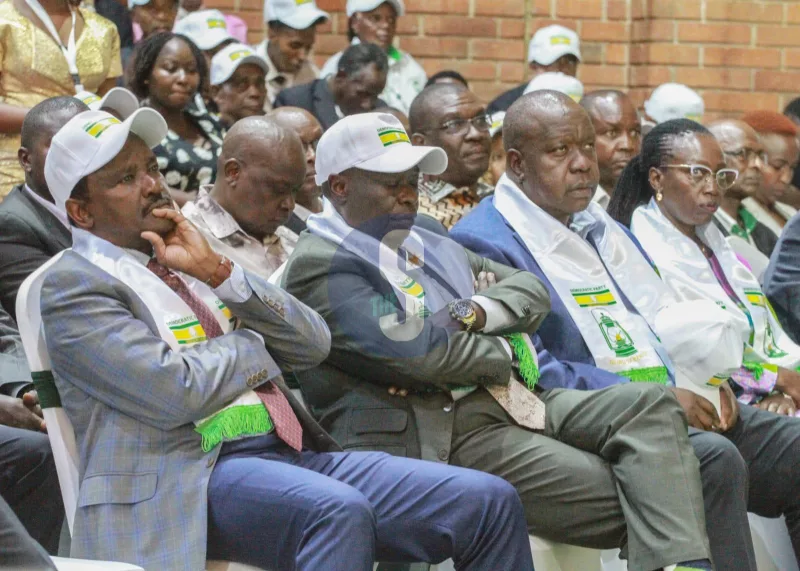
As the country gears up for next year’s general election, the opposition are poised for utter fragmentation, not their promised united front against President William Ruto.
They have continued to splinter into many factions ever since former Deputy President Rigathi Gachagua lost his seat in government through impeachment and joined their ranks.
What initially appeared to be smooth sailing for the anti-government movement is steadily turning out to be choppy seas depriving the opposition’s sails of necessary forward power.
Their regular public pronouncements about unequivocal commitment to a united presidential candidature is now taken with a pinch of salt by the public.
The entry of Gachagua into the opposition movement was anticipated to provide direction and the much-needed energy. However, he turned out to be the Achilles’ Heel of the front for alternative government.
Ever since they launched countrywide crusades for a united opposition, the man from Wamunyoro has never hidden his objective of uniting the voters of Mt Kenya region behind himself alone.
His intention is to use the opposition’s supposed numerical strength to negotiate for at least 50 per cent of government slots.
In the same vein, Kalonzo Musyoka with Wiper team only focused their activities in their stronghold of Ukambani instead of mounting a nationwide campaign.
When Edwin Sifuna bolted out of ODM and into the Linda Mwananchi movement, he gave opposition forces a semblance of unity and national outlook.
He had benefitted enormously from the Gen Z protest momentum. However, his inability to find a home in any existing political party seems to have drained his energy and somewhat exposed his soft underbelly.
Every colleague of his in the opposition has invited him to join their party but not to be the presidential flagbearer. This has contributed to increasing fatigue within the opposition rank and file.
The opposition movement has been bedevilled by a combination of setbacks. They are the result of their internal weaknesses that are exploited and buttressed by external forces.
They revolve around lack of vision, strategy, consistency and resources. The weaknesses unfortunately reinforce each other and have brought the alternative outfit to its knees sooner than was anticipated.
The country has waited with baited breath for the alternative development agenda to the one offered by the government and Ruto. The President has revised the Beta policy and infused it with new paradigms since the Gen Z protests.
The cooperation with ODM and Jubilee development pillars has enriched the vision and invigorated the leadership. A leadership that had premised its philosophy on brinkmanship and regional exclusion has turned around and now promotes national unity and inclusion in terms of regional development.
Since the establishment of the broad-based government, Ruto has initiated and implemented mega infrastructure projects. They are transformative and spread evenly across the country. The development policy of the government has transitioned from the initial Beta to a nationalist transformation agenda.
The President has been leading this process personally and the impact has been monumental. The opposition manifesto pales in comparison with the visionary and concrete trajectory of the incumbent. Ruto has chosen a mix foreign aid with private capital to finance infrastructure development.
The recent launch of the National Infrastructure Fund has been hailed as a milestone and game changer. The opposition on the other hand has been engaged in catcalling and playing catch-up. It is not unreasonable, therefore, for the public to call out the opposition for lack of clarity of vision.
The opposition movement has faced the challenge of inconsistency in strategy. Strategy is a long-term plan of action designed to achieve an overall aim by aligning goals with available resources and navigating challenges.
It involves assessing the current situation, defining clear goals, anticipating obstacles or opponents' moves and managing available resources. Strategy provides the overall direction and reasoning, while tactics are the specific, short-term actions executed to fulfill that larger plan.
It is therefore a comprehensive blueprint that connects high-level objectives (the "what" and "why") with concrete actions and means (the "how").
It is crucial to political parties and governments to support electoral campaigns, policy development, bridging goals to actions as well as international relations and statecraft.
Parties and candidates use political strategy to analyse voter demographics, craft compelling campaign messages and mobilise grassroots support to win elections.
Strategic planning helps governments and leaders ensure that new laws and public policies align with long-term public interests, economic realities, and stakeholder needs.
As noted by military and political theorist Carl von Clausewitz, military actions and broader statecraft are extensions of political objectives: strategy provides the vital link that translates political intent into executable outcomes. On a global scale, grand strategy coordinates diplomatic, economic and military tools to secure national interests and influence global policy.
This critical logical sequence of thought, practice and activities has been identified as largely lacking in the opposition. Doubts abound whether the leaders will ever find their way back to the rail track and demonstrate coherency.
The opposition also faces the challenge of resource mobilisation. They are constrained by not having at their disposal the necessary material and financial wherewithal. This has led to some opponents and analysts labelling them as puppets sponsored by political godfathers.
Resources are the foundational fuel — financial capital, human networks, organisational infrastructure, and ideological identity — that enables political parties to function, mobilise voters and contest elections.
Funds and administrative frameworks sustain physical offices, paid staff and day-to-day operations between election cycles.
On the other hand, human capital and communication tools allow parties to rally volunteers, register voters and drive turnout on election day.
This is essential and necessary for voter mobilisation. It is also requisite for intellectual and ideational resources empowering parties to research, draft platforms and present coherent legislative alternatives as key ingredients of policy formulation.
There has been absence of a cohesive and critical mass of intellectual resources on the opposition bench. This has been responsible for lack of deep organisational and ideological roots that would ordinarily protect parties against sudden crises or poor short-term electoral showings.
Most crucially, the disunity in the leadership of the movement has hindered the movement from accessing the diaspora support.
The diaspora voter population has consistently leaned towards and supported the opposition since the reintroduction of multiparty democracy. Unless they turn the tide, the opposition is in the doldrums.