It all began with two public-private partnership deals in 2024 which Kenyans publicly and consistently opposed, until they were cancelled.
One for the renovation of Jomo Kenyatta International Airport and the other for electricity transmission by the Kenya Electricity Transmission Company.
Both were awarded to the Adani Group. Both were initiated privately as PPPs (unsolicited). It is the handling of these deals that revealed fundamental constitutional flaws in the law regulating PPPs in Kenya, the Public Private Partnerships Act, 2021.
Democratic control over public expenditure
Except for grants, all money raised or received by the government is paid for directly or indirectly by the people of Kenya. Equally, all public resources, including land and natural resources, belong to the people of Kenya and are only held in trust by the national or relevant county government.
For this reason, the constitution entrenches democratic control over public spending. While this power is largely delegated to Parliament, as representatives of the people, the constitution still mandates the concurrent direct involvement of the people in parliamentary business (Articles 10(2)(a), 118(2)(b) and 201(a)).
This means that the people get to participate in setting spending priorities and in authorising not only expenditure but also the revenue sources that will finance the expenditure. They can also access spending data and oversee budget implementation, as well as ensuring accountability and consequences for misuse of public resources.
While the executive at national and county levels bear the constitutional responsibility of originating policy and spending priorities in the form of budgets, these require meaningful democratic input and pre-approval before implementation.
It is for this reason that the constitution requires parliamentary authorisation (appropriation) as a pre-condition for any withdrawal and expenditure of money from the Consolidated Fund.
It is for the same reason that the constitution restricts circumstances under which money may be spent outside the approved budget and further requires such expenditure to be regularised through parliamentary approval within two months – although this control has proved weak.
Understanding PPPs
Public infrastructure and services are ordinarily financed from revenue collected nationally or from borrowed money (public debt) and delivered by the relevant government agencies. Under a PPP arrangement, however, a private entity (investor) undertakes to construct public infrastructure or to offer a public service using its own funds.
PPP projects are typically multibillion and multi-year in nature. It was, for instance, estimated that the JKIA project would cost about Sh258 billion.
The Ketraco project was to cost about Sh95.68 billion. Both were for a period of 30 years. At the end of the agreed period, the asset or infrastructure is usually required to be handed back to the government.
Public expenditure in PPPs
Although PPPs are usually financed by a private entity, they are not cost-free.
Firstly, as is the case with public debt, the investor needs to recoup its investment, with profit. This is ordinarily recovered either through periodic payments by the government (annuities or availability payments) or by the investor directly charging the public for using the infrastructure built (user-pays), or both.
The Nairobi Expressway is an example of a user-pays PPP. Notwithstanding the repayment model, in both, the people pay for the infrastructure. The first, indirectly through government-imposed ordinary taxes and levies. The second, directly when they use the infrastructure.
Secondly, some PPPs require the government to incur upfront costs. These include provision of suitable land, either public or private (the owners of which are financially compensated). In some cases, the government may make a direct financial contribution of part of the project costs.
Thirdly, given that it is not in the ordinary business of private entities to deliver public infrastructure or public services, the government may have to take measures to encourage.
This may require government to take up some costs, make certain promises, assume some risks by providing guarantees or provide some other form of support. The goal is to make private spending on public services less risky and more profitable for the investor.
These promises, commitments and guarantees may seem harmless and cost-free at first. However, if the risks assumed come to pass and events as well as defaults guaranteed against happen, these commitments become financial obligations and liabilities that the government (hence the people) must shoulder. These are, otherwise, referred to as contingent liabilities.
There are also situations where an infrastructure, such as a rural road, is needed, but there aren’t enough people to finance the project by paying to use it. This makes it unviable for private investment. However, given the need for it, often a government would offer to top up the amount of money needed to make such a road viable for private development. This is referred to as viability gap funding (VGF).
Why Kenyans opposed the Adani PPPs
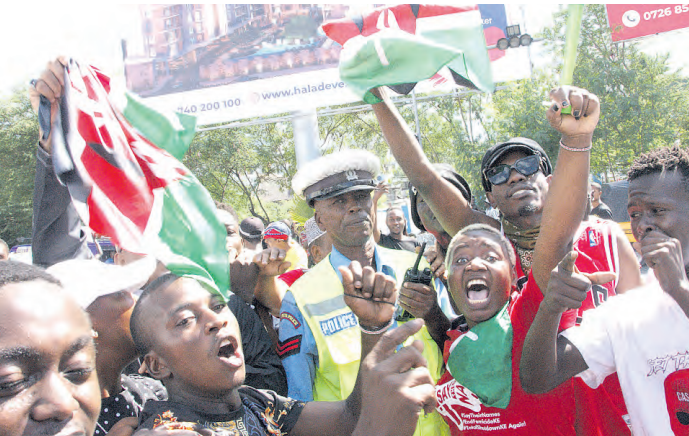
Kenyans opposed the Adani deals for two main reasons. The deals appeared to have been initiated and approved in secrecy without involving either Parliament or consulting Kenyans through public participation. Where these deals were discussed in Parliament, it was mainly in response to the outrage and protests by Kenyans.
Yet Parliament did not have a direct say on whether the projects and their associated expenditure should proceed or be terminated in the public interest.
The lack of both transparency and democratic input and approval, therefore, made Kenyans question whether they were getting value for their money.
Additionally, the fact that the two projects were privately initiated and were both awarded to the Adani Group made the people suspect foul play. This was enhanced by the allegation that other companies had equally submitted bids but were never considered.
All these revealed gaping flaws in the law regulating PPPs.
What was contested before the court
In the above context, Katiba Institute, in November 2024, moved to court to challenge the constitutionality of the PPP Act. We argued that the law failed to mandate democratic control over PPP projects and the public expenditure they generate.
This resulted in the lack of both democratic pre-approval of the associated expenditures as well as lack of oversight and accountability in their implementation.
We also argued that the Act failed to require the government to subject all privately initiated proposals (PIPs) to competitive procurement, thereby violating the constitutional requirement for competition in procurement (Article 227).
This also undermined the constitutional imperative for fairness and cost-effectiveness in procurement since it permitted preferred investors to be hand-picked.
What the court said
On September 17, the High Court delivered its judgment. Agreeing with Katiba Institute, it held that all public expenditure and liabilities under PPPs must be pre-approved by Parliament. This includes any public debt, annuities or availability payments, guarantees, contingent liabilities and VGF.
It also held that Parliament retains a mandatory constitutional oversight role whenever a PPP project exposes the State to financial liabilities.
On this basis, it declared sections 59, 60 and 72(1) of the PPP Act unconstitutional given that they currently bestow this power on a PPP Committee made up of national and county executive appointees.
The court upheld the constitutionality of PIPs, in principle. However, it stated that where the government opts not to subject a PIP to competitive procurement, the decision has to be objectively justified (with rational reasons), and the chosen method must remain fair, transparent, competitive and cost-effective.
While the import appears contradictory, the underlying message is that constitutional procurement standards (Article 227), including open competition, are not negotiable. According to the court, administrative convenience, preference or the mere attractiveness of a proposal cannot be used to bypass competition.
The court, however, suspended its declaration of unconstitutionality of three sections of the PPP Act for six months to give Parliament time to amend the law.
The author isdevolution and public finance lead, Katiba Institute