

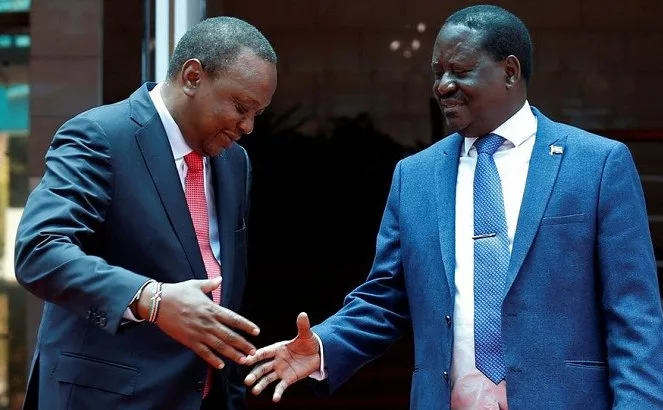
 President Uhuru Kenyatta and ODM leader Raila Odinga in 2018.
About a week ago, former President Uhuru Kenyatta told a Jubilee National Executive Council meeting that Raila Odinga won the 2022 election.
He said it while handing Jubilee's leadership to Fred Matiang'i, the man who served as his Cabinet Secretary for Interior, commanding the country's entire security and intelligence apparatus. A few days later, ODM leader Oburu Oginga responded with three questions.
Why raise it now, four years later? Why hand power to William Ruto if you believed Raila won? And why use the sacrifice of a departed leader as material for a new political project?
Those questions expose precisely the trap this piece warns about. The theft is finally admitted. The accountability is not. The confession is launching the next succession.
Albert Luthuli, the Nobel Peace Prize laureate who led the African National Congress through some of its most brutal years, was once asked how he could still believe in human goodness after everything he had witnessed.
Human frailty, he answered. Greed, pride and selfishness lie at the root of all oppression. These are universal weaknesses, intensified under certain conditions among certain people. But once you cease to believe in men, you cease to believe in God.
In Kenya, the greed of a small elite has been intensified for more than 60 years and weaponised to keep the majority in a cycle of permanent protest while they quietly built empires. Jaramogi Oginga Odinga understood this and was punished for it.
Raila Odinga understood this and spent five decades paying the price before engineering what we now have. Oburu understands this and is now executing what those before him could only point toward.
The mission has not changed across three generations. Only the strategy has evolved.
Karl Marx observed that you cannot build a sustainable superstructure of laws, morality and democracy on an empty economic base.
The base consists of roads, railways, factories and electricity. The superstructure consists of constitutions, courts, political debates and civil liberties.
The base determines what is possible in the superstructure. You cannot debate your way to development or protest your way to a power grid. Kenyan political elites have exploited this distinction for six decades while keeping everyone else in the dark.
For 60 years, the communities of Nyanza, Coast, Western and Northeastern were guided into fighting exclusively for the superstructure. We fought for the second liberation. We fought for the 2010 Constitution. We marched, bled and produced Kenya's most celebrated democratic reformers.
Meanwhile, the elites of two regions quietly monopolised the base. The industries. The land. The transport networks. The financial capital. This is not accusation but arithmetic, visible in every economic survey since independence.
Now that those elites command an unassailable material base, they fund opinion polls, bankroll civil society and manufacture outrage on demand, then demand that we abandon our first real opportunity to secure our own economic foundation to join them in yet another round of superstructure warfare.
This is the myth of Sisyphus. And we are done playing the role.
In Greek mythology, the gods condemned Sisyphus to roll a boulder up a steep hill for eternity. Every time he neared the summit, the boulder rolled back down.
The punishment: the futility. The exhaustion of effort that produces nothing. The madness of repetition without result.
Consider the Kenyan version. We fought for the second liberation and installed Mwai Kibaki. The moment victory was secured, we were locked out of the government we had delivered. John Michuki and Kiraitu Murungi told us plainly they had only wanted Moi out.
In 2005, we rejected the mutilated draft constitution designed to preserve Executive power. In 2007, Kibaki and his cabal stole our electoral victory and was sworn in under darkness. That single act killed more than 1,300 Kenyans, injured thousands and displaced hundreds of thousands more.
Raila once again agreed to serve as junior partner in a coalition still largely controlled by the same local elite. We delivered the 2010 Constitution. Come 2013, votes were manipulated.
Come 2017, the Supreme Court nullified an election for the first time in African history and the state simply repeated it. Each time we neared the summit, a new emergency demanded we abandon our material interests for someone else's national battle.
Come 2022, the boulder rolled again. The man who held the instruments of power, whose Interior CS commanded the intelligence services that either failed to detect the theft or chose to look away, has now admitted it.
If it was incompetence, it was catastrophic. If it was a choice, it was a crime. Four years later, the theft is finally admitted. The accountability is not.
Now, for the first time in 60 years, Raila's accommodation strategy has placed our people inside the engine room. Not as tokens or ceremonial faces in a Cabinet photograph. Inside the rooms where the base is built and distributed.
And the boulder is being rolled back down again.
The evidence appeared with rare clarity in Kakamega. Senator Boni Khalwale, speaking at the burial of his wife Gloria, boasted before assembled mourners that the Mulembe community, a central pillar of Raila's political base, are the trusted house helps who raise the children of the wealthy, the watchmen who guard their estates, the boda boda riders who fuel their mobility.
He then argued that because the Luhya have been such loyal servants, the rich should reward them with the presidency by supporting Edwin Sifuna - a first time senator. That is a confession, not a political pitch. It describes what 60 years of Sisyphean politics has produced.
A community so conditioned to the role of vanguard and servant that its own leaders now cite that servitude as a qualification for power. A classical comprador in the making. We reject that framing completely.
The Linda Mwananchi discourse should therefore be looked at as a calculated scheme to keep our youth as permanent security guards and caretakers of elite wealth, dressed in the language of liberation, recycling the same emotional architecture Uhuru used between 2018 and 2022 to absorb Raila's political energy during the fruitless handshake.
Every major accountability battle in Kenya's history was waged primarily by Nyanza, Western and Coast. Every major material gain was captured primarily by the elites of two regions.
We have been the permanent army and the permanent poor simultaneously. A seat without projects is just a seat. A constitution without a road to your hospital is just paper.
Oburu's historical task is to secure the material base first. The SGR and dual carriageway to Kisumu and Malaba. The nuclear plant in Siaya.
The Homa Bay irrigation schemes. Infrastructure across Coast, northern Kenya and Western that creates conditions for our people to compete from strength rather than permanent sacrifice.
That is not abandonment of accountability. It is sequencing. Build first. Debate from a position of material strength rather than material desperation.
The Odinga family did not spend three generations in detention, exile and enduring electoral theft so that we could remain the most noble poor people in the country. They spent it so that we could eventually enter the room where decisions are made and make them.
But the room is not safe. The confession this week is not accountability. It is the opening move of the next succession. The men who handed power to President Ruto in 2022, expecting to control him through the deputy's office, are now launching a new vehicle to take it back.
Uhuru is not retiring. He is relaunching himself through Matiang'i. The same machinery now trained on Sifuna is the machinery that tried to hollow ODM from within before Raila left us. It failed then. It is being reassembled now.
They did not expect the door to be opened to those they had kept outside for 60 years. The boulder is rolling back down the hill. And the men pushing it are the men who admitted the theft.
This time, the community are in the room to stay. That is not treason but survival. And after 60 years of trying every other strategy, survival is finally looking like justice.
The writer is based in Johannesburg, South Africa





