

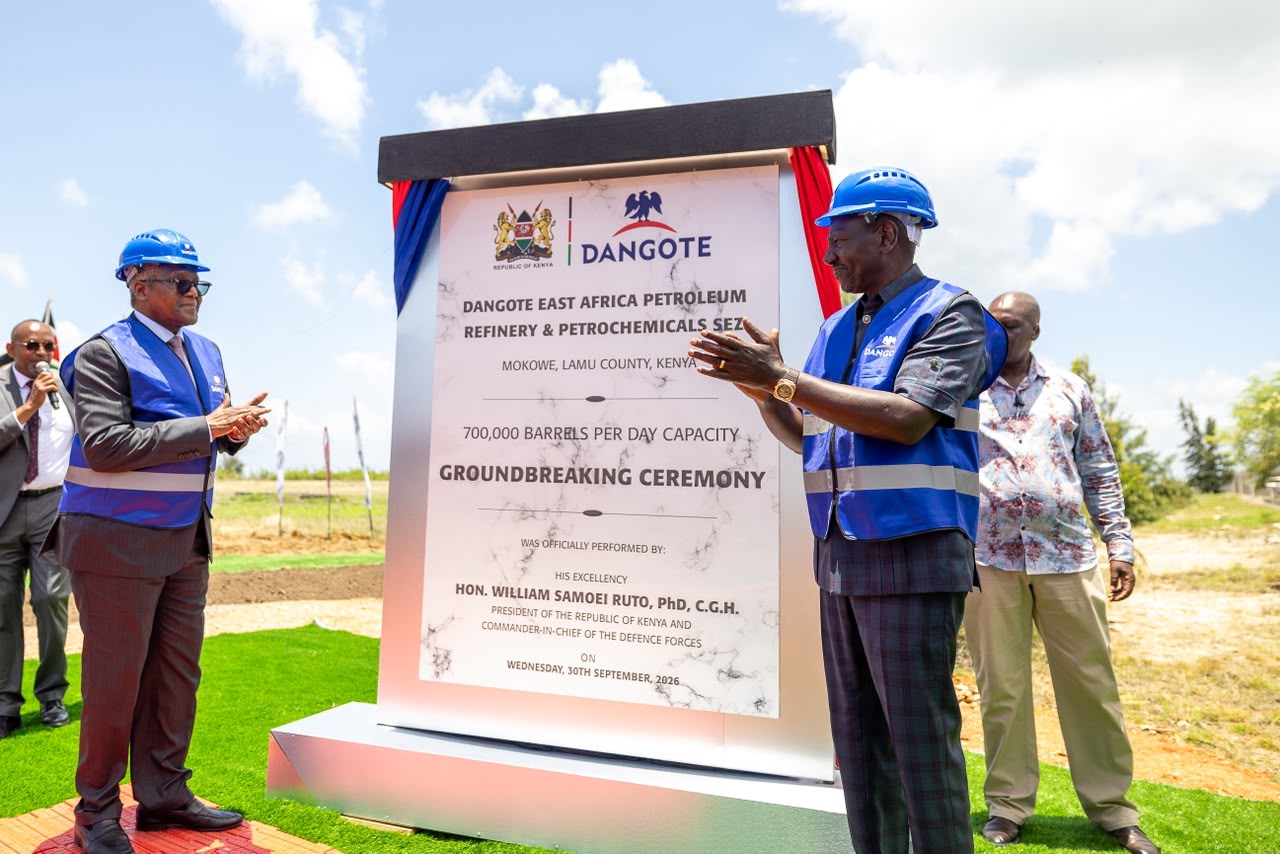
 Nigerian industrialist Aliko Dangote and President William Ruto during the groundbreaking of Dangote Lamu refinery in Lamu /PCS
Dear reader
It’s been a minute!
A lot has happened but we are here!
Expect a compilation of our articles in a book sooner than later. It’s been in the works. Pray that you get to see what is in between the pages.
Zimbabwean businessman Wicknell Chivayo has passed on, at 43, shy of his 44th birthday this November. An African entrepreneur from Zimbabwe who was making it big, he embodied the new face of the rising African multi-national businessman. May his soul rest in peace.
Nigerian tycoon Aliko Dangote happened this week in Lamu. Possibly the richest black man on earth, he is the one who has finally shown faith in investing a whopping Sh2.2 trillion mini oil refinery in Lamu. Finally, my pet subject of Lapsset has a lifeline! For those who don’t know, this stands for Lamu Port, South Sudan, Ethiopia Transport Corridor, one other nine key trans-African infrastructural projects aimed at opening up the continent’s potential. The estimated 1.5-3 trillion project has gotten a major boost, what with the groundbreaking ceremony attended by seven remarkable leaders, including five heads of state, a former president and Dangote himself.
President William Ruto was joined by Presidents Yoweri Kaguta Museveni of Uganda, Romuald Wadagni of Benin and Jean-Lucien Savi de Tové of Togo, and Prime Minister Abiy Ahmed Ali of Ethiopia during the groundbreaking ceremony of the Dangote East Africa Refinery in Lamu.
Former Nigerian President Olusegun
Obasanjo and representatives of other African governments were also present.
The mega project is set to transform the energy and industrial landscape of
Kenya and the region.
Kenya, Uganda, South Sudan and Ethiopia will directly benefit from the project, with countries such as Rwanda, Burundi and the DRC providing a ready market for the products. The refinery will strengthen regional energy security by reducing overreliance on imports thus enhancing our foreign exchange reserves by extension.
The refinery will produce 700,000
barrels daily at its peak, making it the largest in East and Central Africa and
among the biggest in the world. This project will thus cement Kenya’s position
as the economic powerhouse of East Africa and the continent at large. The
installation is in fact an industrial city that will produce 1,000MW power plant,
half of which will be sold to the national grid thus boosting countrywide electricity
supply currently standing at about 3,271 megawatts. There will also be a
plastic factory, fertilisers factory to help boost agricultural productivity
and food sufficiency. Other chemicals will also be produced for use by various
other industries across the continent.
The project that will take 40 months to be complete helping create more than 60,000 jobs directly, providing opportunities for our youth who have been trained in the petroleum value chain. There will also be technology transfer by the various companies contracted to provide expertise at the port city. Lamu is thus not only going to be a tourist destination but a major industrial hub.
This project will also reduce the export of raw materials and the importation of finished products, essentially exporting wealth and jobs meant for the Kenyan and African people.
Manufacturing should be 20 per cent of our GDP, and this project alone will help boost our rating from the current nine to 12 per cent. It is thus a turning point in our quest to industrialize out nation and continent.
Diversity and Inclusion
As we celebrate this great feat, something very profound happened too on the same day that the Dangote oil refinery happened. For the first time in the history of the world, intersex persons from more than 20 countries in the world gathered in Nairobi for the first ever major conference, under the Aegis of the African Intersex Movement.
One may ask why Nairobi and Kenya in particular?
More than 10 years ago, one Saturday morning, I got a tweet from someone calling himself outcast accepted. The person reached out to me appreciating my role on the rights of persons with disabilities like him. His name was Mary Waithera, yet he was also James Karanja. I asked him to come see me the following Monday in Parliament. He indeed showed up accompanied by Patrick, a grassroots human rights defender from Naivasha.
We started a journey of sensitising the public about his plight through the media. Soon, another person Ruth Wangui, now Ryan Muiruri spoke up. I sought his number from a radio host, had the two meet and I inspired and helped them to form the Intersex Persons Society of Kenya, the first organisation of its kind in Africa. In a short span, we have been able to have a first petition to Parliament in 2016, a parliamentary report calling for a taskforce on intersex persons, a task force in place and a report that has led to the first ever national census globally on intersex persons in 2019. Kenya has thus led the way, including having Dr Dennis Wamalwa an intersex person appointed as a commissioner of the Kenya National Commission on Human Rights.
Mary Waithera, now James Karanja was the founding chairman of the AIM and has since gotten a national ID with his new name. A form four leaver then, he has since finished his degree in political science at the University of Nairobi. I sponsored the amendment of the registration of persons act to include the third sex marker and as a consequence of our advocacy, the children’s act and policy both recognize intersex children!
Africa is rising, Africa is leading in claiming and changing its narrative and contribution to world!





