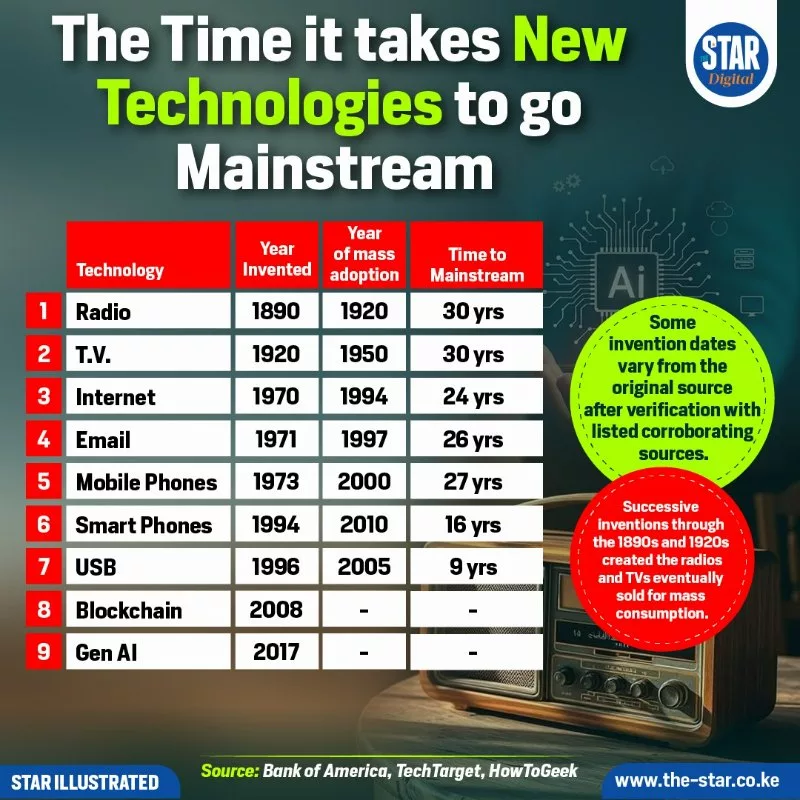
The journey of groundbreaking technologies from invention to mainstream adoption has accelerated rapidly over the last century, shrinking the time required to reach mass market acceptance
Early communication pillars such as the radio and television laid the foundation, both taking three decades to transition from invention to mass adoption
The radio, invented in 1890, achieved mass usage by 1920, while television followed a parallel path from its 1920 invention to widespread adoption in 1950
Successive inventions throughout the 1890s and 1920s created radios and TVs that were eventually sold for mass consumption
Digital technologies significantly reduced these transition timelines
Email, invented shortly after in 1971, reached mainstream status in 1997, spanning 26 years
Physical hardware innovation saw even faster acceleration; USB drives, invented in 1996, reached mainstream status in just nine years by 2005
Emerging frontiers continue their path toward potential mass adoption