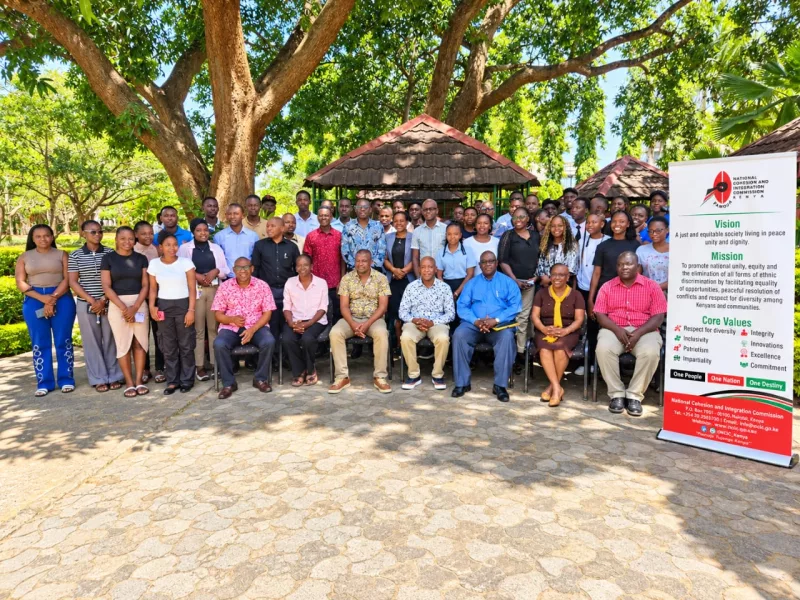
 Participants from NCIC, led by commissioner Samuel Mwachiro and Pwani university staff and students led by DVC research and community engagement Halimu Shauri /HANDOUT
The world commemorated the International Day of Peace on September 21, a day that calls on humanity to reflect on the meaning of peace and what it takes to build and sustain peaceful societies.
At Pwani University, however, the commemoration went beyond marking a day on the calendar. It became an opportunity for practical engagement, dialogue and investment in young people as agents of peace.
The National Cohesion and Integration Commission partnered with Pwani University to train student leaders on peacebuilding, prevention of hate speech and responsible digital citizenship.
The partnership is a welcome demonstration of how public institutions and institutions of higher learning can work together for the common good. More importantly, it recognises that sustainable peace requires partnership with citizens themselves.
The engagement also provides an opportunity to rethink what we mean by peace. Peace is often understood simply as the absence of conflict. Yet conflict is part and parcel of everyday human life.
Wherever people interact, differences in interests, values, expectations, identities and aspirations will inevitably emerge.
Families disagree, students disagree with university administrations, workers negotiate with employers, communities compete over resources and citizens hold divergent political opinions.
However, conflict can be managed through dialogue, negotiation, mediation, compromise and legitimate institutional processes. Indeed, conflict can provide an opportunity for actors to articulate grievances, question existing arrangements and search for better alternatives. Properly managed, it can become a force for positive change.
It is when conflict is poorly managed that it can become destructive. When grievances are ignored, when people are excluded from decision-making, when differences are weaponised and when legitimate avenues for dialogue are closed, frustration can turn into hostility.
Hate speech, misinformation, stereotyping and dehumanisation can deepen divisions and create conditions in which violence becomes more likely.
Conflict resolution and peacebuilding must go beyond telling people not to fight. We must learn how to disagree. This is particularly important for young people. Too often, young people are discussed primarily as vulnerable to manipulation, radicalisation, hate speech and violent extremism.
While these risks require attention, such a perspective obscures a more important reality: young people possess agency. They are not merely beneficiaries of peace. They can be its architects.
Young people organise communities, influence public conversations, create digital content, mobilise their peers and develop innovative responses to social problems.
They can challenge harmful narratives, build bridges across social and cultural differences and create spaces for dialogue. Their energy, creativity and networks give them enormous potential to contribute to peacebuilding.
Consequently, the focus on student leaders at Pwani University was particularly significant. A university is a microcosm of society, bringing together young people from different counties, ethnic communities, religions, cultures and social backgrounds. Differences are inevitable in such an environment. But these differences can become building blocks to coexist.
Student leadership should therefore mean more than representing student interests. It should also involve developing the capacity to listen to competing perspectives, negotiate differences, mediate disagreements and create spaces where difficult conversations can take place without hostility or violence rearing its ugly head.
The skills acquired in such spaces can become part of the leadership culture that young people carry into their communities and workplaces.
The emphasis on responsible digital citizenship was especially timely. Young people inhabit both physical and digital communities, and social media has transformed the way information travels and public conversations are shaped.
A misleading claim, ethnic stereotype or inflammatory message can reach thousands of people within minutes. Digital platforms can therefore amplify conflict. But they can also amplify peace.
Young people can use technology to challenge misinformation, promote dialogue, expose harmful stereotypes and connect communities that might otherwise remain divided.
Every young person who verifies information before sharing it, refuses to amplify hate speech or uses digital platforms to encourage respectful dialogue is contributing to peace.
Conflict, when properly managed and constructively navigated, can become a seedbed for social transformation. Societies change because people question existing arrangements.
Marginalised communities demand recognition. Workers demand better conditions. Citizens demand accountability.
Students challenge policies they consider unfair. Such contestation can expose weaknesses, stimulate debate and generate better ways of organising society.
The problem, therefore, is not the existence of conflict. The problem is our inability to manage it constructively. A society that suppresses every disagreement may appear peaceful on the surface while grievances accumulate beneath it.
A society that allows differences to be expressed, debated and negotiated creates opportunities for learning, adaptation and transformation.
The partnership between NCIC and Pwani University provides the foundation for a sustained partnership in peace education, research, civic engagement and youth-led peacebuilding.
There is also an opportunity to establish Amani Clubs at Pwani University and extend the initiative to neighbouring primary, junior secondary and senior secondary schools. Such an initiative creates a community-based network of young peacebuilders at different levels of learning.
The NCIC-Pwani University partnership demonstrates that institutions can come together around a common public good. It shows that peacebuilding can move beyond rhetoric into practical engagement and that universities can serve as important spaces for cultivating peaceful citizenship.