

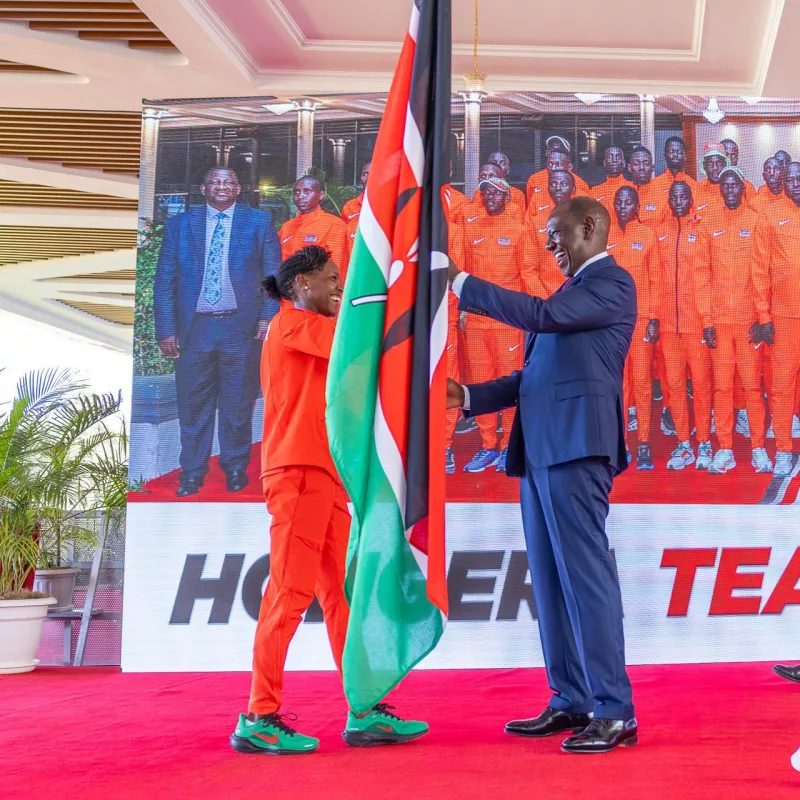
 President William Ruto (R) receives the Kenyan flag from quadruple world 1,500m champion Faith Kipyegon after Kenya's 2025 Tokyo World Championships campaign/ HANDOUT
From allegations of a doping menace to claims of insufficient infrastructure to host a mega sporting event, the first of its kind in Africa, many of these figures, most of them British, were unhappy because Nairobi beat London to bag the main fete.
In fact, palpable in the criticism was the racial undertone, a reflection of the global tendency to openly express anti-Black prejudice and stereotypes that are no longer hidden behind dog whistles.
But the global openness of racism is also a reflection of the toxic tribalism in Kenya’s political discourse, a toxicity now being championed by the so-called Gen Z, many of whom were long expected to be objective, progressive and open-minded. Many, however, engage in racial profiling of political figures on social media.
On the athletics hosting rights debate, Matt Lawton, the chief sports correspondent of London’s The Times, argued that World Athletics was making a mistake. He wrote that its Sports Integrity Unit should be preoccupied with forcing Nairobi to rein in its athletes struggling with performance-enhancing drugs to win major titles.
“It still feels far too soon to be handing a World Championships to a country where doping has been so widespread,” Lawton wrote.
“The focus in Kenya right now should remain on repairing the considerable damage to its integrity, not handing the nation an event that will only increase the pressure on those involved in its national sport to succeed,” he said.
His take was shared by others from the Global North, dismissing Nairobi as not good enough, almost concluding that awarding it the championships was some kind of ‘woke’ decision by World Athletics.
If you have been keen on following international news, especially along the lines of race relations, Europe and the United States are in the throes of a racial awakening, with far-right provocateurs sustaining a push to restore white domination.
They scrutinise any person of colour’s milestone with subliminal prejudice. It is either said that the person faked their way to the milestone, or that the spot deserved by a white person was given to the person of colour as an affirmative-action or hire based on Diversity, Equity and Inclusion.
That is why former US President Barack Obama was subjected to unrelenting birtherism attacks, and why Cambridge Prof Jason Arday was harassed by the UK media to his death.
Arday was a high-flying Black academic, but scrutiny of his studies and work revealed controversies. The barrage of negative press coverage, which had obvious racial undertones, affected his mental health, leading to his sudden death by suicide.
As we enter the heated election campaign season, political alliances are being plotted along tribal numbers. While this has been the norm since the reintroduction of multiparty politics in 1992, the disappointing development in 2026 is the open ethnic profiling that young people are engaging in on social media.
Recently, discussions about circumcision — or the lack of it — have been rife on social media, with people hailing from the lake region being targeted because of their perceived support for President William Ruto’s reelection.
Tribalism, in and of itself, is not wrong, in my view. The negative exploitation of it to exclude and profile a person or a people is harmful because it engenders societal disharmony and sectarian strife.
It does not bode well for our democracy that, just as in 1992, negative ethnicity is rearing its ugly head as the sole deciding factor that undermines sober discourse on how to vote in the elections to come.
Like racism, tribalism provides a free pass for bad leaders and protects them from scrutiny as voters squabble among themselves over which tribe is superior.
We must rise above this pettiness and rescue our country.





