

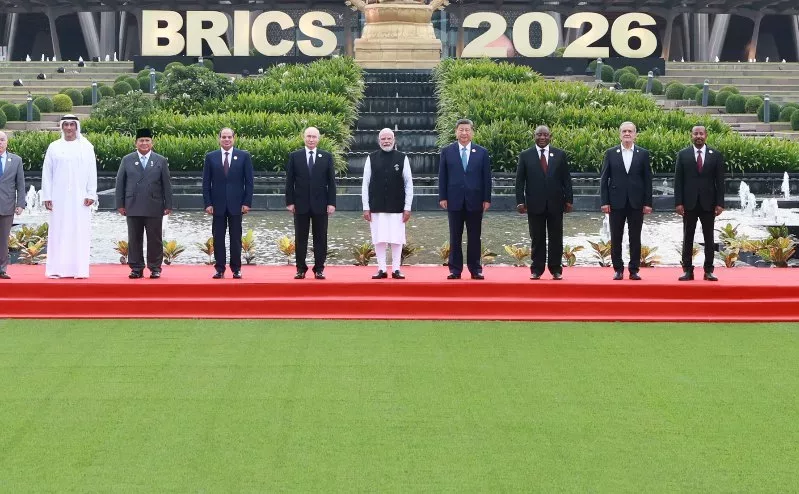
 The New Delhi Declaration calls for greater participation of emerging markets and developing countries in global decision-making structures /FILE
Meeting on September 12 and 13, leaders adopted the New Delhi Declaration, placing resilience, innovation, cooperation at the centre of discussions. Key leaders present included Indian Prime Minister Narendra Modi and Presidents Xi Jinping (China), Vladimir Putin (Russia) and Cyril Ramaphosa (South Africa).
For African countries, this evolution deserves attention. Brics is no longer simply a conversation among a handful of large emerging economies. Its expansion has brought together countries from different regions and with different economic structures, political interests and foreign-policy priorities.
One central theme was reform of global governance. The New Delhi Declaration called for greater participation of emerging markets and developing countries in global decision-making structures, including the UN. It specifically recognised African countries’ aspirations for reform of the UN Security Council.
Modi similarly argued that the Global South should have greater representation and move from being a rule-taker to a rule-shaper.
For Africa, this is significant because questions of representation have long been linked to the continent’s demographic and economic weight.
The Brics discussion therefore fits into a wider debate over whether institutions created under a different global balance adequately reflect contemporary realities.
Economic cooperation was another important strand. The summit supported efforts to strengthen trade and investment cooperation, improve financial connectivity and facilitate greater use of national currencies.
A more diversified payment architecture will require compatible systems, regulatory coordination, financial stability and confidence among participating countries.
Technology emerged as another important area. President Xi Jinping proposed an initiative on AI-empowered new industrialisation, calling for greater cooperation in artificial intelligence research, applications, industrial supply chains and open-source technologies.
He also proposed five initiatives covering open and inclusive AI, trade and investment facilitation, digital industry cooperation, intelligent manufacturing and science and technology talent development.
Among the proposals were a Brics AI open-source community, a digital ecosystem cloud platform, cooperation in building smart factories, a Brics special economic zone partnership and an engineer cultivation alliance. Xi also proposed a youth exchange programme focused on scientific and technological innovation.
Their relevance to Africa is clear, although implementation will matter more than announcements. African economies face gaps in digital infrastructure, industrial capacity, skills and access to finance.
Cooperation that supports technology transfer, training, research and manufacturing could create opportunities, but differences in infrastructure, regulation and financing will require sustained attention.
The summit also highlighted food security, agriculture, healthcare, climate action, energy and sustainable development.
These are areas where developing countries face common pressures but unequal access to technology, finance and expertise. Cooperation can help widen access, but its value will ultimately depend on whether initiatives generate measurable benefits for citizens rather than remaining primarily diplomatic commitments.
For African countries, engagement with Brics does not necessarily have to be understood as a choice between competing geopolitical camps.
It can instead be approached through interests: access to markets, infrastructure finance, technology partnerships, agricultural cooperation, industrial development and a stronger voice in global institutions.
African governments have relationships with many partners, and participation in one platform does not automatically determine positions in another.
Brics itself is not a uniform political or economic bloc. Its members have different interests and sometimes divergent positions.
The presence of major economies such as China, India and Russia alongside African and Middle Eastern members illustrates both the opportunities and complexity of expanded cooperation.
The New Delhi summit nevertheless showed that members can identify common ground around development, multilateralism and economic cooperation.
The expanded grouping now faces the challenge of converting its weight into results. A larger membership brings greater economic and demographic significance, but size alone does not guarantee effective cooperation.
Implementation, transparency, institutional capacity and consistency will determine whether initiatives announced at successive summits acquire lasting importance.
The priorities discussed, from financial connectivity and food security to AI, industrial development and institutional reform, require sustained work between summits.
The handover of the chairmanship to China in 2027 provides another opportunity to build on the New Delhi agenda. Its future direction, however, will be shaped collectively by all members.
For the Global South, the wider lesson from New Delhi is that a more plural international system will matter most when greater representation is accompanied by cooperation, credible institutions and development outcomes that can be measured on the ground.
The writer is a journalist and communications consultant





