

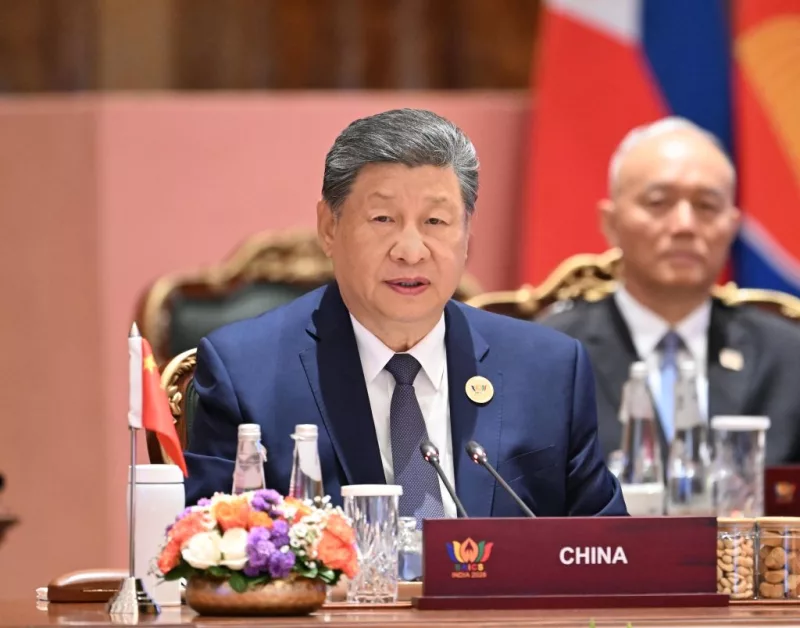
 Chinese President Xi Jinping delivers a speech when attending the second day of the 18th BRICS Summit in New Delhi, India, Sept. 13, 2026.
The morning begins twice.
First, it arrives over the Aberdare ranges in central Kenya, where mist lifts gently from coffee bushes and maize fields. A rooster breaks the silence before the sun does. Children weave between banana trees while an elderly farmer looks across land cultivated by generations before him.
Thousands of kilometres away, another morning unfolds in rural China. Rice terraces catch the first light. Tea leaves are gathered by practiced hands, while beneath tiled roofs, a family begins another day in a village whose traditions have outlived generations.
Different continents. Different languages. Different histories. Yet the mornings feel familiar.
The similarities of harvests that bring communities together, elders passing knowledge to children, festivals that send families home and hands that transform the products of the land into food, craft and art. This is what civilisations look like before they become history books.
This September, Nairobi will become a meeting place for these living memories. At the Nairobi National Museum, Kenyan and Chinese artists will gather for a joint art exhibition titled ‘Art weaves coexistence: China-Africa cultural exchange and mutual learning fine arts exhibition’, celebrating rural life and traditional holiday practices.
It will serve as a celebration of China and Africa’s long-standing friendship built on deep people-to-people ties, nurtured across generations through cultural, social and developmental exchanges.
The paintings may depict people, farms, festivals, villages and landscapes. But beneath the brushstrokes lies a larger visual dialogue about heritage, identity and the meaning of preservation in a rapidly changing century.
Long before nations drew borders, communities learned to read seasons, rivers, mountains and rainfall. The first calendars were harvest calendars. The first classrooms were farms. And perhaps the original social media was simply an elder telling a story to a child who was expected to remember it.
In China's Huangling village, autumn arrives on rooftops. Families spread harvested chilies, corn, pumpkins and chrysanthemums across bamboo trays to dry beneath the mountain sun. Known as Shaiqiu, the practice began as a practical agricultural necessity. Over generations, necessity became ritual, ritual became identity, and identity became heritage.
For a few weeks, the village itself appears to become a painting.
Kenya has equally striking landscapes where agriculture becomes part of cultural identity. In Mwea, rice fields turn golden before harvest. In Kericho, tea plantations roll across mist-covered hills, their leaves gathered by generations of farmers. In the coffee-growing highlands of Nyeri and Murang’a, the harvest connects families and communities to land that has sustained them for decades.
The sceneries are different, but the values are remarkably similar. Shared inheritance is one of the most compelling threads in this China-Kenya artistic exchange.
Agriculture teaches patience, responsibility and community through shared labor. A harvest is also about gratitude, cooperation and continuity. Every civilisation begins with a relationship to the land.
Rural landscapes thus matter in art. The artist is not simply painting a field. They are painting the relationship between people and place.
In China, agricultural rhythms have helped shape festivals that remain deeply embedded in contemporary life. Mid-Autumn Festival carries themes of harvest, gratitude and reunion. Seasonal celebrations connect food, family and memory.
Kenya's cultural traditions similarly carry the rhythms of land and community. Harvest celebrations, pastoral traditions and indigenous ecological knowledge have historically helped communities interpret rainfall, grazing patterns, planting seasons and livestock cycles.
The hands threading a Maasai necklace are not so different from those weaving bamboo baskets in rural China. Kisii artisans carve soapstone shaped by Kenya's landscape just as Jingdezhen potters shape porcelain from Chinese clay. Kamba woodcarvers transform hardwood into storytelling, while Suzhou embroiderers stitch history into silk.
Ultimately, civilisations survive because one generation deliberately teaches another what is worth remembering.
The exhibition will also be about enhanced cultural dialogue beyond cultural exchange.
We have seen Kenya-China relations through trade, infrastructure, investment and government agreements. Another key dimension of this relationship is one that cannot be measured in kilometres of railway or tonnes of cargo, but on familiarity between people.
A Kenyan visitor standing before a painting of an autumn harvest in China, may unexpectedly remember coffee berries drying outside a family home in Nyeri. A Chinese visitor looking at a Kenyan harvest celebration may recognise the same communal rhythms found in villages thousands of kilometres away. Neither needs to know every detail of the other's history to experience that moment of recognition.
Cultural dialogue moves international relations beyond governments and conference rooms, into museums, classrooms, festivals and artistic collaborations. It allows people to encounter another society through its people, landscapes, celebrations and traditions. At the joint art exhibition, visitors will encounter this engagement through the paintings.
The exchange also resonates with China's Global Civilisation Initiative, which promotes dialogue among civilisations, respect for cultural diversity, mutual learning and people-to-people exchanges. It also aligns with Kenya’s cultural diplomacy objectives, the creative economy development agenda and tourism promotion through cultural heritage.
Thus, the joint art exhibition should be viewed as two civilisations showing each other how they remember, adapt and preserve.
Visitors will walk through the gallery without crossing borders. From Chinese family festivals to Kenyan community celebrations, and from terraced mountains to pastoral plains. Moments preserved that make a stranger's life feel strangely close.
The bridge between Kenya and China, is not only built from steel and concrete.
Sometimes it begins with a field, a festival, a village, a harvest, and a brushstroke that makes someone thousands of kilometres away pause and think, ‘I know that feeling.’
That is the art of understanding.





