

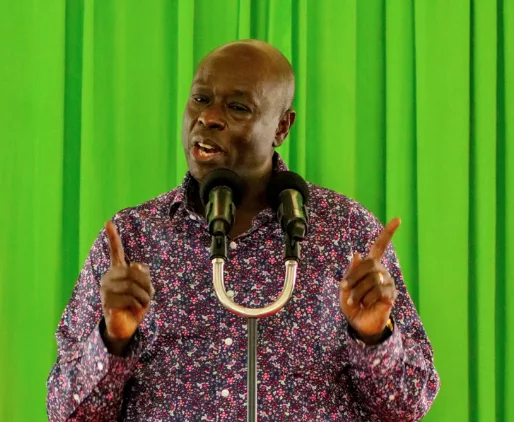
 Former Deputy President Rigathi Gachagua/FILE
There is a particular quality of
political theatre that reveals itself only to those willing to sit with the
discomfort of paradox. On the surface, impeached DP Rigathi Gachagua’s recent
national address was exactly what he intended it to appear: the declaration of
a man wronged by the system, galvanised by popular mandate, and marching
resolutely toward 2027. But beneath that performance, a different and far more
consequential drama is unfolding, one that the communities of Nyanza, Western,
Coast, and North Eastern must read carefully before they are swept into a false
choice that will cost them far more than any election.
That false choice, stripped to its bones, is between supporting President Ruto’s government and supporting Gachagua’s resistance. It is a binary designed to erase the third and most consequential option: finishing what Raila Odinga built.
Gachagua declared before the microphones that he is not a kingmaker but a king, and that Kenyans have mandated him to contest for president in 2027 under the Democracy for Citizens Party. A careful examination of his trajectory reveals a man operating on an entirely longer horizon than 2027. His immediate mission is to harvest parliamentary, senatorial, and county assembly seats at scale, building an institutional fortress that grants him real bargaining power for the 2032 succession cycle.
President Ruto understood the same logic when he spent a decade planting himself inside successive political formations before his eventual ascent. The critical difference is that Gachagua is attempting to build that fortress by positioning himself as the authentic voice of resistance against the very government he served, in the very constituencies that have historically sustained the progressive movement.
Gachagua’s entry into the opposition space does not weaken the incumbent. It fragments the counter-narrative, making it impossible to consolidate a credible unified opposition around a leader whose politics are rooted in the communities that built that opposition. When tribal arithmetic governs opposition politics, the man who commands the largest consolidated regional bloc, even one built entirely on grievance rather than governance, can veto any boardroom negotiation on purely ethnic terms. His price will not be policy commitments. It will be structural concessions that insulate him from the accountability that has thus far eluded him. The communities that would pay for those concessions are the same ones he is currently courting with the language of liberation.
His reckless claims regarding the British military training unit in Nanyuki, promptly demolished under scrutiny and subsequently walked back, were not the stumbles of a careless politician. They were deliberate provocations designed to force a media cycle, generate a government response, and position himself as the man whose accusations the state fears enough to answer. The attention economy of Kenyan political media rewards exactly this behaviour, and he understands its incentives better than most.
What makes this strategy a recognisable con rather than genuine opposition is the choice architecture it constructs. Kenya’s political elite has perfected a trap across six decades: either the progressive base supports the status quo and submits to its management, or it joins the performative opposition and exhausts its energy in a contest that changes no underlying economic arrangement. Either way, the distribution of the base, the industries, the land, the transport networks, the financial capital, remains undisturbed. The marginalised communities supply the energy. The elite collect the proceeds. This is not abstract theory. It is the documented pattern of every major political transition since Independence. Gachagua is now positioning himself as the next manager of that arrangement, knowing that a community perpetually mobilised toward performances of resistance is a community perpetually kept away from the rooms where their resistance would actually matter.
The Uhuru Kenyatta episode remains the most instructive precedent. In 2005, Kenyatta stood alongside Raila and progressive forces to defeat the government draft constitution in the Orange referendum, creating the genuine impression of a rupture. Yet the countermovement had already been prepared. Kenyatta occupied the opposition space with studied passivity before executing a stunning cross-floor migration in September 2007 to endorse the incumbent Mwai Kibaki. When Kibaki was illegally sworn in under darkness hours after a disputed announcement, the post-election violence that followed killed over 1,300 Kenyans and displaced hundreds of thousands more.
Kenyatta’s role in mobilising that violence landed him at the International Criminal Court but the case fell apart before trial, without conviction and without acquittal. He was later rewarded with a deputy prime ministership in the coalition government that Raila negotiated to end the bloodshed. The communities that had provided the intellectual and street energy for the Orange revolution were left with mass graves and the memory of a fight that delivered power to the very people who stole it.
The broad-based arrangement that Oburu Oginga now anchors was not conceived in a boardroom between two convenience-seeking politicians. It was born in the streets. In 2023, Raila led the Azimio protests against the rising cost of living and corruption, protests that left 57 Kenyans dead. Those streets produced the National Dialogue Committee, Nadco, which produced the 10-point agenda, which became the binding framework for the broad-based arrangement. That deal was formally sealed when Raila and President Ruto signed a Memorandum of Understanding at KICC on March 7 last year.
But between Nadco and that MoU was a critical moment that most Kenyans have forgotten.
On June 26, 2024, as Gen Z protesters were being killed at Parliament, Gachagua flew to Mombasa and held a parallel press conference directly contradicting Ruto’s position, blaming NIS for intelligence failures and breaking openly with the government he served. He later admitted that press conference had ended his relationship with Ruto permanently.
Three months later, he was impeached. Raila, watching a man whose political philosophy had explicitly treated marginalised communities as minority shareholders manoeuvring to replace Ruto, made a decisive calculation. He chose to anchor Ruto over Gachagua, understanding that a Gachagua presidency would return power to the very forces that had oppressed Kenyans for six decades under a different flag.
That choice stabilised the republic. Oburu, a trained economist with three decades of institutional experience from the Ministry of Planning to the Senate Energy Committee, is now executing the economic stabilisation that Raila’s political calculation made possible. He is delivering major infrastructure commitments across Nyanza, Western, Coast and Northeastern regions that were deliberately starved of development for 60 years.
The Gen Z generation must understand that the anger they feel is legitimate and the cause it serves is real. The question is not whether to channel that anger. The question is whether they will allow it to be channelled by someone whose record, whose philosophy, and whose current strategy are all designed to serve interests that are not theirs. Gachagua was not removed from office because he was too honest. He was removed because he revealed, in real time, that his loyalty was to a different political project entirely.
Gachagua is counting on the noise to drown out the signal. He is counting on grief, anger, and the media appetite for drama to keep the communities that built ODM looking at the debris of conflict rather than at the concrete being poured. That is the long con. And the only way to defeat it is to read the blueprint rather than the performance.





