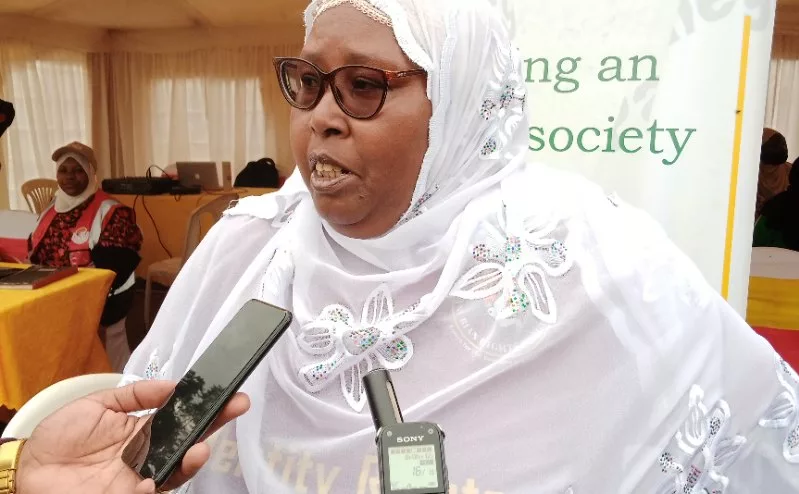
 Mwanaisha Twaha speaking during International Identity Day in Kibra, Nairobi
For years, Mwanaisha Twaha watched as her sons struggled to obtain what many Kenyans take for granted: a national identity card.
The residents of Bondeni East in Nakuru Town East Constituency say the additional scrutiny previously imposed on some applicants denied her children access to opportunities and essential public services that require proof of identity.
Her eldest son first applied for an ID in 2016 but only obtained the document in 2025, after years of delays.
Twaha says his Borana father’s name subjected him to additional scrutiny, with a vetting committee requiring her presence during the application process.
At the time, she was working in Saudi Arabia and could not travel to Kenya to accompany him.
“My son was supposed to get his ID in 2016, but because of his name, he did not get it until last year in 2025. He could not get it because the vetting committee demanded that I accompany him, yet I was in Saudi Arabia for work,” she said.
Twaha says she returned to Kenya in 2018, by which time her son had almost given up on obtaining the document.
Although the government has since abolished the formal vetting requirement, she says some families continue to encounter hurdles in accessing identification documents.
Her experience is at the heart of a renewed push by rights organisations to have the abolition of vetting firmly anchored in law to prevent the practice from returning.
The Nubian Rights Forum is calling for the complete removal of vetting and other forms of differential treatment in the issuance of national identification documents, particularly for communities that have historically faced additional scrutiny.
Forum CEO Shaffie Hussein says President William Ruto’s directive ending the additional vetting brought relief to affected communities but argues that a presidential declaration alone does not offer a permanent safeguard.
“The aspect of discrimination has come down since President William Ruto’s declaration two years ago. As activists, we say the President did well, but an ID is a basic right for every citizen,” Hussein said.
His concern is what could happen under a future administration if the changes are not protected by legislation.
“Our worry is, what happens after the 2027 General Election? Does it mean the declaration will be reversed by the next administration?” he asked.
Hussein also says some applicants continue to experience delays in obtaining identification documents despite the abolition of the formal vetting system.
Citizenship paralegal Rudhwan Haidar says the barriers extend beyond national IDs to birth certificates and other documents needed to establish legal identity.
“Lack of identification documents remains a challenge, especially among marginalised communities, yet this is an important right when it comes to citizenship. Some communities have been denied the right of being recognised as citizens,” he said.
Haidar welcomed the government’s decision to end additional vetting but said the reforms must go further.
“The move by the government to end vetting during ID application is a success we have achieved since we started pushing for recognition, but vetting has not been abolished completely. The State should know that giving me an ID is not doing me any favour,” he said.
The call is backed by Haki Centre, Nubian Rights Forum, Paranet, Namati Kenya and Haki na Sheria Initiative, which want the government to end differential treatment of ID applicants and remove discretionary powers that could trigger ad hoc investigations or review committees.
The organisations want applicants who provide the required proof of name, age and citizenship to have their documents verified at no cost and IDs issued without additional hurdles.
They are also calling for affirmative action to help Kenyans who were previously excluded from accessing identification documents because of historical discriminatory practices.
The government has maintained that the additional vetting requirements have been discontinued and that national ID registration is now conducted through a standardised process.
In a 2025 Senate response, the government said the previous community-based vetting had been officially discontinued and that applicants were now being processed under a uniform national registration mechanism.
The Ministry of Interior’s 2024 regulatory reforms also stated that the amended registration rules were intended to eliminate vetting and align the identification system with the Constitution.
The reform followed years of criticism from rights organisations and affected communities over the additional scrutiny, documentation and delays faced by some applicants.
For Twaha, however, the debate is not simply about an administrative procedure. It is about whether a Kenyan citizen should have to prove their belonging through a process that other citizens do not face.
Without an ID, access to employment, banking, public services and other opportunities can be severely restricted. Namati says lack of identification has historically locked affected Kenyans out of jobs, healthcare and voting.
Rights groups now want the government to move beyond administrative directives and place the principle of equal access to legal identity firmly within the law.
For families like Twaha’s, they say, that would ensure that access to an ID remains a right—not a privilege dependent on the policy of the government of the day.