A smartphone-based technology and a locally repairable field cart could help Kenyan and other African crop breeders collect plant data more easily and make better-informed breeding decisions.
Researchers have developed smartphone-based artificial intelligence (AI) tools and a locally repairable field cart to help breeders assess crops more conveniently and affordably.
One of the tools is Ona, a smartphone-based computer vision workflow that converts field images into quantitative data on plant traits.
According to Lennart Woltering, Sustainable Innovation and Transformation Lead – Digital Inclusion at the Alliance of Bioversity International and CIAT, the technology supports tasks such as identifying and counting plants, flowers and pods, as well as assessing visible disease symptoms.
The technologies were recently presented at the ninth International Plant Phenotyping Symposium (IPPS9), held for the first time in Africa, in Accra, Ghana.
Organised by the International Plant Phenotyping Network and the West Africa Centre for Crop Improvement, the event was held under the theme “Phenotyping for All: Bridging the Gap in Global Agriculture”.
Through the Artemis project, the Alliance of Bioversity International and CIAT has been working to bridge the gap by developing tools that are affordable, easy to use and maintainable locally.
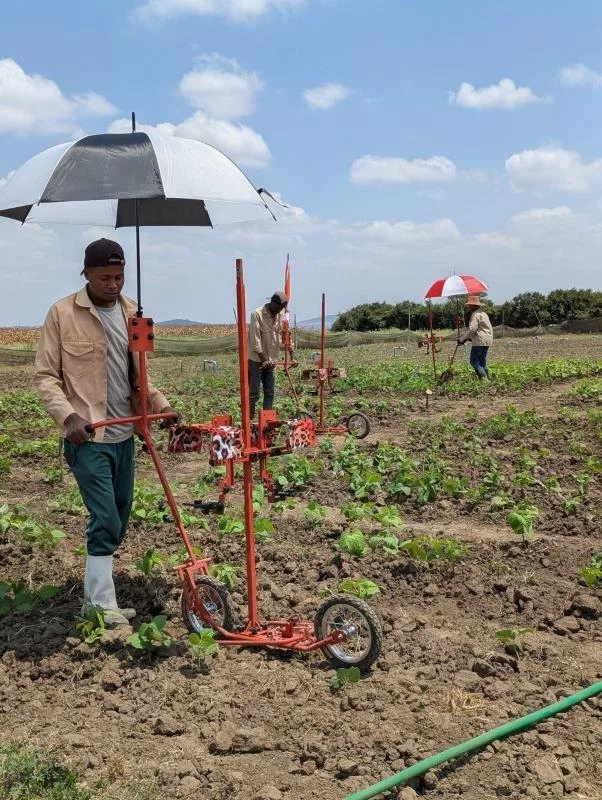
The team has also developed a hand-pushed steel cart known as Bruno, which is fitted with a smartphone to standardise image collection. The cart costs about Sh39,000 ($300) and is built using locally available materials. It can be assembled in about two hours and repaired locally.
Woltering said the technologies are currently being used for beans, sorghum and cowpeas, with further development expected to extend their application to other crops important for food security.
“A phenotyping tool is only useful if it works where breeding teams actually operate. The hand-pushed steel cart, known as Bruno, can be built using locally available materials and repaired on site, while Ona runs on a regular smartphone,” he said.
“Artificial intelligence does not replace the breeder; it helps provide more consistent data across locations and seasons,” Woltering added.
The Alliance also presented research exploring how accessible imaging tools could help identify banana traits associated with performance under water stress.
Using a smartphone fitted with a micro lens, field teams capture images of banana leaves.
AI models then analyse the images to measure stomatal density, size and pore opening. Stomata are microscopic pores on leaves that regulate gas exchange and water loss.
Moureen Nansamba, a plant breeder at the Alliance of Bioversity International and CIAT, explained that these observations are combined with porometer measurements of transpiration and stomatal conductance.
“Transpiration is the process through which plants lose water vapour, while stomatal conductance measures how easily gases move through the pores. The combined measurements help researchers estimate how banana plants use water under field conditions,” she said.
She added that teams can collect hundreds of leaf images in a day, allowing researchers to investigate differences in how banana plants respond to limited moisture.
“To breed bananas for a changing climate, we need to understand how plants use water under stress. By combining physiological research, AI and smartphone-based phenotyping, we can turn that understanding into faster and more practical breeding decisions,” Nansamba said.
The researchers noted that affordability must go hand in hand with ease of use, relevant local data, training and integration into crop-breeding programmes.
They added that the tools must also perform reliably across different crops, locations and environmental conditions.
Strong partnerships with national research institutions and field teams are essential to developing the technologies and encouraging their wider adoption.