

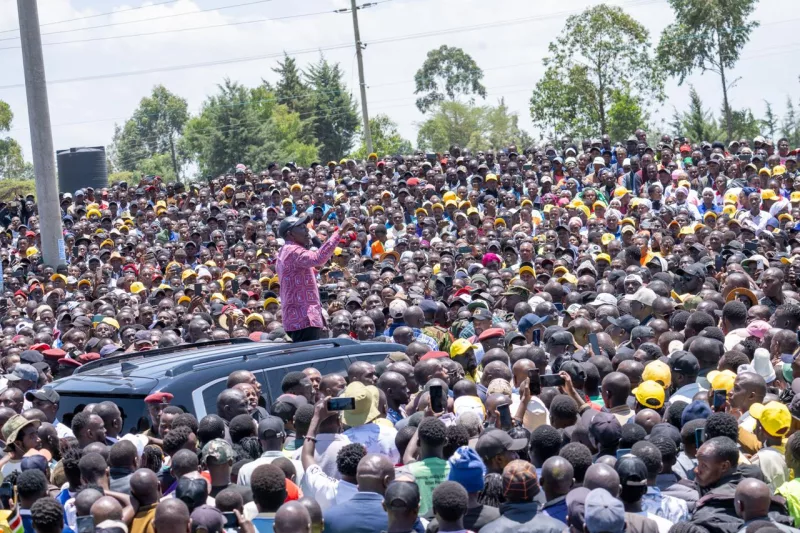
President William Ruto's emerging political strategy in Western is a fascinating gamble. It seeks to secure the support of a changing electorate through a familiar political establishment.
The Magharibi Movement, assembled to rally the region behind the President’s reelection in 2027, brings together prominent figures whose names have dominated the region’spolitics for decades.
Whether that gamble succeeds may determine not only Ruto's fortunes in Western in 2027 but also the future relevance of the region's established political leadership.
Yet beneath this political architecture lies a fundamental contradiction: a striking lack of imagination. The initiative appears to have identified the destination without thinking through the vehicle needed to get there. True, Western can legitimately be invited to assess the government's record, consider its interests and be convinced that the President deserves another term.
However, a political message does not travel independently. It is carried by people, and the credibility of those people often determines whether the message is heard at all.
Many of the messengers assembled to champion the initiative have spent years at the centre of the region's political life. However, experience does not automatically translate into trust, longevity into legitimacy, or high office into public credibility.
Among significant sections of the population, these familiar faces carry baggage accumulated through years unkept promises, shifting alliances, disappointments and perceived distance from ordinary citizens.
Consequently, the movement faces a communications Waterloo long before it even reaches the campaign trail. People are willing to listen to the message, but they may not trust the messenger.
When that happens, attention moves away from the substance of the argument and settles on the character of the messenger. Instead of discussing the merits for Ruto's reelection, citizens begin questioning the motives and character of the politicians making that case.
The messenger becomes the story, and the message is lost. Political mobilisation requires more than assembling prominent names. Trust cannot be assumed because someone occupies an important office or has survived in politics for decades. It must be continually earned.
The challenge facing the Magharibi Movement, in part, exposes a wider weakness in UDA's political imagination. There is still a lingering assumption that communities will be mobilised through intermediaries: identify influential regional leaders, bring them together, negotiate political interests and then expect their followers to move accordingly. That model is dead on arrival in the run up to 2027.
The authority of the traditional kingpin has been eroded by social change, technology and a new generation of voters. Citizens today have access to multiple sources of information and competing political voices. They are less dependent on picking cues from political gatekeepers to interpret national events or determine their choices.
Social media has disrupted the old hierarchy between leaders and citizens. Citizens increasingly want to know what politics will mean for their lives rather than which politician has endorsed which candidate.
This change requires a corresponding fundamental change in campaign strategy. The starting point should no longer be the question of who can deliver the people. The people are not commodities to be delivered. They are citizens who possess sovereign power and must be persuaded.
Political entrepreneurs should recognise that the constitution's declaration that sovereign power belongs to the people is also a political instruction. It requires leaders to listen before mobilising, engage before instructing and persuade before expecting loyalty.
Western region cannot simply be handed over by a collection of political kingpins, however experienced or influential they may be. The region's voters must make their own political choices.
The Magharibi Movement should therefore have been an opportunity for political innovation. Instead of asking, "Which leaders can deliver western Kenya?" its architects should have asked, "What are the people of western Kenya saying, and who do they trust?"
That would have produced a fundamentally different political movement. It would have created space for young leaders, professionals, entrepreneurs, grassroots organisers, women, farmers, religious leaders and community voices. It would have recognised that legitimacy is increasingly built from below rather than imposed from above.
There comes a point when familiarity produces fatigue. When political experience becomes baggage. And, when citizens want to hear new voices speaking to new realities. That is the contradiction at the heart of Magharibi Movement Western gamble: old kingpins are being asked to mobilise new voters who increasingly reject the politics of kingpins.
The Magharibi Movement may have the right political message. The people may even be willing to listen. But if the message continues to be delivered by messengers whose credibility and legitimacy have been eroded, the initiative will struggle to connect with the very voters it seeks to persuade.
The UDA-ODM alliance must understand that 2027 will not be won through political inheritance. The people have changed. The voters have changed. Kenyan politics must change with them.
The age of kingpins is ending. Those who fail to recognise it may discover, painfully, that the people they thought they controlled moved on long ago.





