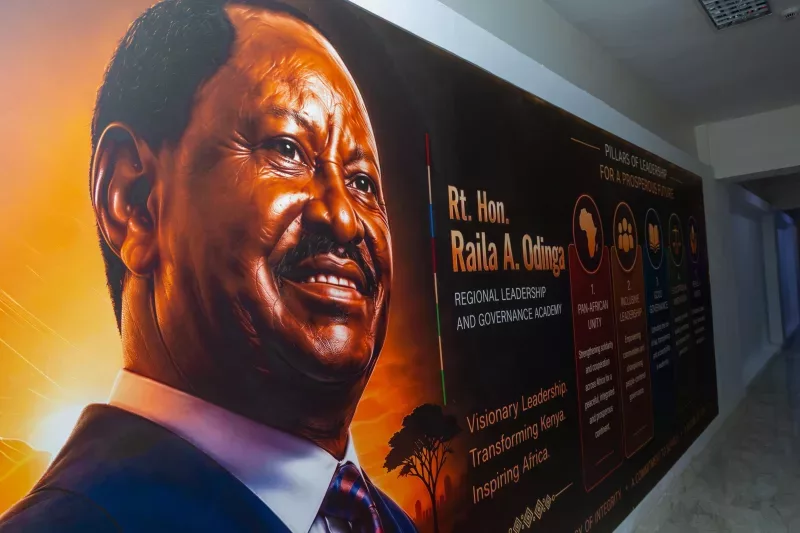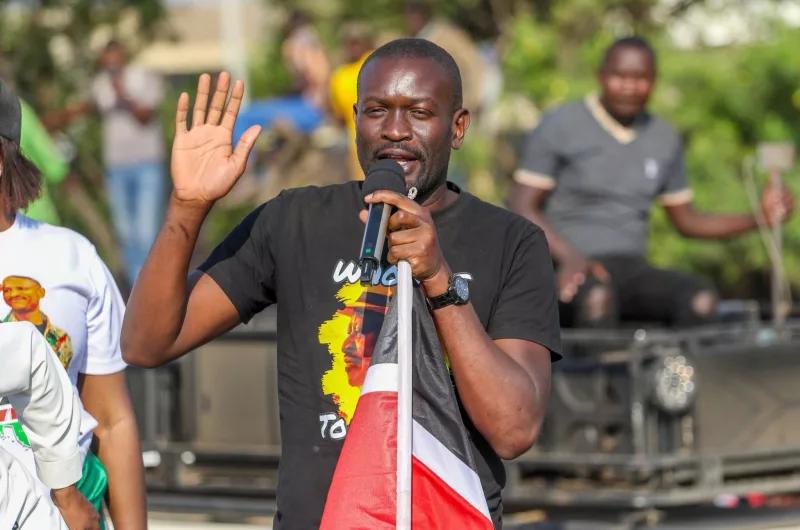
No one saw this coming — least of all Nairobi Senator Edwin Sifuna himself. Raila Odinga’s death created a political vacuum so vast it swallowed the opposition landscape. Into that void stepped Sifuna, until recently known mainly within Nairobi political circles as the capital’s senator but barely known nationwide.
Today, his rallies trend before they begin and his name is increasingly uttered in conversations once reserved for politicians with decades of presidential politics behind them.
The excitement is real. It should neither be dismissed nor underestimated.
But political popularity is tricky. It can lift you to the mountaintop or walk you straight into a trap.
Kenya has had many political waves, but arguably only one true national movement in the last three decades: Raila’s campaign against the Wako Draft.
He rallied Kenyans across regions, communities and political traditions around one simple national purpose: reject the draft constitution. From that emerged the energy that birthed ODM and cemented Raila as Kenya’s most consequential opposition figure for two decades.
The movement worked because the referendum offered a binary national question. Presidential elections are different. They immediately introduce personality, ethnicity, regional arithmetic and individual ambition.
That distinction matters when analysing Sifuna.
His rise has some of the electricity of Raila’s moment, but not yet its architecture. There is national frustration, youthful energy, relatable messaging and digital virality. But he needs more. No, “Ruto must go” isn’t it.
And therein lies both opportunity and danger.
Consider 1992. President Daniel Moi’s operatives convinced Kenneth Matiba that he was the favoured opposition candidate. Matiba believed the hype and ran, splintering the opposition vote among himself, Mwai Kibaki and Jaramogi Oginga Odinga. Moi capitalised on that division to win by only about 36 per cent.
It doesn’t require a magnifying glass to see how that playbook could be deployed today: identify a rising opposition star who cannot ultimately defeat the incumbent, inflate his perceived viability, feed him flattering polling and encourage him onto the ballot. Voilà — the opposition fragments and the incumbent hits the jackpot.
Sifuna is therefore at risk of becoming Matiba 2.0 — not through malice, but miscalculation.
I do not believe Sifuna would knowingly participate in such a scheme. The danger is that a politician can advance his opponent’s strategy without ever being part of it.
Fortunately, I believe the Nairobi senator is smart enough to smell this trap from miles away.
Which brings us to 2002.
Raila had presidential ambitions, yet when the moment demanded something larger, he uttered two words that changed Kenyan political history: “Kibaki Tosha.”
By surrendering the immediate prize, he enormously increased his own political capital.
Sifuna may be approaching his own version of that moment.
His greatest opportunity in 2027 may not be becoming president or anyone’s running mate. It may be becoming kingmaker.
If Sifuna backs Fred Matiang’i, he brings precisely what Matiang’i needs and the two, plus a third who shall remain nameless for now, will no doubt complement one another in a manner that can only portend victory at the polls come 2027.
Were Rigathi Gachagua to align with them, 2027 could resemble the euphoric rejection of an unpopular candidate witnessed in 2002.
Sifuna need not be Matiang’i’s running mate. Indeed, political arithmetic militates against it. His greater value lies outside the ticket.
Could he instead say “Kalonzo Tosha” and become Kalonzo’s running mate? Theoretically, yes. But listen carefully and you can almost hear champagne bottles popping at State House. That’s the ticket dreams are made of there.
Sifuna’s power lies somewhere more consequential.
A “Matiang’i Tosha” moment could consolidate the opposition while positioning Sifuna for national leadership beyond 2027. He becomes kingmaker, not spoiler — the bridge between youthful political energy and an opposition capable of winning.
The alternative is the Matiba path: Sifuna runs, the opposition fragments and anti-incumbent votes divide. He could become enormously popular yet unable to convert popularity into sufficient votes, unintentionally strengthening the very incumbent his supporters want defeated.
That is the path of doom.
Sifuna therefore stands at a crossroads shaped by three lessons: 1992, 2002 and 2005. Yes, there are also lessons from 2013 and 2022, but those are less consequential.
Sifuna must decide which lesson defines his moment.
Wisdom is avoiding 1992.