
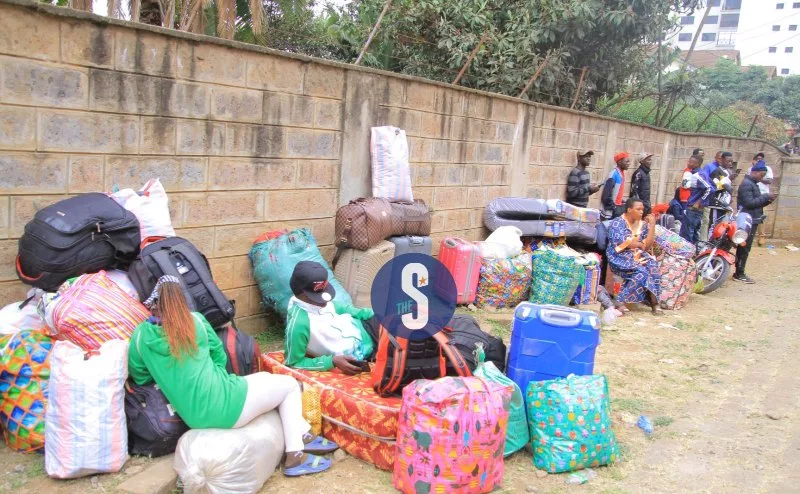
 Burundians living in Kenya camp outside their Embassy along Dennis Pritt Road Nairobi on September 8, 2026 /EZEKIEL AMING'A
At the risk of crying louder than the bereaved, few things recently have escalated as quickly as the directive regarding restrictions on African small-scale traders in Kenya.
What began as a presidential pronouncement on September 2, has spiralled into a regional diplomatic incident, exposing the fault lines between domestic political messaging and the hard reality of East African integration.
President William Ruto’s instruction that foreigners should vacate small-scale retail and hawking has triggered panic, condemnation and a hasty government retreat. The order left in its wake a sobering question: is this a genuine regulatory effort, or a calculated political gambit ahead of the 2027 election?
The public reaction has been as swift as it has been divided. On one side, human rights organisations and civil society have raised the alarm.
The Kenya National Commission on Human Rights warned that the crackdown could trigger widespread violations if enforcement is not conducted lawfully, saying it had already received complaints of threats and intimidation from migrant communities.
The East Africa Law Society called on Kenya to stop harassing Burundian and other EAC citizens, reminding Nairobi of its obligations under the Common Market Protocol.
Former Chief Justice David Maraga condemned the enforcement as being based on a presidential directive rather than an enacted law, arguing that “a directive read at State House does not amend the constitution.”
Opposition leader Kalonzo Musyoka accused the administration of harbouring “sinister motives”, while Senator Danson Mungatana warned that the attacks risked perpetuating organised xenophobia.
Yet there is also a constituency for the crackdown. Local trader associations and informal business groups have praised the directive, arguing that foreign nationals undercutting micro and small enterprises create unfair competition.
For every critic of the crackdown, there is a Kenyan trader who sees the foreign presence as a threat to their livelihood. This popular sentiment is precisely the political fuel the administration appears eager to harness.
By framing the directive around protecting the hustler economy and aligning it with the proposed Local Content Bill of 2025, the President is appealing directly to his core economic base.
The strategic calculus is clear: deflect frustration over domestic economic pressures — soaring public debt, increased taxation and high youth unemployment — toward a visible foreign target.
As Prof Gitile Naituli observed, foreign traders are “convenient political targets precisely because they possess little power. When governments become unpopular, scapegoating offers an attractive political shortcut”.
The directive projects an image of decisive action, protecting local livelihoods while the administration struggles with the failure of its bottom-up economic agenda.
The crackdown stands in stark tension to Kenya’s foreign policy. Nairobi advocates for pan-Africanism, visa-free access and EAC regional integration. However, domestic immigration law mandates that visa exemptions do not grant automatic rights to trade or work without valid permits.
The government’s defence is that the crackdown targets those operating without documentation, not all foreign nationals. Yet the reality on the ground has been far messier.
Though the directive was not intended exclusively for Burundians, informal traders from Burundi and the DRC faced immediate harassment and attacks. Footage showed large groups of Burundians gathering at Nairobi's Machakos country bus station, seeking transport home. Hundreds queued outside their embassy, seeking travel documents.
The diplomatic fallout was immediate. Foreign Affairs Principal Secretary Korir Sing’oei was forced into damage control, apologising to Burundians for the harassment they suffered. He clarified that the President’s remarks had been “taken out of context” and that documented foreign traders remained protected under Kenyan law.
A high-level coordination meeting on Tuesday, September 8, brought together Burundi’s ambassador, UNHCR and Iinternational Organisation for Migration representatives.
The government extended the compliance window to 90 days and established a joint task team, with any returns to be strictly voluntary and coordinated. Burundi’s government, meanwhile, began sending buses and issuing free laissez-passer documents to facilitate the return of citizens who wished to leave.
According to state sources, Kenya hosts more than 927,000 foreign nationals, about two percent of the population. Somalis form the largest group at over 400,000, followed by Ugandans and South Sudanese.
There are an estimated 16,000 Burundian refugees and asylum seekers. These numbers underscore the scale of the regional interdependence that the head of state’s directive has imperilled.
The spectre of South Africa and xenophobia looms large over this affair. There, vigilante groups intensified campaigns against undocumented migrants, leading to violence, looting and diplomatic spats.
The parallel is unsettling: what begins as a state-sanctioned enforcement effort can quickly morph into populist xenophobia, with vigilantes taking the law into their own hands.
The Kenyan government has explicitly warned against this, stating that “no individual or group has the authority to harass, intimidate, threaten or interfere with foreign nationals or their businesses.” But the warning came after the damage was done.
The risk of retaliation is real. Millions of Kenyans work across East Africa — in Uganda, Tanzania, Rwanda and Burundi.
Burundi’s Foreign Affairs Minister has already warned that “if the hate speech against Burundi continues, things will certainly change.” A diplomatic tit-for-tat could see Kenyans abroad facing similar hostility.
So what is the better way to handle such a transition? The government’s eventual shift toward a phased documentation process offers a template.
Providing reasonable timelines — the 90-day extension — for informal traders to regularise work permits and licences is sensible.
Clear public communication that does not incite vigilante action is essential; the State House warning against discrimination and lawlessness was a necessary corrective.
Regional consultation through EAC frameworks, joint task forces, and international bodies like UNHCR and IOM is not optional but imperative. Most critically, enforcement must be based on individual legal violations, not the collective profiling of migrants.





