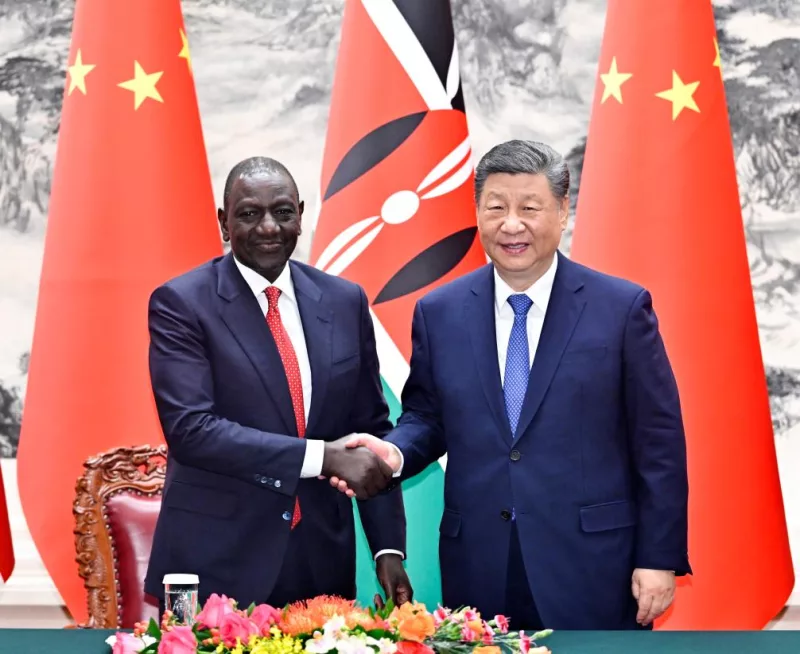
I was coincidentally in the middle of reading Mahmood Mamdani’s book, Slow Poison, when news seeped in that President Ruto had ordered Tata Chemicals out of Kenya for “failing to benefit the country”.
According to the President, the Indian multinational had been exporting soda ash out of Kenya, instead of processing it locally into finished products. Ruto made the declarations while on a tour of Kajiado county.
Incidentally, the head of state also stated that the government had identified new investors to take over the company’s operations, with an aim of bringing in more employment and investments into Kenya.
Predictably, there was no mention of the process through which these new “investors” had been selected, to replace the Indian conglomerate, which is Africa’s biggest soda ash producer. Neither did the President explain what constituted “not doing enough for Kenyans”, the main accusation levelled against Tata Chemicals.
Mamdani’s Slow Poison is basically a political history of Uganda from the coup that brought Gen Idi Amin to power in 1971, to date, but is especially an overview of the two presidencies of Amin and the long rule of Gen Yoweri Museveni.
The contrasts are intriguing, and the author will bust some widely held views about both gentlemen in the book, an eye-opening look into the period of upheaval in the neighbouring nation, as it struggled with its divisions over the decades.
A few early chapters of the book are dedicated to the infamous decree by Amin expelling Asians from Uganda. Mamdani, then working at Makerere University, was one of them.
Ahead of the expulsions, the narratives churned out by the regime and its apologists made the old adage that “when a hyena wants to eat its cubs, it first accuses them of smelling like goats”.
Basically, Asians in Uganda, and especially within the business community, were first accused of “not doing enough for Ugandans”, on top of the usual racist and marginalisation claims.
Everyone knows the devastation that the foolish decree caused. The fall of the GDP and the decline of manufacturing, witnessed in the intervening years, were testimony to the fact that roadside political decrees never really translate to the hyped progress.
Asian businesses handed over to indigenous citizens, mostly loyal soldiers, couldn’t pick up as envisaged. The unwritten rule in business is that every long-term commercial entity has unique supply chain and operational networks that can not easily be replicated by simply changing ownership.
In the current Kenyan scenario, the President didn’t quite expel all Asians, but the mere targeting of an influential corporate giant like Tata would ordinarily spook a large section of the foreign-owned businesses.
With an average annual turnover of nearly $80 million (over Sh10 billion), Tata Chemicals is no small concern to be asked to “pack up and leave”, without a deeper analysis of the potential consequences.
At any rate, whatever sins of omission and commission that may have been committed by the Indian giant, it is safe to assume that a country run within the auspices of the law would have regulatory frameworks and remedial measures to mitigate any gaps attendant to “not doing enough for Kenyans”.
The relevant ministries and government agencies are competent enough to catalogue all accusations made against Tata, and indeed all corporate organisations that run businesses in Kenya, whether local or foreign-owned, and address such issues to a credible conclusion.
Shutting down businesses on a whim is a dangerous route to take, and doesn’t inspire confidence among investors.
But just when we thought the threat to shut down Tata Chemicals was bad enough, the head of state ordered the closure of small-scale businesses run by foreigners. Strangely, following this order, Burundians appeared to be the nationality most affected, with massive human caravans turning up at their embassy in the Kilimani neighbourhood of Nairobi, in the intervening days.
I would be surprised if the President had been too naïve to know that the order would cause fear among foreign citizens dwelling in Kenya, especially in the informal settlements within urban centres.
It isn’t too long since we witnessed ugly scenes in the streets of major South African cities, as xenophobic attacks, based on the feeling that immigrants had taken up jobs belonging to locals, happened. Thankfully, in the case of South Africa, neither the President nor any senior public figure fuelled the madness.
In fact, my most memorable quote from that ugly period came from South African firebrand politician, Julius Malema, who asked fellow countrymen busy expelling immigrants from neighbouring countries to “come back after you chase them away, and show us which jobs they left that are now held by South Africans”
When you speak to citizens of neighbouring countries who live in Kenya, you encounter painful anecdotes of violence, suffering and loss of family.
Many have been forced to move to Kenya, seeing opportunity and stability that their countries don’t offer them, escaping to Kenya in an “all or nothing” manner, nearly similar to the thousands of Africans who undertake the dangerous journey across the Mediterranean via rickety boats to seek solace in Europe.
Most of the “jobs” held by these immigrants are in the informal sector, which is both liberal and elastic in a way that enables everyone to create their own commercial space, so to speak.
It is difficult to accuse a Burundian street hawker of Tropical Mints or mandazi of having taken up a job belonging to a native Kenyan, because it is not a formal employment opportunity that can simply be transferred to another individual.
In fact, if we were to paraphrase the words of Malema, it would be interesting to see “what jobs have been left by the Burundians that have now been restored to Kenyans”.
I am certain that the Tata expulsion order was well-thought in advance, while the one on small scale foreign business owners wasn’t. But in terms of the damage, they both pose a serious threat to national stability.
First, expelling huge investors on a whim ruins the economic space in a debt-laden economy that struggles to keep every possible revenue stream flowing.
But expelling immigrants in a casual manner not only exposes all immigrants to danger, but creates an avenue for reciprocal action by Kenyans in the affected neighbouring countries. A Burundian in danger in Nairobi equals a Kenyan in danger in Bujumbura, make no mistake.
It is high political season in Kenya. Populist statements will abound, including these ones by the head of state, ostensibly meant to protect Kenyan citizens, but whose effects may be the opposite of what is intended.
You have to meanwhile spare a thought for the Cabinet Secretaries in charge of the ministries that should handle the matters that the President prosecutes on sunroofs during his campaign tours.
It must be really difficult working backwards, so that instead of formulating policy positions based on existing needs and circumstances, the CS hears presidential roadside declarations then works backwards to turn them into policy.
In the meantime, we, including the head of state, must be clear that reckless statements directed at investors and foreign citizens in the country will only hurt our people and our economy.
There is already too much rhetoric on the political scene. We need someone to restore sanity in politics and tone down the tension ahead of the elections.
That person should be the country’s number one citizen; the President. It is not too much to ask.