The government is racing against time to grow 15 billion trees in an ambitious restoration programme running from 2023 to 2032.
The programme seeks to restore 10.6 million hectares of degraded landscapes and increase Kenya’s tree cover to 30 per cent by 2032.
The initiative targets restoration across forests, water towers, rangelands, farmlands, wetlands, marine ecosystems and urban areas through tree growing and sustainable land management practices.
It responds to climate change, biodiversity loss and land degradation, while creating green jobs, strengthening food security, improving water resources and enhancing community livelihoods.The state says the mission is a whole-of-government and whole-of-society effort, bringing together national and county governments, private sector, development partners, communities and every Kenyan citizen.
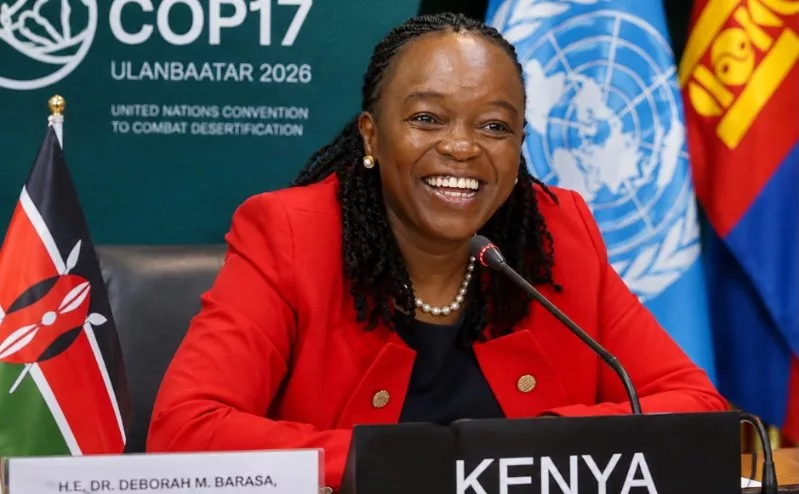
Speaking to the Star, Environment CS Dr Deborah Barasa delves into Kenya’s participation in the 17th Conference of the Parties to the United Nations Convention to Combat Desertification in Ulaanbaatar, Mongolia.
She says the event placed the country firmly at the centre of the global conversation on land restoration, drought resilience, sustainable rangeland management and climate action.
The CS speaks to Environment and Science reporter Gilbert Koech on the insights from the conference that took place from August 17 to 28.
The forum brought together governments, scientists, development partners, businesses, communities and civil society to confront one of the defining challenges of our time: the rapid degradation of the land upon which food, water, livelihoods and economies depend.
The Star: What does this conference mean for Kenya?
CS Barasa: The conference represented far more than an international gathering.It was an opportunity to demonstrate that the country is moving from environmental commitments to practical action and to position land restoration not simply as an environmental responsibility but as an economic, social and national development priority.Kenya is particularly vulnerable to the consequences of land degradation and drought. Vast areas of the country are drylands and rangelands that support millions of people and livestock, while sustaining critical ecosystems. With rangelands covering a significant proportion of the country, the health of these landscapes is directly connected to food security, water availability, pastoral livelihoods, biodiversity and economic resilience. The issues discussed at COP17 are, therefore, not distant global concerns for Kenya; they are matters that directly affect communities and the country's development trajectory.Kenya’s message at COP17 was clear: land restoration, drought resilience and climate action cannot be treated as separate priorities. They are interconnected challenges requiring integrated solutions.
Kenya used the global platform to advocate for a shift in approach from waiting for droughts and environmental crises to occur before responding, to investing in resilience, restoring degraded landscapes, protecting natural resources and creating sustainable livelihoods before communities are pushed into crisis.The conference also provided Kenya with an opportunity to present its ambitious national restoration agenda. What lessons did Kenya gain from the conference?The country has set a target of planting 15 billion trees by 2032, restoring 10.6 million hectares of degraded landscapes and increasing national tree cover beyond 30 per cent. These targets demonstrate that restoration is increasingly being viewed as a national development programme capable of delivering benefits across environmental, economic and social sectors.Kenya’s message was also about ensuring that restoration translates into tangible benefits for communities. The country highlighted the importance of watershed restoration, sustainable land management and initiatives such as the Kenya Watershed Services Improvement Project as examples of how landscape restoration can strengthen water security, ecosystems and livelihoods when interventions are properly coordinated.How should Kenya view its vast land?At COP17, Kenya further advanced the argument that land must be viewed not only as an environmental asset but also as an economic asset. This was particularly evident during discussions under the Business4Land agenda, where the focus was placed on unlocking investment for land restoration. For Kenya and much of Africa, this represents an important shift in thinking.
Millions of people depend directly on agriculture, pastoralism, forests and natural resources. Restoring degraded land therefore means restoring productivity, protecting livelihoods, creating opportunities for green jobs and strengthening local economies.
Women, youth, pastoralists, indigenous communities, farmers, local institutions and civil society are not simply beneficiaries of environmental programmes; they are essential partners in delivering sustainable restoration.
Successful restoration must, therefore, be designed around the knowledge, needs and aspirations of the communities that live on and depend upon the land.Most of the land, particularly in Africa, is degraded. What opportunities did the conference offer?
Kenya’s participation at COP17 also helped strengthen Africa’s voice in the global land and drought agenda. Across the continent, drought and land degradation continue to threaten food production, water security, livelihoods and economic stability. The scale of these challenges demands solutions that bring together climate finance, development finance, science, technology, community knowledge, private-sector investment and strong public institutions.One of Kenya’s key priorities was, therefore, to advocate for financing mechanisms capable of transforming restoration ambitions into bankable, investable projects. The challenge is no longer simply identifying degraded landscapes or understanding what needs to be done. The challenge is ensuring that the resources required for implementation reach the ground and remain available over the long term.The global momentum generated at COP17 reinforced this direction. Lack of finance is a major impediment to restoration efforts. Did this come up during the conference?
The conference advanced significant financing initiatives for land restoration and drought resilience, including a $1.3 billion portfolio across 23 countries, while the Rangelands Flagship Initiative brought together $1.2 billion across 45 projects. A Drought Resilience Investment Facility also aims to mobilise up to $400 million in public and private capital. These developments point towards an important evolution in the global land agenda, moving from declarations and commitments towards implementation, investment and measurable results.For Kenya, however, the real test begins after COP17. The country must now translate the commitments, partnerships, ideas and opportunities generated in Ulaanbaatar into concrete action at home. This means accelerating the restoration of degraded landscapes, strengthening watershed management, improving rangeland management, expanding climate-smart agriculture, supporting pastoral communities and strengthening drought preparedness and early-warning systems.It also means making restoration economically viable. Kenya will need to develop more investment-ready restoration projects capable of attracting public, private and development finance. This will require stronger partnerships between national and county governments, communities, development institutions, businesses, financial institutions, researchers and civil society. By creating an enabling environment for investment in restoration, Kenya can position environmental action as a key pillar of the country's green economy.What was Kenya pushing at the Conference?
Kenya’s presence at COP17 was ultimately about ensuring that the voices, experiences and priorities of Kenyan communities are reflected in global decisions on land, drought and climate resilience. Kenya went to Ulaanbaatar with a clear national agenda, contributed to the global debate and emerged with an even greater responsibility to transform international commitments into action on the ground.The message from COP17 is clear: The future of Kenya’s land is inseparable from the future of its people and its economy. Restoring degraded landscapes is not only about planting trees or rehabilitating ecosystems; it is about restoring water, livelihoods, productivity, opportunity and hope.As Kenya continues its journey towards restoring 10.6 million hectares of degraded landscapes, expanding tree cover, strengthening rangelands and building drought resilience, the country has an opportunity to demonstrate that environmental stewardship and economic development can advance together.The next chapter will not be written in conference halls. It will be written in Kenya’s forests, farms, watersheds, rangelands and communities. It will be measured in landscapes restored, livelihoods strengthened, water secured, investments mobilised and communities made more resilient.If the commitments and partnerships forged in Ulaanbaatar are matched with sustained action, financing and accountability, Kenya can move beyond being a participant in the global land-restoration conversation and emerge as a leading example of what ambitious, people-centred restoration can achieve not only for Kenya, but for Africa and the world.
What next for the country? The next phase must, therefore, focus on implementation, financing, partnerships, accountability and measurable impact. The ambition expressed at COP17 must be translated into restored forests, productive rangelands, protected watersheds, healthier soils, secure water sources, resilient communities and sustainable livelihoods.Kenya’s leadership also carries a broader global significance. Land degradation is not a challenge confined to one country or continent. It affects food systems, ecosystems, economies and communities across the world, while drought is increasingly recognised as a major threat to sustainable development and human security. The lessons Kenya is developing through its own restoration journey can, therefore, contribute to a wider global effort to build resilience.If Kenya succeeds in demonstrating that large-scale land restoration can create productive landscapes, strengthen communities, improve water security, generate economic opportunities and attract investment, the country can provide a model that other African nations and developing countries can adapt to their own circumstances.The significance of Kenya’s engagement at COP17, therefore, extends beyond the conference itself.It represents a changing understanding of restoration, from viewing it primarily as a cost or conservation activity to recognising it as an investment in natural capital, economic resilience, food security, climate adaptation and human well-being.