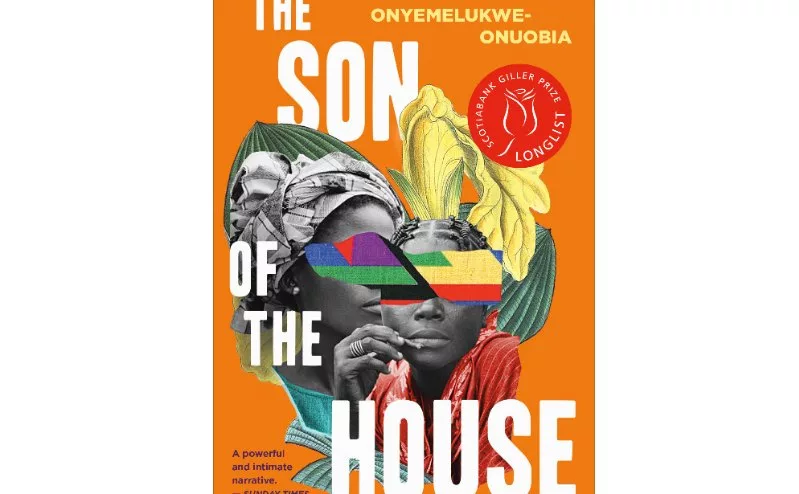
What if the place called home is the first place to teach you fear? In The Son of the House, Cheluchi Onyemelukwe-Onuobia constructs a compelling story around two women whose lives seem worlds apart until fate and violence forces them together.
Nwabulu and Julie come from profoundly different circumstances, but their paths cross when both women are kidnapped, an ordeal that becomes the doorway into the secrets, histories and scars that have shaped them. This unsettling encounter strips away the distinctions between the women and places them in the same terrifying space, allowing the reader to discover that beneath their different social positions lie experiences that are disturbingly connected.
Nwabulu’s story is particularly haunting because her childhood is marked by deprivation and the crushing vulnerability of being a girl in a society where poverty can make children commodities and silence can become a form of imprisonment. The brutality of her circumstances is captured with devastating simplicity when she recalls being accused by her stepmother of killing her parents: “‘I did not kill my mother and father,’ I would say, my head turned away, waiting for her hard knuckles to rap against my almost hairless big head.”
The power of the passage lies not merely in the accusation but in the child’s expectation of punishment. Nwabulu has become so accustomed to violence that she anticipates it even while defending her innocence. The image of her ‘almost hairless big head’ makes the memory painfully intimate, capturing childhood vulnerability in a single, unforgettable image.
Julie’s experience reveals another kind of pressure: the relentless expectations placed upon women to master their emotions and understand the rules of a world structured around male power. In one revealing moment, after her mother berates her, Julie reflects: “I had let my fury, my frustration, get the better of me. And I knew that my mother could not abide stupidity. Women who were foolish did not survive long in the world of men, she often said.”
This is significant because Julie’s mother is not simply scolding her for being angry. Beneath the reprimand is a philosophy of survival. Her mother believes that a woman who cannot think carefully, control herself and navigate male-dominated spaces is dangerously exposed. The passage also adds complexity to Julie’s character. She is not merely shaped by what happens to her but by the expectations, warnings and judgments handed down by the women who came before her.
This is where Cheluchi makes the novel particularly absorbing. Her characters do not simply tell the reader their stories; they seem to reveal them in fragments, as though memories have been locked away and must be coaxed into the light. The past keeps intruding upon the present. A conversation can carry the weight of an old wound, while an apparently ordinary recollection can suddenly expose something devastating. There is an intimacy to the storytelling that draws the reader close, but there is also an underlying unease; you sense that every revelation may open another door.
The novel also refuses to make its women simple victims. Nwabulu and Julie are shaped by their circumstances, but they are not defined exclusively by them. Their ambitions, mistakes, desires and compromises give the story its moral complexity.
The novel’s title itself carries symbolic weight. The ‘house’ is not merely a physical dwelling but a space where family, power, gender and secrets intersect. It represents the structures people inherit and the roles they are expected to occupy. The ‘son’ at its centre points towards the privileges attached to masculinity and the unequal expectations imposed upon daughters and sons. Through Nwabulu and Julie, the novel asks what women are forced to sacrifice simply to remain standing.
There is, however, one significant weakness. The novel sometimes carries so many themes at once — gender inequality, domestic violence, poverty, motherhood, class, exploitation and social expectations — that its emotional focus can diffuse. Some revelations and shifts in the narrative take longer than necessary to arrive, and the accumulation of traumatic experiences can occasionally feel overwhelming rather than illuminating. The result is that certain sections lose the sharp momentum established by the novel’s strongest passages.
Ultimately, The Son of the House leaves an uncomfortable question behind. How much of a woman’s life is truly her own when the world has already written so many rules for her? Nwabulu and Julie may begin as strangers, but their kidnapping exposes something larger than coincidence. Their lives are connected by the invisible architecture of a society that teaches women to endure, calculate, remain silent and survive. And once those carefully buried histories begin to surface, the house can no longer keep its secrets.