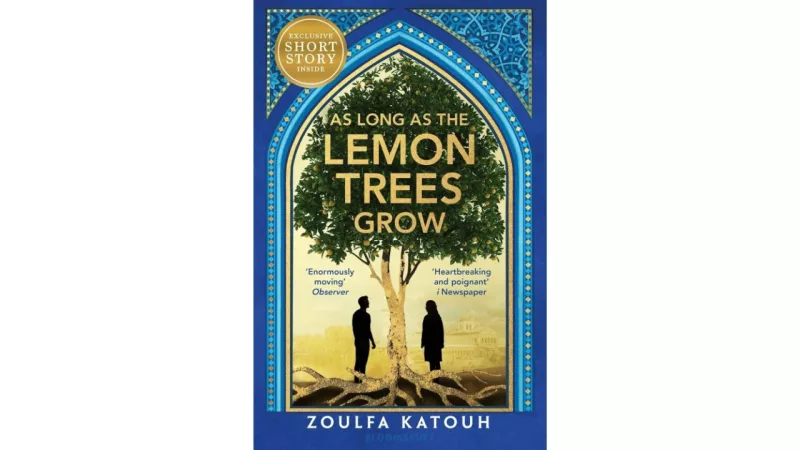
Some novels ask whether love can survive impossible circumstances. As Long as the Lemon Trees Grow by Zoulfa Katouh asks a far more devastating question: What happens when hope itself becomes a dangerous act?
Set against the Syrian revolution, Katouh's debut plunges readers into a landscape where every sunrise promises another round of bombings, every goodbye risks becoming permanent and every choice carries the unbearable weight of survival. Before long, the novel stops feeling like fiction and begins to read like memory borrowed from lives too often reduced to headlines.
At the centre of the novel is Salama Kassab, an 18-year-old pharmacy student whose dreams of university lectures and ordinary adulthood have been swallowed by civil war. Now she spends her days volunteering at a hospital, surrounded by the wounded, the dying and the relentless weight of survival. Her parents are gone, her brother is gone and all she has left is her pregnant sister-in-law, Layla.
Salama is desperate to escape Syria before the violence claims them, too; but leaving means abandoning the country she loves and potential blooming romance with a previous suitor called Kenan.
Salama wrestles not only with external violence but with an internal companion, Khawf, the physical manifestation of her fear. Rather than functioning as a simple metaphor, Khawf becomes one of the novel’s most haunting creations, giving trauma a face, a voice and relentless persistence.
The result is an intimate portrait of psychological survival as gripping as the conflict raging outside. Equally effective is rather than interrupting realism, these psychological conversations deepen it, revealing how trauma reshapes perception without ever distancing readers from Salama's reality.
Katouh refuses to sensationalise suffering. Instead, she layers moments of tenderness beside unimaginable brutality, allowing joy and grief to occupy the same page. A fleeting conversation, the scent of lemons or a glimpse of an untouched sunset suddenly acquires extraordinary significance because every ordinary pleasure exists under the constant threat of extinction. This emotional contrast gives the novel its remarkable power. When Salama reflects, “We don't have to stop living because we might die,” the words resonate far beyond optimism; they become an act of rebellion against despair itself.
The novel’s greatest triumph lies in its humanity. No character exists merely to symbolise courage or tragedy. Every decision is messy, conflicted and painfully believable. Even romance unfolds cautiously, never eclipsing the larger realities of war, but instead reminding readers why survival matters in the first place. Love is not presented as an escape from devastation; it is portrayed as evidence that devastation has not yet conquered the human spirit.
Katouh's prose is lyrical without becoming ornamental. Her imagery repeatedly returns to nature, particularly lemon trees, not as decorative symbolism but as living testimony that beauty can outlast destruction. Vivid sensory details transform ruined streets into places readers can almost smell and hear, while recurring motifs of gardens, seasons and fruit quietly challenge the permanence of violence. The symbolism never feels imposed because it grows organically from Syrian culture and memory.
Dialogue carries equal weight. Conversations rarely exist to deliver exposition; they expose fear, resilience, longing and impossible moral choices. Even brief exchanges linger because Katouh understands the emotional economy of people living under constant threat. One line captures the novel’s central heartbeat with breathtaking simplicity: “It reminds me that as long as the lemon trees grow, hope will never die.” The sentence distils the entire novel into an image that is simultaneously fragile and enduring.
One significant weakness, however, lies in the novel's tendency towards emotional repetition. Salama's internal conflict — whether to remain in Syria or escape — returns so frequently, and in such similar emotional rhythms, that sections of the middle narrative begin to feel cyclical rather than cumulative. Instead of revealing new dimensions of her dilemma, these repeated reflections occasionally stall narrative momentum. The effect is not merely slower pacing; it dilutes the urgency established in the opening chapters by revisiting the same psychological territory without sufficient evolution. A leaner middle act would have sharpened the emotional trajectory and amplified the impact of the novel's later revelations.
In the end, As Long as the Lemon Trees Grow is not simply a story about war, nor solely about love, grief or exile. It is an insistence that identity survives even when cities crumble, that memory refuses erasure and that hope is not naïve but fiercely defiant. Katouh has crafted a novel that invites readers to witness rather than merely observe, to mourn without voyeurism and to remember long after the final sentence fades. Few debuts possess this degree of emotional conviction. Fewer still make readers feel that turning each page is itself an act of bearing witness.