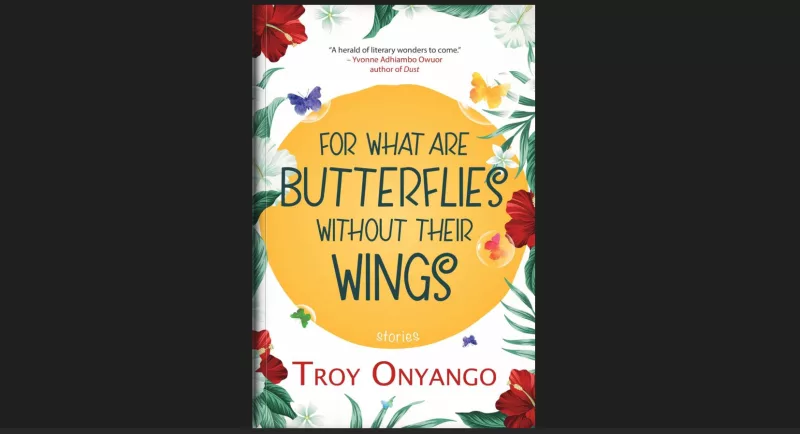
Some books ask to be read. Troy Onyango’s For What Are Butterflies Without Their Wings asks to be felt. This debut collection of 12 short stories is populated by people carrying invisible bruises: lovers separated by circumstance, siblings haunted by old rivalries, queer people searching for somewhere they can exist without apology and lonely souls discovering that sometimes, cruel distance is the one between two people standing in the same room.
Published in 2022, the collection moves across Kenya while remaining intensely intimate, turning ordinary lives into sites of longing, grief, desire and rebellion.
The title itself is a beautifully unsettling question. What is a person when something essential has been taken away? What happens when love loses its object, identity loses its shelter, childhood loses its innocence or hope loses its reason to survive? Onyango does not answer these questions neatly. Instead, he places them inside 12 stories and lets them flutter, wounded, through the pages.
The titular story offers perhaps the collection’s most haunting image. The female protagonist’s brother disappears into the lake, leaving behind memory, resentment and the terrible silence of unfinished things. The lake becomes more than a body of water: it is an enormous archive of family secrets, childhood wounds and grief.
In that moment of dread, her voice pleads, “No Rajula wuod Mariko, son of my mother, the lake is too small to swallow you.” The line lands with the force of a lament. It is both intimate and mythic, as though the protagonist is trying to bargain with death itself, and with the impossibility of accepting that someone once so large in your life can simply vanish.
Elsewhere, Onyango turns to Kati, a young woman raised by an aunt who, because of the difficult circumstances surrounding Kati’s birth, was entrusted with the responsibility of becoming her mother.
Their relationship gives the story an especially tender ache: the aunt is not simply a guardian, but the mother Kati has known, while Kati must navigate the complicated question of identity, belonging and what it means to be different in a world that is often unforgiving of difference. It is within this intimate bond that Onyango Kati’s aunt mutters the heart-breaking words, “My poor child, the world does not know how to accept difference, and you learnt this the hard way.” The tragedy is not simply that Kati is different; it is that she has been forced to learn, through pain, how little patience the world can have with those who refuse to fit its expectations.
This is where Onyango’s greatest strength becomes impossible to ignore. His sentences have a peculiar ability to arrive quietly and leave a bruise. He moves between the conversational and the poetic without making either feel ornamental. Familiar Kenyan rhythms, Luo-inflected expressions, sensory details and startling metaphors give the stories a texture that feels lived rather than manufactured. The prose can be tender one moment and knife-sharp the next. He trusts silence, too. What his characters cannot say often becomes as powerful as what they confess.
The collection’s greatest weakness, however, is also connected to its short story form. Not every story achieves the same emotional intensity. Some feel deliberately elliptical, withholding context or resolution when the reader is already deeply invested. Characters occasionally seem to disappear just as their inner worlds become most compelling, leaving certain narratives feeling unfinished rather than hauntingly open-ended. For readers who prefer stories with clear arcs, this can be frustrating. The unevenness means that the collection sometimes feels less like one continuous emotional journey and more like a series of rooms, some unforgettable, others easier to leave behind.
By the final page, the butterfly in the title feels less like an insect than a metaphor for damaged humanity. Wings can be lost through grief, rejection, violence, shame or time. But Onyango’s stories keep asking the more difficult question: If the wings are gone, does the creature cease to be beautiful? Or does its struggle to move become the beauty itself? That question is the book’s quiet sting. And it stays with you long after the fluttering stops.