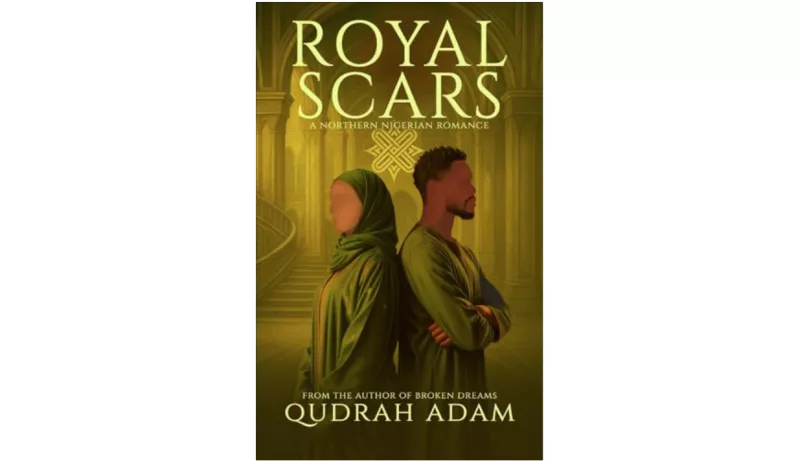
What happens when the one person you cannot recognise becomes the one person you cannot forget? That is the deliciously painful question at the heart of Qudrah Adam’s Royal Scars, a romance that slips quietly through the doors of a royal palace and then proceeds to dismantle every expectation of what a love story should look like.
At its centre are Aisha Adam, a young woman forced to begin again after losing her father, and Sultan Bugaje, a prince trapped inside a life made strangely unfamiliar by his fading ability to recognise faces. When Aisha arrives in Kano, Nigeria, and crosses paths with Sultan, neither of them knows that fate has already begun moving pieces across the board.
And then there is the palace. Beautiful, prestigious and full of people, it somehow becomes the loneliest place in the novel. Sultan lives within its walls, yet his condition has reduced his world to routines, journals and the unnerving uncertainty of waking up unable to recognise even those closest to him. Aisha, meanwhile, enters this world as an outsider carrying her own grief, only to find herself drawn into the orbit of a prince who seems to exist at a distance from everyone around him.
Then something extraordinary happens. Sultan remembers her. His realisation lands with almost cinematic force: “AISHA ADAM. Her name is... Aisha Adam.” Coming from Sultan’s perspective, the moment is more than recognition. It feels like a crack appearing in a wall that has kept his world sealed away. A name becomes an anchor. A person becomes a certainty.
From Aisha’s perspective, that same miracle becomes even more intimate: “His voice carved the hush in two. My name on his lips, clear, certain, stole the breath from my lungs. He remembers.” Those two words — He remembers — carry the weight of an entire relationship.
This is where Adam makes Royal Scars particularly compelling. She does not simply tell you that Aisha and Sultan are falling for each other; she makes memory, recognition and presence part of the romance itself. Their attraction is tangled with something much more fragile: the terror of forgetting and the overwhelming comfort of being remembered. The result is a love story that repeatedly asks what it truly means to know another person.
Adam also knows how to make emotion linger. Her prose has a conversational intimacy that makes the characters feel as though they are confiding in the reader rather than performing for an audience. Scenes move with an almost effortless readability, while moments of vulnerability are allowed to breathe. Humour, tenderness, grief and tension sit surprisingly close together. One moment you are smiling at Aisha’s reactions; the next, you are staring at the page, wondering how something so romantic could also hurt this much.
Yet Royal Scars is not flawless. Its biggest weakness is its ending. Rather than providing a satisfying emotional landing, the novel pulls the rug out from under the reader and leaves the story suspended at a deeply consequential moment. For readers who want their first book to feel complete, the cliffhanger can be genuinely frustrating rather than exciting. The novel also occasionally struggles with its multiple points of view. While switching perspectives can offer useful insight into different characters, there are moments when the shift feels less like an opportunity to deepen a character and more like a chance to revisit information the reader already knows. This results in the pacing feel slower than necessary.
Royal Scars is romance dressed in royal clothing, but underneath the palace intrigue is something more vulnerable — a story about grief, memory, identity, betrayal and the terrifying possibility that the person capable of bringing colour back into your life may also become the person you have the most to lose from. Read it for the prince. Stay for the memory. And prepare to be haunted by what happens when love remembers what the mind cannot.