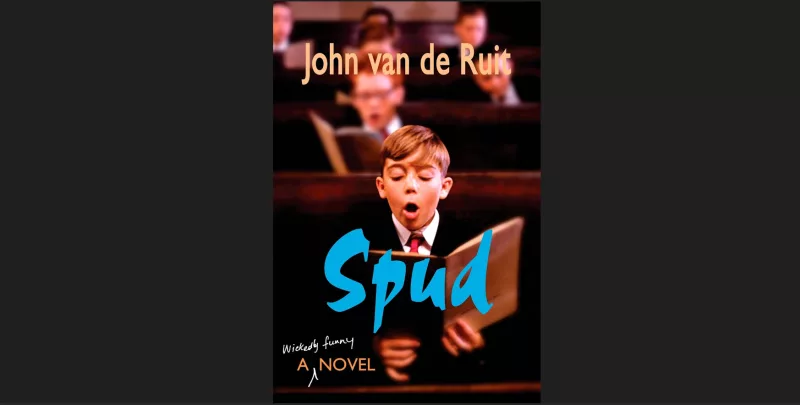
Imagine being 14, painfully self-conscious, trapped in an all-boys boarding school, surrounded by eccentric teachers, intimidating prefects, strange friends and enough teenage hormones to power a small city.
Now imagine having to survive all of that while trying desperately to become a man. That is the wonderfully chaotic world of Spud, John van de Ruit’s hilarious and sharply observant coming-of-age novel.
Set in South Africa in the early 1990s, Spud follows John ‘Spud’ Milton, a young boy beginning his life at an elite boarding school. Armed with a diary, an anxious imagination and an almost heroic lack of confidence, Spud records the triumphs, disasters and absurdities of adolescence.
His world quickly fills with unforgettable characters: larger-than-life classmates, eccentric teachers, unpredictable housemates and a collection of adults who seem barely more mature than the boys they are supposed to control. What begins as a nervous boy’s attempt to make sense of boarding school becomes a vivid journey through friendship, embarrassment, rivalry, first love and the bewildering business of growing up.
Spud’s greatest weapon is his diary. Through it, readers experience his world from the inside, where even the smallest humiliation can feel like a national emergency. His insecurity is particularly intriguing because he possesses enough self-awareness to recognise his awkwardness but not enough confidence to escape it.
At one point, after months of trying to sound more masculine, he admits, “Despite months of spectacular knack-jumping and other verbal pyrotechnics, my voice has hardly dropped below the level of a masculine woman.”
The sentence perfectly captures Spud’s predicament: he desperately wants to become the confident young man he imagines himself to be, yet his body, voice and circumstances stubbornly refuse to cooperate.
The novel’s humour is one of its greatest attractions. Van de Ruit finds comedy in embarrassment, exaggeration and the strange logic of teenagers. Nothing is too insignificant to become a crisis, and nothing too serious to escape Spud’s wonderfully dry observations.
Even his relationship with his father becomes a source of comic confusion. Spud observes his father’s confidence in his sporting future with disbelief: “He’s convinced I’m about to make my debut for the firsts, possibly as Captain. Unfortunately, he’s seriously misguided and semi-insane.” The humour works because Spud does not present himself as the heroic centre of his own story. Instead, he frequently becomes the butt of his own observations.
Van de Ruit’s words race across the page with a mischievous energy, giving the novel its unmistakable heartbeat. His sentences feel as though they have been scribbled directly from a teenager’s overactive mind. They are quick, dramatic, observant and occasionally gloriously ridiculous.
The diary format allows the narrative to jump between sincerity and comedy without warning. One moment Spud is wrestling with loneliness or insecurity. The next, he is dissecting some absurd school incident with the seriousness of a military historian. This makes the novel feel intimate without becoming unbearably sentimental.
However, Spud does have a weakness: its episodic nature. This can make the story feel scattered. Because the novel is built around diary entries and a succession of school experiences, some episodes feel more like entertaining fragments than parts of a tightly constructed narrative.
The sheer number of eccentric characters and comic incidents can also occasionally overshadow the deeper emotional development of Spud himself. As a result, readers looking for a strongly plotted coming-of-age story may find the novel frustratingly loose.
Ultimately, Spud captures the beautiful disaster that is adolescence. Growing up is hardly a graceful journey; it is a chaotic cocktail of awkward silences, humiliating blunders, unexpected laughter and bewildering moments of self-discovery, often crashing together at once.
John van de Ruit transforms this wonderfully messy stage of life into a story that pulls readers effortlessly into Spud’s world and leaves an imprint long after the final page. Spud dreams of becoming extraordinary, yet it is the painfully ordinary nature of his struggles that makes him so unforgettable.
Funny, irreverent and unexpectedly touching, Spud is less a story about becoming a man than a wonderfully chaotic record of discovering what it means to become yourself.