Every situation in life has contrasts. Even calamities have their own contradictions: good and bad.
Ancient Chinese philosophy teaches the concept of yin and yang of life. Simply put, this dualism refers to the fortunes and misfortunes; positives and negatives of any situation in the natural world that we inhabit.
It’s such a dichotomy that makes life wholesome. Minus one, and the other half atrophies. The picture can’t be whole! Both are parts of same system. Systems thinking theory explains this holistic integration better.
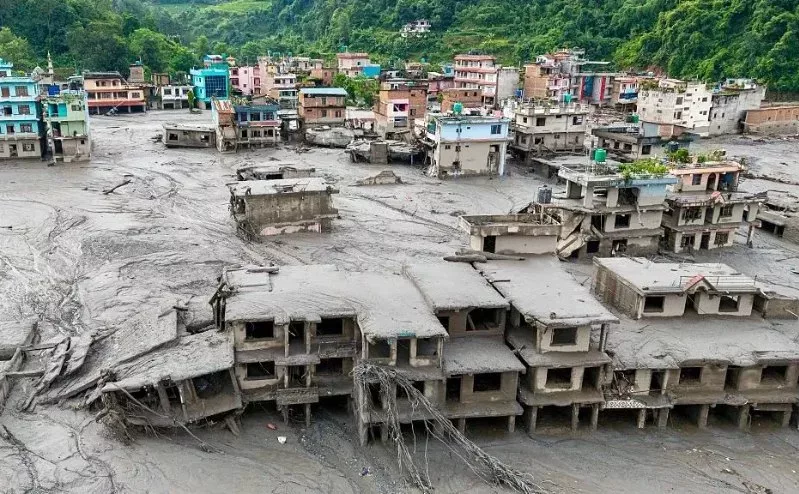
Back to Nepal disaster: lives were lost, injuries sustained and properties obliterated in the marauding floods. No force within its way was formidable enough to survive to tell a tale for another day.
And that’s the sad part of the tragedy.
Yet we have the other good side that affords us all to smile. Lives were indeed saved! Not those few who managed to escape the onslaught, by scrambling to safety, or by sheer luck, but those who heeded a clarion call to relocate. And relocate they did in realtime.
This tragedy, as much as it’s mourned, is in equal measure celebrated. And it has birthed not just a single hero, but heroes and heroines in their hundreds.
And this is what happened.
Accounts goes that Rajendra Dawadi, a school headmaster of Tribhuvan Tsishuli Secondary School in Bidur, Nepal received an urgent alarm from a member of his staff on raging flash floods roaring downstream. In the floods pathway coursed along the riverine was the school he headed hosting about 900 students within the busy border township.
The head didn’t ask questions. He simply acted on primal instincts. And in his mind were his students as the number one priority to be saved.
He barked evacuation orders, and the students responded instantly. They understood the danger, and moved to higher grounds, and just then, when everyone was safely perched uphill, the fury slammed through the settlement indiscriminately, wiping out every infrastructure, local population - school inclusive - and rest is a sad tragedy.
It’s reported that this action right from information, to directives to move to safer grounds, and eventual relocation of entire school population happened in under 10 minutes record time. It was successful as no student was a sad statistic, as all were accounted for.
I can’t speak for the school head, or any of the students on what really happened during the frenzy, or went through their heads at the time. Thanks God they are all safe and reunited with respective families. But their former school is no more as of now - with no visible trace of prior existence. They’ll have to find a new home for a school.
But we can only speculate, by drawing inferences from available accounts.
One, the school was within a danger valley, just along the river bank. It must have been a victim of floods before, albeit at a lesser level.
With such a troubled history, the school community must have been fully conscious of the risks and dangers surrounding them.
And as such, they instinctively acted and fled in good faith, but not stay put to fight the challenge. No rationalisation was needed on their part at such a desperate time. Hence no questions were asked. Just an instinct of fleeing.
Two, this is a school environment, with a youthful population. Students operate within a controlled environment supported by discipline as a cornerstone, hence put their trust in their leaders (and don’t ask questions just for the sake of it) - unless for knowledge’s sake.
This may explain as to why they promptly acted on issued instructions. That is different in a set-up of adults who exercise freedom of thought and inquiry, hence affect their critical decision making outcome.
The power of discipline and compliance to rule setting therefore matters, especially in matters of life and death - desperate situations of fight or flight!
And it’s the power that gives us a good lesson to learn from - as adults - on how we can sometimes gain more graces through blind faith and discipline from leaders and authority. This is the power of trust in agency of leaders, even in what you may not see or feel as long as it can save lives during times of desperation.
This explains as to why leadership is key, after all, during critical moments of decision making. Leaders’ pay-grade is for seeing and guiding - where the followership does not, or may not see due to limitation of official information.
Just as Jesus said, “Truly I tell you, unless you change and become like little children, you’ll never enter the kingdom of God.” (Mathew 18:3). It’s such meekness that we need most of times.
We therefore celebrate the hero of the tragedy, Dawadi, for saving lives, and the entire school community that he led, for discipline and good followersip. Their collective collaborative action affords us a rich lesson to benchmark on how to respond to emergency situations and save lives in turn.