The evolution of multiparty democracy in Kenya often plays out in scenes that seem familiar, as if we are re-enacting events as they happened before.
Within political parties and coalitions, the mistrust built up over the years always comes back to muddy the most well-laid plans.
Perhaps the biggest effect of this mistrust is that two big egos usually find it difficult to coexist under one roof, so that in recent history there can be only one powerful political personality in any political party, with the rest being merely his surrogates.
Over the past electoral cycles, evidence suggests that attempts to bridge this “gap” has failed. This is why the combinations of Raila Odinga and Mwai Kibaki in Narc, Raila and William Ruto in ODM, Uhuru Kenyatta and William Ruto in Jubilee - or indeed, Ruto and Rigathi Gachagua in UDA - leave us with no other conclusion except that one political movement is never large enough for the bloated egos of two populist politicians. It is much harder if there are more than two such inflated egos.
But for the purposes of this article, I am more interested in perhaps the biggest and most consequential movement in multiparty Kenya - the original Ford. It was founded as a pressure group in 1990 after years of agitation for free speech and restoration of multiparty democracy.
It morphed into a powerful political movement in 1991, carrying the hopes and aspirations of a large portion of the population.
At its peak, it became the biggest threat to the continued domination of politics by the ruling Kanu party and its single-party philosophy.
After the infamous Section 2(a) of the Constitution was repealed in 1991 to restore pluralism, and the country set on election mode for the first multiparty general elections the following year, activities within Ford hit fever pitch. The stakes, especially over the mode of picking the presidential flagbearer, rose dramatically.
Section 13 of the party’s own constitution was the sticky mess, as top party luminaries fought over whether the candidate should be picked by universal suffrage of members or via the collegiate system preferred by Jaramogi Oginga Odinga.
The entry into the fray of Kenneth Matiba, who had been recuperating in London following a stroke suffered in detention, set in motion the events that would ultimately divide Ford.
Matiba wanted the presidential candidate chosen via universal suffrage, popularising the “Let the People Decide” phrase. Jaramogi’s wing, wary of the larger tribal numbers Matiba would garner via that method, preferred the electoral college system.
Ultimately, and quite predictably, no side was willing to cede ground and the party finally split - Jaramogi going with Ford Kenya and Matiba launching his Ford Asili Party.
Over the years, many political commentators have blamed the Special Branch for fuelling the split by deploying agents to convince Matiba that he was the more popular of the two.
But if you ask me, the intelligence services are often blamed even for basic tribal and political divisions sown by surrogates and small-time political operators around party leaders.
Quite often, the so-called “intelligence moles” are merely hangers-on and idlers around senior politicians, who spend the drinking hours with the bosses, planting seeds of discord using manufactured narratives and shallow stories.
In Kenya’s current political set-up, there are two possible scenarios that have become living nightmares for President William Ruto’s regime. The first is a possible united election front bringing together Nairobi senator and Linda Mwananchi movement leader Edwin Sifuna and former Deputy President Rigathi Gachagua.
The combination of Sifuna’s massive, youthful following across the country, and Gachagua’s huge, heavily indoctrinated Mt Kenya region base would be lethal to any rival by any scale used to gauge it.
This partly explains the amount of time and resources the regime has deployed in selling the narrative, especially to ODM broad-based adherents, that “Sifuna wants to sell you to Gachagua.”
Indeed, in Luo Nyanza, the most dominant conversation used to sustain the rapprochement between the new political lords in Raila’s old home base and the ruling UDA party is “anything but Gachagua”.
Given this rising apparent anti-Kikuyu sentiment, the ruling party’s networks in the hinterlands believe they have done enough to deny Sifuna entry into these bases, if does he strikes a deal with the former DP.
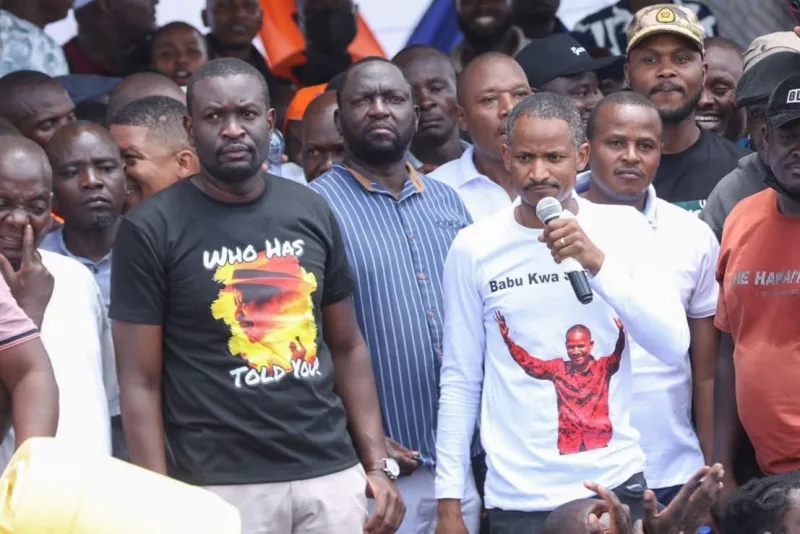
The second living nightmare for the ruling UDA party is the sheer potential of a long-term partnership between Embakasi East MP Babu Owino and Sifuna.
And this where those two gentlemen have to check out the Jaramogi-Matiba rivalry script and be wary of all the “intelligence moles” who will seek to destroy their union.
Actually, there shouldn’t be any conflict between the two, because the Embakasi legislator seeks to be the next governor of the capital city, while the Nairobi senator has set his eyes on the presidency. But in Kenya’s politics, it is not as simple or easy as that.
Both legislators are young, with a touch of abrasive politics. In all honesty, both are also known to carry big egos. Together, they make a formidable and indomitable political pair.
“Blessedly” they seek two different offices in the general elections, so their union and cooperation, given their huge appeal among young Kenyans, would be heavily consequential, at least within the next five years. But the pitfalls that lie ahead include traps set by both friend and foe.
There is no understating the fact that Sifuna and Babu need each other in the medium term. The Embakasi East MP traces his ancestry to Raila’s Luo Nyanza, and enjoys considerable support among the youth there. It is easy to see why ODM leaders shake in their boots whenever Babu plans a visit to the region.
They remain aware that his popularity would expose the sinking sand on which they have built their own broad-based house. The region is key to Ruto’s reelection plans, and Babu’s forays there cause considerable trepidation.
Meanwhile, Sifuna has entrenched himself as a Nairobi politician with great skill and wide support within the electorate. At least in these two regions, and given their interests, their partnership would excel.
In fact, if their union sought out coalitions beyond their Linda Mwananchi movement, one can begin to see the reasons why regime bloggers obsessively watch the two and report on any little “mishap”, including microphone use and mentions at the movement’s countrywide rallies. To the regime, a falling out between the two young politicians would be welcome.
Our electoral history may be replete with anecdotes of how promising coalitions and parties were brought down by clashing egos and unhinged power contests. However, the joint opposition has so far made the nation believe that it will field a single candidate in the 2027 general election.
That may be easier said and done, because at this juncture, each opposition luminary considers himself the best pick. Where and when the rubber meets the road, however, we will probably be talking about divisions and fallings-out.
Jaramogi and Matiba may have provided the first template in multiparty Kenya for how not to go about it - by splitting - and subsequent political fallings-out in major political parties may have sustained the bad habit.
Sifuna and Babu, however, have the opportunity to break that political “generational curse” and build, for themselves and their millions of followers, a joint political movement that will defy all attempts to divide them.
And these attempts will be myriad, including those attributed to “intelligence operatives” who in this case will be just the usual friends and political idlers around the two. They owe it to a very large part of the country to stick together.