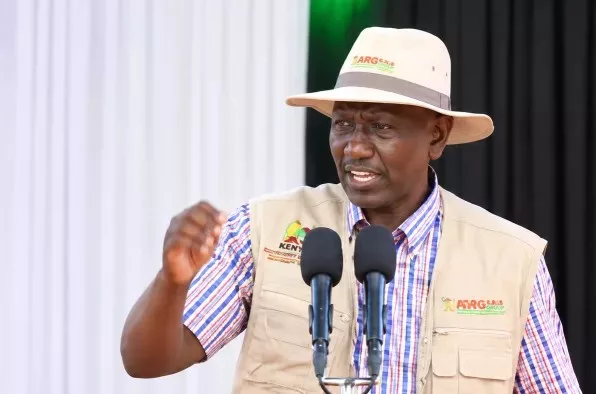
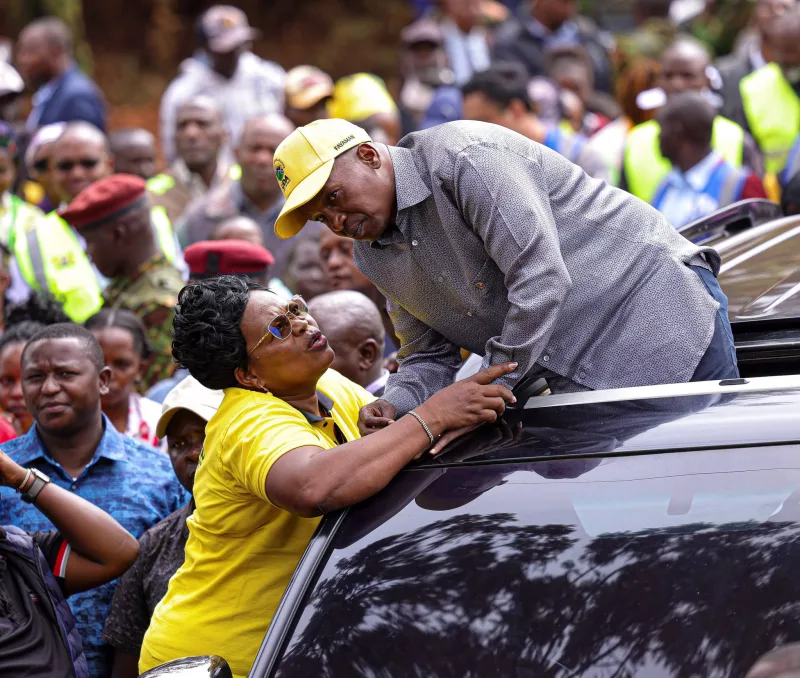
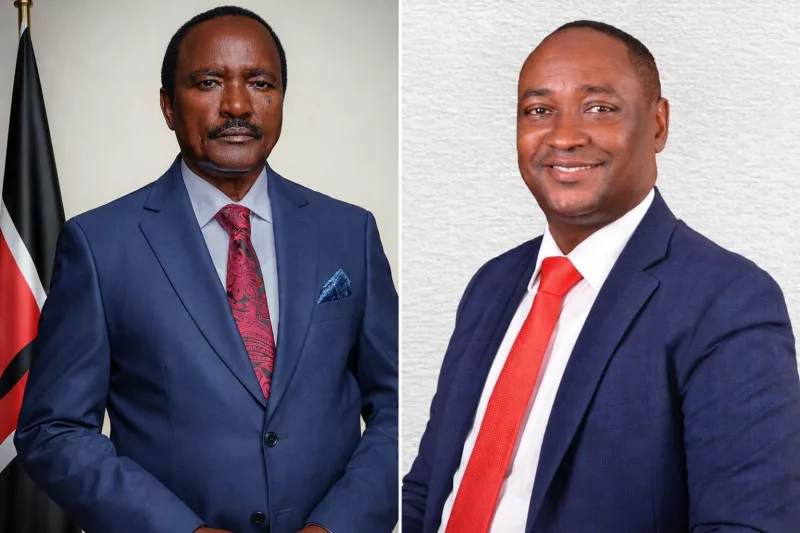
 A collage of Wiper leader Kalonzo Musyoka and National Liberal Party (NLP) leaders Dr Augustus Muli
National Liberal Party (NLP) Secretary General Omondi K'Oyoo has challenged the political establishment in Ukambani to rethink its longstanding approach to national politics.
He has argued that the region's loyalty to individual leaders and opposition politics has not delivered the development it deserves.
K'Oyoo said many Akamba were increasingly questioning whether remaining loyal to one political formula for nearly two decades had produced tangible benefits for the people of Kitui, Machakos and Makueni.
“For almost two decades, Ukambani has largely followed one political formula; remain loyal to one political leader, stay in opposition, and hope that loyalty will eventually be rewarded with development,” K'Oyoo said.
He argued that the region's political strategy should now shift from emotional loyalty to strategic bargaining, with leaders demanding concrete development commitments from political formations seeking the support of the Akamba community.
According to K'Oyoo, the challenges facing Ukambani remain visible despite the region's longstanding political influence.
“Drive from Athi River to Mutomo and the challenges remain familiar. Water insecurity continues to affect communities. Roads and infrastructure remain inadequate in many areas. Young people continue to leave Ukambani for Nairobi, Mombasa, the Gulf and elsewhere in search of jobs and opportunities that remain scarce at home,” he said.
K'Oyoo said the Akamba have frequently been described as one of Kenya's most politically loyal voting blocs, but argued that loyalty alone had failed to secure the scale of investment needed to transform the region.
He cited water infrastructure, dams, irrigation schemes, industries, markets and employment opportunities as some of the areas where he believes the region needs greater political leverage.
“Perhaps the problem is not the people. Perhaps it is the strategy,” he said.
His remarks amount to a challenge to the political strategy associated with Wiper leader Kalonzo Musyoka, which has for years centred on opposition politics and alliances aimed at securing national power.
K'Oyoo argued that while Kalonzo has played a significant role in Kenyan politics, Ukambani should not build its political future around the expectation that another potential presidential contender will be unable to contest an election.
He pointed to the 2013 General Election as an example of the risks associated with such calculations.
At the time, President Uhuru Kenyatta and his then running mate William Ruto were facing cases before the International Criminal Court. The ICC proceedings were a major feature of political debate ahead of the election, but the two proceeded to contest on the Jubilee ticket and ultimately won.
For K'Oyoo, the episode demonstrated the danger of building a political strategy around the assumption that a rival will be weakened, disqualified or prevented from appearing on the ballot.
He said the same lesson could be applied to the 2027 political contest, particularly amid questions surrounding former Deputy President Rigathi Gachagua's political future following his impeachment.
Gachagua has maintained that he remains eligible to seek the presidency despite the legal issues surrounding his removal from office. K'Oyoo argued that the courts and the Constitution, rather than political speculation, should determine such questions.
“If, therefore, the political calculation behind another Kalonzo presidential bid is that Gachagua will eventually be locked out of the race, then Ukambani risks repeating the same strategic mistake,” he said.
He argued that the region should instead prepare for an election in which all major political actors could potentially participate, building alliances based on what they can deliver rather than waiting for political circumstances to eliminate competitors.
“The Akamba cannot afford to gamble their political future on such uncertainty,” K'Oyoo said.
He posed a different question that he believes should guide the region's political choices ahead of 2027.
“The question should no longer simply be, ‘Who are we supporting?’ It should be: ‘What are we getting for our support?’” he said.
K'Oyoo said remaining in opposition has a legitimate place in a democracy but warned that prolonged political marginalisation could make it harder for a region to influence national decisions and secure major investments.
He argued that development should not be treated as a reward for political loyalty, but should instead result from effective representation, strategic negotiation and accountable leadership.
“If Ukambani wants major investments in water, roads, irrigation, industry and employment, its political leadership must have the capacity to negotiate effectively with whoever holds national power,” he said.
K'Oyoo said the region should therefore be willing to engage with whichever political formation forms the next government while maintaining the ability to advocate firmly for its interests.
“The objective should not be perpetual opposition, nor unconditional support. The objective should be results,” he said.
He said Kitui, Machakos and Makueni could not be transformed through political rallies alone, arguing that the region needed leaders capable of influencing decisions on national budgets, infrastructure, agriculture, investment and employment.
A significant voting bloc, he said, should translate its political strength into tangible development commitments.
K'Oyoo said the National Liberal Party, under Dr Augustus Kyalo Muli, was advancing a different political proposition for Ukambani based on bargaining for development rather than offering unconditional political support.
At the centre of the proposal is the development of a costed regional agenda covering water projects, roads, irrigation, agricultural value chains, industries, jobs and markets.
Such priorities, K'Oyoo said, should be identified, costed, prioritised and assigned clear implementation timelines.
“We must be in the room,” K'Oyoo said, arguing that Ukambani should seek influence within national decision-making structures rather than permanently positioning itself outside government.
He said the region should be prepared to work constructively with whichever administration is in power while retaining the ability to demand accountability.
K'Oyoo also highlighted the political and community profile of Muli, describing him as a leader from Kitui Central who has sought to establish links between the region and the diaspora.
Muli is a graduate of Starehe Boys' Centre and School and Kenyatta University and holds an MBA from Dubai.
Through the Kyalo Kya Maendeleo Foundation, he has been associated with initiatives focusing on education bursaries, water projects, youth and women empowerment.
K'Oyoo said Muli's political proposition was based on placing measurable development commitments at the centre of political engagement.
He, however, acknowledged that such credentials alone could not guarantee political success and argued that voters should not give any politician a blank cheque.
The NLP secretary general also pointed to Muli's cultural activities and his planned October 3 coronation as Chief of the Anzauni clan, saying the occasion could provide another platform for mobilising the community around development and unity.
K'Oyoo's intervention comes as political parties and leaders across the country begin positioning themselves for the 2027 General Election, with regional voting blocs expected to play a significant role in the presidential contest.
For decades, Ukambani has been associated with Kalonzo Musyoka, who has repeatedly sought the presidency while also playing a central role in opposition alliances.
But K'Oyoo argues that recognising Kalonzo's contribution to national politics should not prevent the Akamba from considering alternative political strategies.
“Kalonzo Musyoka has played a significant role in Kenyan politics and deserves recognition for his contribution to the national political landscape. But acknowledging that contribution does not mean that the Akamba must remain permanently tied to one political strategy,” he said.
He said the time had come for the community to assess political alliances through the lens of tangible outcomes rather than historical loyalty
“The Akamba do not need another politician's misfortune to create their opportunity. They need to create the opportunity themselves,” K'Oyoo said.
He described the proposed shift as a move from waiting for power to negotiating for results.