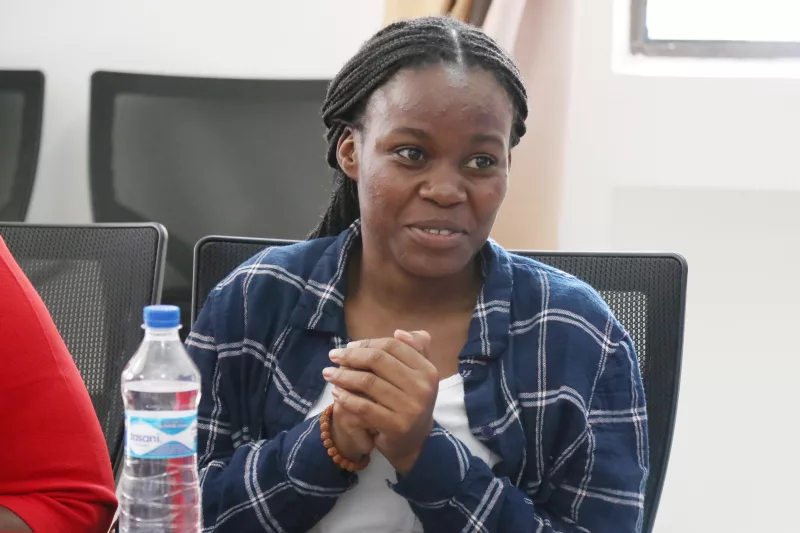
 Miriam Achieng during an interview at the Confucius Institute on August 27, 2026/LEAH MUKANGAI
When Miriam Achieng Kenyatta first watched a Chinese television drama in high school, she had no idea the unfamiliar language and culture she was watching would one day take her to China and place her among the world’s top Chinese language learners.
Now 23, the University of Nairobi geospatial engineering student has returned home after finishing among the top 15 out of 157 participants from 137 countries at the 25th Chinese Bridge Chinese Proficiency Competition for Foreign College Students.
Her achievement also placed her among the top three contestants in Africa, marking a remarkable milestone for the young Kenyan who once had little confidence in her ability to speak Chinese.
For Achieng, the journey began almost by accident. She had initially wanted to become a doctor.
But while in high school at Asumbi Girls’ High School, a Chinese television programme featuring a drama about traditional Chinese medicine caught her attention.
“I first got interested in learning Chinese when I was in high school, when I had watched a certain TV programme. It was showcasing a Chinese drama, where it was basically about Chinese medicine,” she narrates to us in an interview.
“At that time I wanted to become a doctor, so I got intrigued by the strange ways of healing that I could see in that movie, and that is how I started.”
Her interest grew gradually.
After joining the University of Nairobi, she learnt that the institution offered Chinese classes through the Confucius Institute.
She began taking the classes at the University, eventually progressing to HSK 3.0 level.
But Achieng did not limit her learning to the classroom.
She transformed her phone and entertainment habits into an informal Chinese-language immersion programme.
“I decided to bring China to myself through what I was able to afford, which was my phone,” she says.
Achieng says she turned things on her phone to Chinese.
"I started watching only Chinese videos. I started only using Chinese media and social media," she explains.
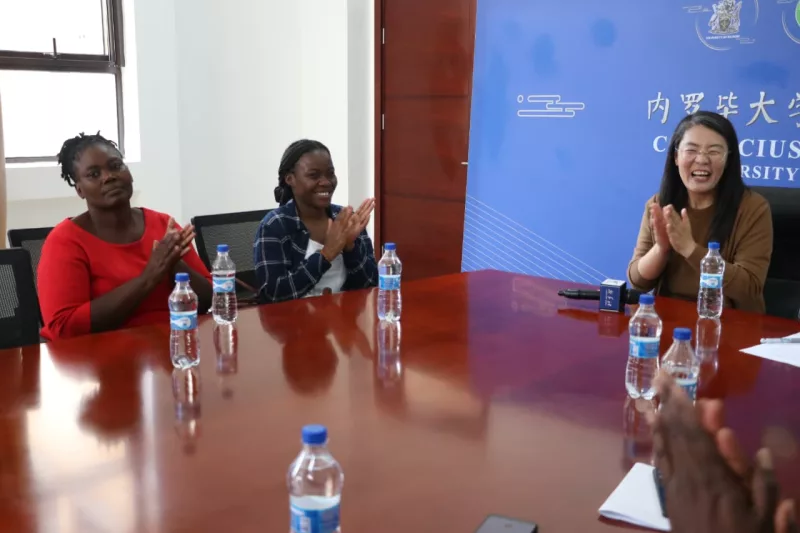 Hellen Ajuma (left), Miriam Achieng and Confucius Institute at University of Nairobi Director Wang Shangxue on August 27, 2026/LEAH MUKANGAI
 She even stopped watching English-language films, opting instead for Chinese productions to expose herself to the language.
“I feel like if you want to learn a language, you have to live the language,” she says.
“You can learn a whole lot of vocabulary in class. You can learn a whole lot of writing and reading, but if you do not get out there and start actually speaking and actually listening, you are halfway there.”
China trip and competition
The 25th annual global finals for the Chinese Bridge college student competition took place in China from August 5-23, 2026.
Her breakthrough came when a teacher encouraged her to enter the Chinese Bridge competition.
Achieng had not even known that applications were open because she had stopped following some of the class groups.
Her teacher challenged her: “Why have you not applied? Your Chinese is so good. Why have you not applied?”
Even then, Achieng lacked confidence.
“It’s not that I don’t want to apply. I do not dare to apply because I feel like I wouldn’t be able to make it,” she recalls.
That doubt disappeared during the competition.
The global contest brought together some of the strongest Chinese language students from around the world, including contestants who had studied the language from childhood.
“It was very competitive because you get to compete with the top people from every single country,” she says.
The competition is rigorous, beginning with preliminary tests evaluating listening, speaking, and writing skills.
It is designed to test participants’ proficiency in Mandarin as well as their knowledge of Chinese culture. Contestants typically demonstrate their skills through Chinese-language speeches, knowledge and cultural quizzes, talent performances and other activities that showcase their understanding of China and the language.
When contestants who had made it into the top 30 were being announced, Achieng sat anxiously waiting.
“My hope was dwindling more and more. I wanted to get to the top 30, but I also didn’t have that confidence that I had gotten there,” she says.
Then her name was called.
“And then finally, I hear my name, and voila, I’m in the top 30.”
Making the top 15 was an even greater surprise.
“I was kind of exhilarated, but at the same time, I was content with my performance because I had not thought I would make it to even the top 30, and now I had made it to the top 15. I felt very proud of myself," she says.
The experience also transformed her confidence.
To her, finishing in the top 15 is self-growth
At the beginning of the competition, Achieng said she didn’t have that much self-confidence in her Chinese or her stage presence at all, and "being able to make it that far just proves my then self very wrong.”
Her trip to China further deepened her appreciation of the country she had previously experienced mainly through her phone.
Her first moments in Beijing, including visits to the Forbidden City and the Great Wall of China, remain among her most treasured memories.
“When I was able to walk the Great Wall of China and climb it, I felt like everything is possible because who would have thought I would go to the Great Wall of China?” she says.
“I only expected to experience China just as I was used to, just through my phone.”
She was particularly impressed by Pingtan and Xiamen.
“I don’t think there’s a city more beautiful than Xiamen,” she said.
Beyond the scenery, the trip exposed her to people from different countries and made the world seem smaller.
“I got to interact with lots of people from lots of different places, and at that moment it felt like the world was really such a small place,” she says.
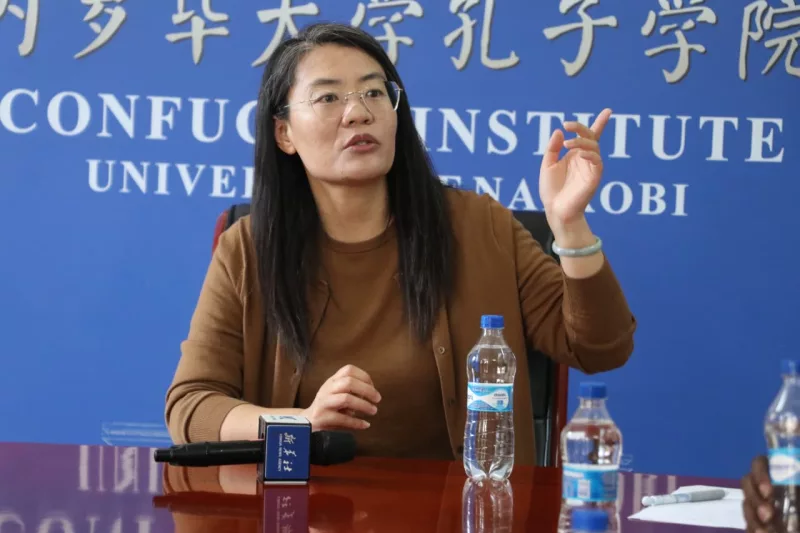 Confucius Institute at the University of Nairobi Director Wang Shangxue during an interview/LEAH MUKANGAI
 Achieng says learning Chinese has also changed her career ambitions.
Before discovering the language, she imagined a straightforward future, graduating, securing a stable job in Kenya and settling down.
Now, she sees many more possibilities.
“I realised I have opened the door to lots of opportunities, and now I have a very vibrant variety of choices for my future," she says.
As a geospatial engineering student, she believes Chinese could give her an advantage in a country where Chinese companies and investors are involved in major infrastructure and development projects.
“I definitely see myself using Chinese professionally in the future. There’s lots of development projects that are happening in Kenya that are being facilitated by the Chinese, and I am in the engineering field, so I’m definitely going to use it," she says.
She sees opportunities not only in engineering but also in translation, education, scholarships and business.
“If you are well-versed in Chinese, you can apply for scholarships to go and study in China. You can also find jobs in Kenya because there are a lot of projects that Chinese people are doing here in Kenya, and most of the time, they lack translators or people that they can communicate with freely in the places of work," she says.
Achieng also believes the growing presence of Chinese in Kenya makes the language increasingly valuable for young people.
“Everyone can literally see it, the expressway, the railway, Talanta Stadium,” she says.
“If there is a blank space somewhere between these developments, between these factories, between these projects and the labour in Kenya that is available for them, I don’t see the reason why you should not learn Chinese and fill that gap.”
She acknowledges that Chinese is difficult, particularly because its writing and speech systems are vastly different from English and Kiswahili.
But she says the biggest challenge for Kenyan learners is not necessarily the language itself; it is the lack of opportunities to practise with native speakers.
“Language is not something that you read in a book and remember or memorise. Language is something that you need to speak now and then,” she said.
Her mother, Hellen Juma, 46, initially worried that learning Chinese would distract her daughter from her university studies.
The family had previously lived in Kibra before relocating to their rural home in Mowlem, Kisumu County, after her husband became ill and underwent surgery.
Juma, a mother of four, said she is now proud of her first-born daughter and has herself developed an interest in Chinese programmes.
“At first I never liked it when she told me she wanted to learn Chinese because I thought it would distract her studies. Now I encourage others to learn Chinese,” she says.
The achievement has also drawn praise from the Confucius Institute at the University of Nairobi.
Its director, Wang Shangxue, said Achieng’s performance exceeded expectations and demonstrated the potential of Kenyan students in mastering Chinese.
For Achieng, however, the competition is not the end of the journey.
She wants to continue improving her Chinese and eventually use it professionally while encouraging other young Kenyans to take advantage of the opportunities offered by the language.
Her message is simple: do not wait until you are certain you will succeed.
Achieng herself almost did not apply for the competition because she did not believe she was good enough.
Yet the student who once lacked the confidence to enter a competition went on to finish among the top 15 Chinese language learners in the world.
“I feel like putting yourself out there and trying to actually practise the language is what counts,” she says.