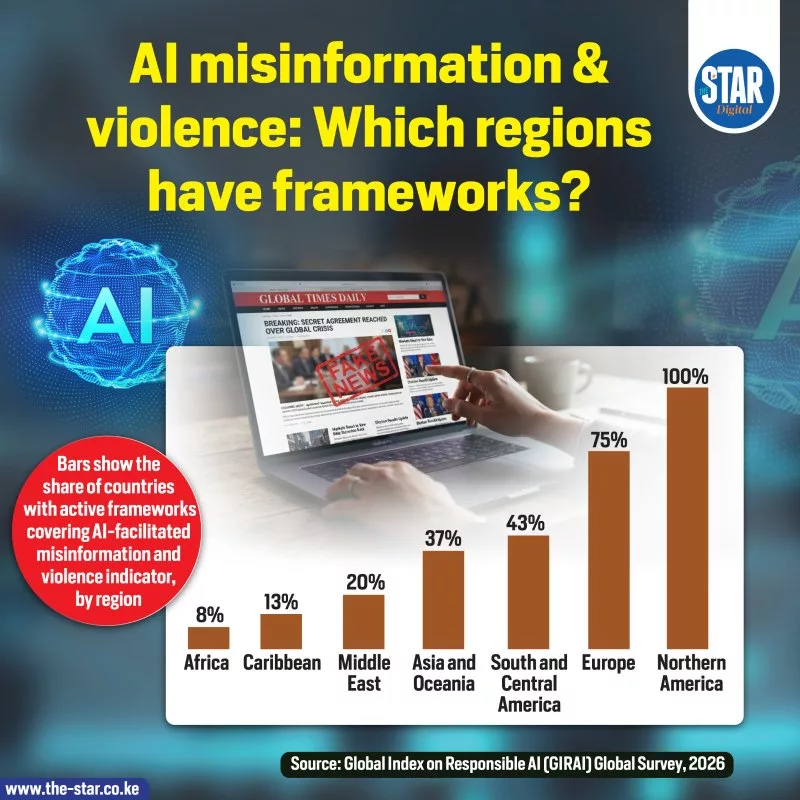
North America leads the world in establishing active frameworks to counter AI-facilitated misinformation and violence, with 100% of its countries having regulations in place.
Data from the Global Index on Responsible AI (GIRAI) Global Survey (2026) highlights a significant global disparity in regulatory preparedness, showing distinct gaps in policy adoption across different geographic regions.
Europe follows North America closely, with 75% of nations having implemented official indicators and frameworks to mitigate risks associated with artificial intelligence.
South and Central America demonstrate moderate adoption rates, where 43% of countries maintain active regulatory mechanisms.
Meanwhile, Asia and Oceania report that 37% of nations possess policy structures designed to curb AI-driven disinformation and conflict risks.
Conversely, several key regions exhibit low levels of regulatory coverage despite the growing widespread adoption of automated technologies.
In the Middle East, only 20% of countries have active policy frameworks governing these threats. The coverage drops further in the Caribbean, where just 13% of nations maintain active measures.
Africa records the lowest proportion globally, with merely 8% of countries operating with active frameworks dedicated to addressing AI-facilitated misinformation and violence indicators.
Overall, the data underscores a sharp contrast in global readiness, leaving vast areas of the developing world largely without active policy protections against digital disruption and automated misinformation.