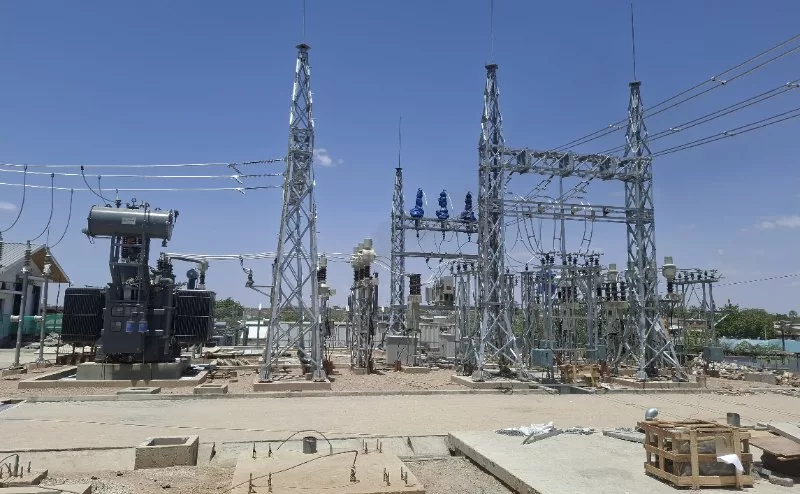
 Lodwar 66/11kv substation. 85% complete/HANDOUT
For 35-year-old Hamisi Kokane, electricity is more than a new utility in his Garsen village, Tana River county. It is proof that his remote community has finally been included in the country’s development story.
“Since independence, we have not had electricity supply,” Kokane said. “We are now using it to do a number of things besides lighting our homes.”
For years, Kokane and his neighbours relied on solar lamps, paying daily subscriptions to keep their homes lit.
The cost was higher, and the service disappeared whenever they could not pay.
Now, electricity has reached the village after engineers overcame the challenge of transporting poles across the Tana River, an area where commercial investment would have made little sense.
“Out of this, we now feel that we belong to Kenya,” Kokane said.
In Ndori village in Gem constituency, Siaya county, 65-year-old Margaret Aloo said electricity had immediately changed household life.
“We didn’t pay anything to be connected; we just buy tokens,” she said.
The biggest difference, she said, was the end of daily payments for solar lighting.
“Life is now better since we use electricity to charge our phones and light our homes,” Aloo said.
“We used to pay for solar every day, and it was a bit expensive, and the day you don’t pay you find yourself in darkness. It is now cheaper.”
For Pamela Nyamita, a resident of Imbaya in Siaya, the transition from kerosene to electricity feels like starting a new life. "The day we received this miracle, I thanked God because we had been in darkness," she said.
In Siaya’s Gangu, Ruth Atieno plans to use her new connection to start a business. "I'm truly thankful to the government. My plan now is to buy a posho mill to set up here so that I can serve the community," she said.
Benson Bett, a boda boda rider in Soin-Sigowet, said the change had brought direct savings.
“Things were tough. Paying for these solar lanterns was cumbersome,” Bett said.
“Now with Sh50, I can get unlimited power for three to four days, which is better than Sunking and the other solar lights.”
Their experiences capture the human face of a government electricity programme that has connected 1,597,586 customers between September 2022 and June 14, 2026.
The data from the Rural Electrification and Renewable Energy Corporation (Rerec) and Kenya Power offers the clearest scorecard yet of the geographical spread of President William Ruto’s push to extend electricity beyond the commercially attractive parts of the country.
The connections were made through a combination of direct government investment, donor-funded programmes and grid extensions.
Mini-grids have also been installed, targeting areas where ordinary commercial connections have historically been difficult or too expensive.
The data shows that 318,217 customers were connected in 2022-23, rising sharply to 465,811 in 2023-24.
A further 401,848 customers were connected in 2024-25, followed by 411,710 in 2025-26 to June 14.
The result is a cumulative 1.6 million customers over the period.
The largest number of connections was recorded in Nyanza, with 321,010, accounting for about one-fifth of the national total.
"While not every village has been connected to power, the increased connection has expanded to areas previously ignored. There are large swaths of Nyanza that were not connected but over the recent years, there has been more coverage," Oloo Janak, the convenor of Nyanza Dialogue Forum, said.
"The net effect of this improved connection is that businesses have either been established or expanded. These include welding, hotels and bars, cyber cafes, carpentry and joinery, and other forms of business that require power to operate,” he said.
“Many market centres have streetlights, enabling market women and others to extend their sales into late evening. Entertainment joints have come up, including social halls for watching football and other games."
For a long time, the power supply in many parts of Nyanza was unstable, Janak said.
But over the last five years, additional power lines and sub-stations have been built and stabilisation done through Ketraco and related power agencies - expanding the capacities of the Miriu and Gogo Falls power stations and building new power lines in Siaya with extensions to Busia and Bungoma.
"The power supply in Kisumu, especially in the Miwani and Muhoroni sugarbelt, in Homa Bay, especially in Ndhiwa and the lake region of Mbita, Rusinga, Sindo, Magunga through to Nyatike, Uriri and Kuria in Migori county, have all been expanded and stabilised, reducing the previously frequent power outages," Janak said.
Rift Valley followed with 313,893, while Eastern recorded 256,740. Coast had 196,191, Central 190,090, Nairobi 111,893, Western 102,131 and North Eastern 58,432.
Turkana, treated separately in the programme data because of its distinctive off-grid requirements, recorded 47,206 connections.
In terms of counties, Kisii leads with 120,583 connections, followed by Migori with 82,943. Mombasa recorded 62,495, Makueni 59,602, Kisumu 55,412, Meru 47,710, Turkana 47,206, Machakos 46,622 and Kiambu 43,958.
Some of the largest gains have been recorded in remote and historically underserved areas where extending the national grid requires significant public investment.
Nyanza’s 321,010 connections make the region the biggest beneficiary in absolute numbers.
Kisii alone accounts for 120,583, with the county registering an extraordinary 41,290 connections in 2023-24 and another 37,394 in 2024-25.
Migori follows at 82,943, with more than 64,000 connections recorded in the last two financial years.
Kisumu has 55,412 customers connected, while Siaya has 19,821, Homa Bay 23,015 and Nyamira 19,236.
Rift Valley comes second with 313,893 connections of which Nakuru has 41,279 customers connected, while Kericho has 25,580, Nandi 34,920, Trans Nzoia 36,877 and Bomet 29,994.
Laikipia has 28,910, Narok 14,296, West Pokot 16,826 and Baringo 7,808.
The story in Baringo illustrates why electricity is increasingly being viewed as part of security, settlement and economic development rather than merely household lighting.
In some parts of the county, the Ilchamus and Pokot communities had begun abandoning villages.
As communities returned following security interventions, schools and households were connected.
The emergence of electricity then attracted other services and activities.
Officials say some centres are now growing so rapidly that residents are already reporting overloaded transformers, a problem that, while presenting a new challenge, is also a sign of increased demand.
Eastern has recorded 256,740 connections.
Meru leads the region with 47,710, followed by Machakos at 46,622 and Makueni at 59,602. Kitui has 20,331, Embu 17,695 and Tharaka Nithi 33,481.
Isiolo recorded 14,719 while Marsabit has 16,580.
The pattern reflects the government’s decision to use public investment to reach communities that commercial operators might otherwise overlook.
Energy and Petroleum Cabinet Secretary Opiyo Wandayi said the philosophy behind the programme was to overturn the perception that electricity was a utility for the wealthy.
“For a long time, electricity has been perceived as a utility for the rich,” Wandayi said.
He said the government under President Ruto was changing that narrative by treating electricity as a social right that should reach Kenyans regardless of their social status.
That explains the emphasis on remote settlements, islands and arid areas where extending the conventional grid can be prohibitively expensive.
Coast recorded 196,191 connections, led by Mombasa with 62,495. Kwale has 38,852, Kilifi 26,256, Lamu 21,166, Tana River 33,421 and Taita Taveta 14,001.
Off-grid systems have been deployed in places such as Mageta Island and parts of Kwale, while solar farms are being pursued on islands including Mfangano, Takawiri and Ngodhe.
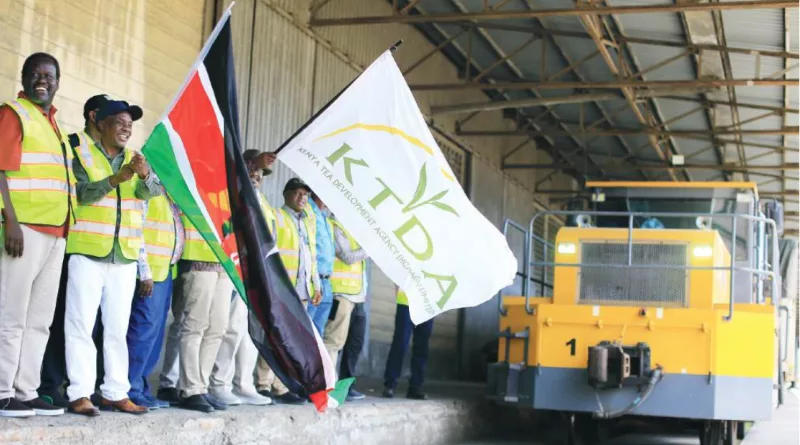
The government is also pursuing the completion of the Lodwar substation, which officials say will connect Turkana’s capital to the national grid and reduce reliance on generators.
Mandera and Wajir continue to depend heavily on generators, with plans for grid extensions and hybrid systems combining solar during the day and generators at night.
Turkana has 47,206 connections, while North Eastern’s Garissa, Mandera and Wajir have recorded a combined 58,432, owing to the distances involved.
Wandayi pointed to off-grid systems as an important part of the answer.
“Look at the issue of the off-grids, which we have done in Mageta Island, Turkana and Kwale,” he said.
Such places, he noted, could not easily have been connected through conventional grid extension because of distance and terrain.
In Garsen, engineers had to work across the Tana River, while in remote Soin-Sigowet in Kericho, the terrain was so difficult that even the helicopter carrying the CS to oversee the project struggled to find a landing point.
Central counties have recorded 190,090 connections, led by Kiambu with 43,958, Nyeri with 42,528 and Nyandarua with 42,447. Kirinyaga has 32,081 and Murang’a 29,076.
Nairobi, meanwhile, has recorded 111,893 connections, although its electrification challenge is largely different from that of remote rural counties.
The figures include Nairobi South with 43,802, Nairobi North with 31,468 and Nairobi West with 36,623.
Western recorded 102,131 connections, with Vihiga leading at 40,797, followed by Busia at 36,123, Kakamega at 14,468 and Bungoma at 10,743.
Wandayi said the biggest obstacle to achieving universal access was money.
“Budget is the only challenge, because we are competing for resources with other sectors,” he said.
He said the government would have preferred to connect the entire country immediately but had to proceed progressively.
A village scheme requiring one transformer can cost about Sh10 million, although the final bill varies depending on terrain, distance and other factors.
The government is therefore combining Treasury allocations with support from development partners, including the European Union, European Investment Bank, French Development Bank and African Development Bank.
Rerec prioritises schools, health facilities, colleges, boreholes and other common facilities, with the expectation that once a public institution is connected, surrounding communities can also benefit.
Kenya Power, being a commercial entity, cannot economically serve every remote settlement.
Rerec therefore acts as the state’s social investment arm in areas where commercial returns may not immediately justify the cost.
Wandayi said the government was also increasing generation and distribution capacity to cope with rising demand.
The bigger test now is whether electricity connections translate into productive economic activity.
Wandayi said the ministry was working with other government departments, including trade and health, so that connectivity would support businesses, health services and other economic activities.
On the threat of vandalism of electricity infrastructure, the CS said it amounts to economic sabotage and said the ministry was working with law enforcement agencies to apprehend offenders.
For the millions who have gained access, however, the immediate transformation is much simpler.
In Garsen, Kokane sees cheaper lighting and new possibilities. In Soin-Sigowet, Bett no longer has to worry about daily solar subscriptions.
In Ndori, Aloo can charge her phone and light her home without paying for a lamp every day.
And in remote villages where electricity was once considered impossible, the glow from a bulb is becoming a powerful symbol of belonging.
As Wandayi put it: “I am happy to see people’s lives being changed before my very eyes as we go to officially switch on the lines light up the homes.”
INSTANT ANALYSIS
The 1.6 million electricity connections represent more than an infrastructure achievement; they mark a shift in how development reaches communities long excluded by commercial calculations. For households in remote villages, electricity is already reducing the cost of lighting while creating opportunities for businesses, health facilities and other services to take root. The regional disparities, however, show that universal access remains unfinished, particularly in arid and remote areas where connections are expensive. The next test is turning access into productive economic activity while expanding generation and distribution capacity fast enough to meet rising demand.