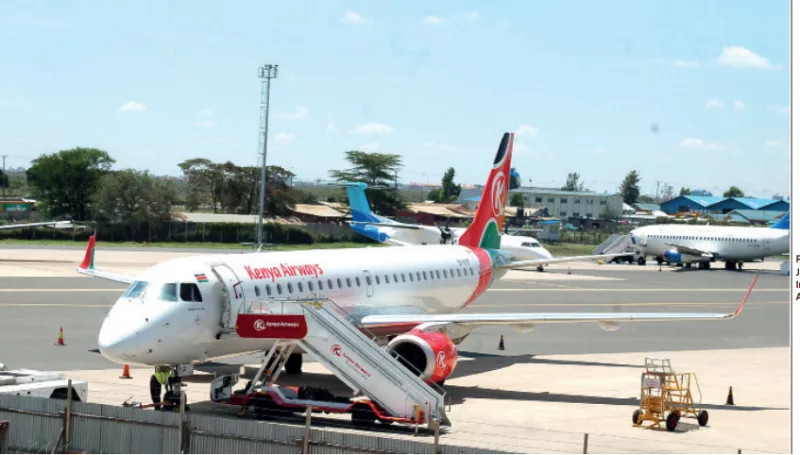
 Planes at the
Jomo Kenyatta
International
Airport /FILE
Planes at the
Jomo Kenyatta
International
Airport /FILE
EARTHMOVERS began moving this month for the long-overdue expansion of Jomo Kenyatta International Airport, a strategic pillar of Kenya's ambitions as East and Central Africa's leading aviation, business and diplomatic hub.
The JKIA Integrated Modernisation and Expansion project valued at Sh272 billion under a 20-year masterplan was finalized in February.
It is the first project to be financed under the National Infrastructure Fund Act, which President William Ruto signed into law on March 9.
The fund aims to mobilise non-budget million over the next decade to shift infrastructure financing from a debt-driven model to a sustainable, investment-led approach.
In November 2024, the government cancelled a proposed Sh214 billion expansion deal with India's Adani Group, which had sought to add a second runway and upgrade the passenger terminal in exchange for a 30-year lease
That deal was scrapped after legal challenges, sustained public pressu
JKIA is Kenya's primary international aviation gateway and the operational base of Kenya Airways. It handles the majority of Kenya's international passenger traffic and is a leading air cargo hub in sub-Saharan Africa.
"With 8.91 million passengers processed in 2023 – significantly exceeding its original design capacity of 7.5 million – JKIA is operating under severe infrastructure stress," Meshack Ochieng', general manager of Kenya Airports Authority, told the Star.
The government, through KAA, commissioned and finalized a 20-year Integrated Master Plan and Feasibility Study in February to guide a phased modernisation and expansion that will position JKIA as East Africa's premier aviation hub through 2045.
The airport contributes more than Sh1.2 trillion (3.3 per cent of GDP) annually and facilitates Sh1 trillion in tourism and trade.
"With passenger traffic projected to grow at 4.6 per cent annually to reach 22.31 million by 2045, and regional competitors aggressively expanding capacity (Ethiopia's new airport, Rwanda's Bugesera under construction), the urgency of Kenya's response cannot be overstated," Ochieng' said.
JKIA's cargo growth from 407,214 tonnes (2023) to a projected 860,408 tonnes by 2045 will position Kenya as a leading export gateway for fresh produce and high-value goods.
“The expansion includes a new 4,500 metre parallel runway to be ready by 2029 and an X shaped passenger terminal. Phase 1 will have a capacity of at least 10 million passengers a year."
The airport expansion will create thousands of construction jobs, long-term employment in airport operations, logistics, tourism, hospitality and trade.
The formal tender was issued in March, a pre-bid session conducted in April and construction is targeted to commence this month.
The expansion includes a new 4,500-meter parallel runway to be ready by 2029 and an X-shaped passenger terminal. Phase 1 will have a capacity of at least 10 million passengers a year while phase II will accommodate an additional 5 million.
Airfield declared capacity will increase from 14 to 63 aircraft movements per hour.
Cargo infrastructure will be upgraded to handle more than 860,000 tonnes annually, up from 407,214 tonnes last year.
The airport will have a rail link to Nairobi Central Station of the proposed Railway City.
Aviation supports 1.2 million jobs, across direct, indirect and induced categories. Thousands of direct construction and engineering jobs will be created in the ongoing projects.
Significant expansion in airport operations, ground handling, retail, logistics and hospitality sectors is expected.
"JKIA is Kenya's primary gateway for international tourist arrivals. Expanded capacity, improved passenger experience and additional airline routes will directly increase tourist arrivals, supporting Kenya's target to grow tourism revenues and positioning Nairobi as a regional hub for conferences, business events, and leisure travel," Ochieng' said.
Kenya's horticulture, floriculture and fresh produce export industries are heavily dependent on air freight capacity. JKIA handles a significant share of Africa's air cargo.
Doubling cargo handling capacity (to 860,408 tonnes a year) will unlock export growth, reduce logistics costs for exporters and attract manufacturing and logistics foreign direct investment near Special Economic Zones adjacent to the airport.
Ethiopia's new Addis Ababa International Airport and Rwanda's Bugesera Airport (under construction with Qatari investment) threaten to compete with JKIA for regional hub status.
Failure to expand would risk Kenya losing airline route allocations, conference business, logistics operations and the high-value economic activity that flows from hub connectivity.
"Kenya is investing decisively in 21st-century infrastructure – from the capital to the country – under President Ruto's Bottom-Up Economic Transformation Agenda and Kenya Vision 2030," Government Delivery Unit director Olinda Ozan said.
"These projects are not aspirational – they are at various active stages of delivery, with procurement, construction, and operations already underway.
"Aviation expansion is an economic imperative; JKIA is beyond capacity today, and the master plan is Kenya's strategic response to both domestic need and regional competition," Ozan said regional equity is a core principle in the expansion in civil aviation.
"Kabunde Airstrip is proof that infrastructure investment is reaching historically underserved areas, opening Lake Victoria's economy to Kenya and the world."
The airstrip in Homa Bay has been upgraded at a total cost of Sh390 million, including Sh101 million for the runway and apron works and Sh108 million spent on the terminal building.
It has created direct construction and operational jobs and provided indirect stimulus to transport, fishing, agribusiness and micro, small and medium enterprises trade in western Kenya.
The runway that was extended from 1.1km to 1.3km was reopened in April. The terminal building under construction will be completed in May next year.
Taxiways and the apron were rehabilitated, a new tarmac surface laid and the runway edge and piano markings completed to international aviation standards. The perimeter fencing was repaired at both runway ends and turning loops constructed.
Pending works include the upgrade of navigation and lighting equipment, and construction of the cargo freight apron and handling facilities.
Renegade Air operates three flights per week from Nairobi Wilson Airport to Homa Bay.
Kabunde Airstrip serves as the primary air gateway for Homa Bay county and the wider western and Nyanza regions.
Long characterized by operational dormancy and inadequate infrastructure, the facility has undergone a phased government-funded upgrade under KAA to address geographic isolation, stimulate economic development, support tourism and advance the government's devolution agenda.
The project forms part of a broader programme to upgrade airstrips across the Nyanza region, alongside similar works at Lichota Airstrip in Migori county.
The airstrip provides an all-weather alternative to road travel during the rainy season (when trips to Nairobi can take up to eight hours).
Its proximity to Ruma National Park – the only habitat of Kenya's roan antelope – and Lake Victoria's tourism and fisheries economy positions the facility as a catalyst for regional tourism development.
The upgrade also supports agricultural export logistics, reducing post-harvest losses by enabling faster market access for fresh produce.
In line with the government's devolution agenda, the project demonstrates equitable infrastructure investment beyond major urban centers.
Homa Bay is a significant producer of fish, agricultural produce and artisan goods. Air freight access enables fresh fish and produce to reach Nairobi – and potentially international markets via JKIA – within hours, reducing post-harvest losses and increasing fisher and farmer incomes. The airstrip also improves medical supply chain reliability, supporting the county's health infrastructure.
The airstrip serves not only Homa Bay but also neighbouring Kisii and Nyamira counties, which lack their own air facilities.
Plans for regional cross-border connectivity with Tanzania are cited by the government as a downstream strategic objective, positioning the facility as a Lake Victoria regional gateway.
Kabunde represents a concrete example of the national government's commitment to infrastructure equity. Communities in Western have historically been underserved by national infrastructure investment.