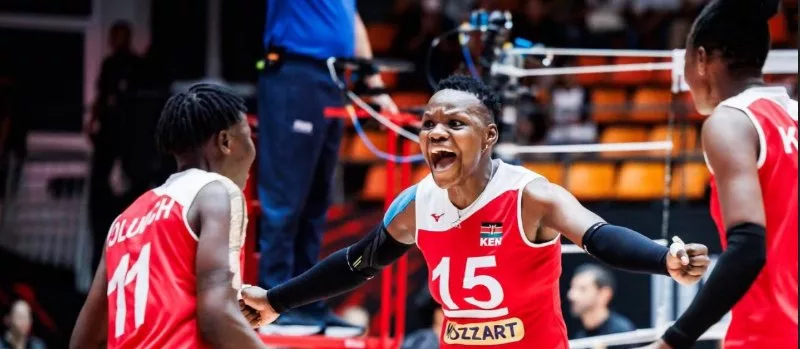
 Malkia Strikers captain Meldina Sande celebrates with teammates /HANDOUT
For Meldinah Sande, volleyball is much more than a game.
The sport has reshaped her dreams, given her wings beyond Kenya’s borders, earned her the chance to perform at the highest level, and given her the weight of national aspirations and hopes.
The Malkia Strikers captain, who wears Kenya Prisons team colours at club level, has spent the past two seasons in Kigali boosting the fortunes of Rwanda Police.
Her journey shows what sport can offer Kenyan youth when talent meets opportunity — a career, exposure, livelihood, a chance to inspire loads of talented youth, and to hoist national pride.
Sande is among a growing number of athletes who admit government support has begun to make a real difference in their lives.
The backing might be in fits and bursts, but she believes it's worth recognition.
“Not many countries (youths) get that kind of support in terms of sports,” Sande says, contending the government has made a genuine effort and should be appreciated even though athletes are desperate for more.
For the likes of Sande, the changing fortunes of Kenyan sport should not be measured only in medal hauls.
These are high-profile windows that allow talented youth to flourish and provide rewarding career paths and have evolve beyond a pastime.
Government scholarships, improved rewards, new sporting facilities and grassroots talent programmes are opening doors previously slammed shut for many young athletes.
Kenya Pipeline and Malkia Strikers middle blocker Marian Sokoiyo, another shining star, believes government support has made a striking difference to both senior and junior athletes.
For her, every opportunity comes with an additional responsibility — the onus of representing Kenya with pride.
Government programmes and scholarships send a powerful message to young athletes growing up in remote villages - it matters not where you are, your talent can change your life.
When they see elite athletes enjoying support, she says, they start to believe their own talent could take them places.
That sense of possibility is particularly important in a country packed with the can-do spirit.
Sokoiyo believes sport can lift youths out of obscurity, out of poverty and into a rich and fulfilling career if given a chance to hone their gifts.
“Kenya is a home of talent, and every person should be allowed to showcase what they are good at doing,” she says.
The progress is particularly perceptible in athletics, Kenya’s traditional sporting forte.
Athletics Kenya Youth Development Committee chairman Barbara Korir says government investment, in the past three years, has had a significant impact on infrastructure, welfare and talent evolution.
Stadiums and sporting facilities are coming up in counties across the country, while mammoth flagship projects such as Talanta Stadium provide proof that sporting infrastructure remains a cornerstone of sporting ambition.
For young athletes, however, perhaps the most significant change is the growing emphasis on identifying talent before it is lost.
Athletics Kenya is working with the Ministry of Education to identify budding contenders in school competitions and subsequently direct the talent to regional training hubs.
The programme is deliberately moving beyond the traditional athletics conveyor belts historically famous for producing world-class champions.
Emerging talent from backwaters like Amboseli, Kilifi and Turkana can now be channelled and nurtured to maturity.
For Korir, the idea is simple: a child should not have to come from a famous athletics powerhouse to earn a chance.
“We wanted to give every child from different parts of the country, who wants to run, an opportunity to nurture their talent,” he says.
The rapid growth of modern facilities is beginning to change the prospects of sports that have traditionally run with limited infrastructure.
For Kenya Rugby Union vice-chairman Moses Ndale, the construction of Talanta Stadium could be a game changer for Kenyan rugby, giving the sport a modern venue capable of hosting top-flight international matches.
For years, the union has relied on the tumbledown RFUEA ground, in contrast to top-ranked rugby kingdoms with purpose-built stadiums.
“This is massive for the sport. We can now say Talanta can host top-flight rugby events and it is a step in the right direction,” Ndale says.
Nyayo Stadium hosted the HSBC Sevens Challenger in February, with the union now exploring the possibility of staging the next at Talanta.
But Ndale says the benefits of the new facility will depend partly on whether sporting federations can afford to use it.
“We are hopeful the fees will be reasonable,” he says.
Beyond infrastructure, government support has also extended to national teams readying for international competitions.
Ndale says the Ministry of Sports now provides accommodation at the Kasarani hostels and picks the tab during preparations, while additional technical personnel can also receive support when and if necessary.
He credits the Sports Fund, launched six years ago, with helping cushion rugby from financial pressure, including during the Covid-19 period and subsequent events such as the Under-20 World Rugby and Barthes Cup.
The rewards awaiting athletes who make it to the top have also ballooned.
Korir says Olympic allowances have increased from $60 (Sh7,764) to $200 (Sh25,840) per day per athlete competing in international championships through the recommendations of the Salaries and Remuneration Commission.
Athletes who break world records receive Sh5 million, while gold, silver and bronze medallists land Sh3 million, Sh2 million and Sh1 million respectively.
World-record holders are gifted houses, with superstar Faith Kipyegon one of the high-profile recipients.
At national level, increased sponsorship has pushed up prize money at events such as the Kip Keino Classic, Sirikwa Classic World Cross Country Tour (a World Athletics Gold-level event), the Great Chepsaita Cross Country Run (a World Athletics Cross Country Tour Gold label event) and Nairobi City Marathon.
For athletes, such gestures do more than highlight their feats.
It makes sports an enriching source of income and gives young people an incentive to remain committed to the path.
National Olympic Committee of Kenya president Shadrack Maluki says the investment is bearing fruit across the sporting spectrum.
He attributes the improvement to increased investment and points to new facilities and county-based sports academies as part of a deliberate plan to expand the sporting base.
The academies are intended to identify talent early, nurture and prepare young athletes for high-pressure world-level contests.
Maluki believes the growing cooperation between the government, NOC-K and national federations has also strengthened the ecosystem.
The benefits are being felt beyond athletics and team sports.
For Kenya’s first female Olympian judoka Teddy Cherotich, sport has the potential to transform lives by creating jobs, shaping talent, improving health and providing a positive path.
Policymakers, she says, must view sport as an investment, a rewarding passion and not merely a stop-gap entertainment.
Government support, she says, should help athletes train and compete successfully, earn a living and secure their future long after the cameras stop rolling.
Yet the athletes say the progress should not create complacency.
The next phase, they argue, must be about ensuring the investment is deep and wide enough to support athletes at every stage.
For Sande, infrastructure remains a major concern.
Kenya has abundant talent but needs more, and better, training and competition venues.
She points to Rwanda, where she has spent the past two seasons as an example of how infrastructure can make it easier for athletes to prosper.
In Kenya some still train on grass yet the real competition takes place in ultra-modern venues they can only dream about.
She calls for more programmes to empower athletes and help them understand how talent can become a life-changing career.
The financial welfare of athletes outside established clubs is another concern.
Sande says players attached to institutions such as Kenya Prisons, Kenya Pipeline and KDF benefit from contracts, but athletes outside those structures struggle with just about everything.
Some get little or no income at all despite having the potential to make something out of their talents.
Without support, she fears some get frustrated and ditch sports altogether.
For Sokoiyo, access to good facilities, equipment, coaching and medical care is central to success.
Volleyball is an indoor sport, yet Kenya has limited suitable gyms, making preparations for international competitions a challenge.
The swimmers' experience is similar.
National team swimmer Cian Omondi complains about delayed funding that undermines months of preparation, with money for international championships often hitting bank accounts only a day before departure or even after a championship has started.
He also cites inconsistent access to swimming pools, including the Kasarani Aquatic Stadium, which he describes as the country’s only Olympic-standard pool.
Omondi says swimmers, many of whom are students, would benefit from the government waiving user fees at Kasarani.
Commonwealth 3,000m steeplechase champion Edmund Serem says delayed payments and medal rewards, limited stadiums and quality training venues need serious attention.
Korir acknowledges the gaps.
Despite the construction of facilities, equipment and training gear remain a challenge, while shortages of coaches and medical support are particularly worrying in far-flung areas.
“The medical needs are very high. Injuries are real, and when there is nobody who can treat them, it is a big problem,” he says.
Maluki also acknowledges delays in government funding, saying approved money can sometimes arrive when a championship is already underway.
Better planning can reduce, or even eliminate, the problem.
“It is not an emergency, so we should not be acting like it is an emergency,” he says.
For Ndale, the challenge is similarly about ensuring investment in infrastructure translates into meaningful access for sports federations and athletes.
A modern stadium can open doors to international events, but only if athletes and federations can afford to use the facilities and have the support needed to prepare.
For the athletes, the message is therefore not one of rejection but continuation.
They recognise the gains and want the momentum sustained.
Sokoiyo says financial support is particularly key because an athlete's mental harmony, physical and spiritual peace allow them to give their best.
The investment, they believe, ultimately benefits more than athletes.
It gives young people a reason to dream, a pathway to build careers and a chance to represent Kenya.
The emerging story across Kenya’s sporting landscape is therefore not simply about medals or stadiums. It is about building a system in which talent discovered in a remote village can receive coaching, facilities, medical care, competition and financial support — and eventually bloom.
For a nation long addicted to topping the world and celebrating its achievers, the next challenge may be ensuring the journey to those podiums is as smooth and high as the expectations.
Talent we have. It's on display in every major sporting venue.
Now, athletes demand that Kenya polish what is working and create a sporting colossus that reaps every nascent talent.