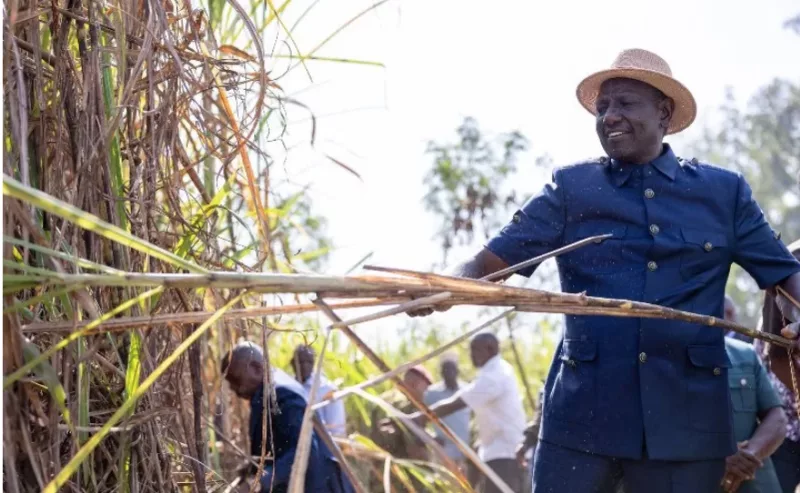
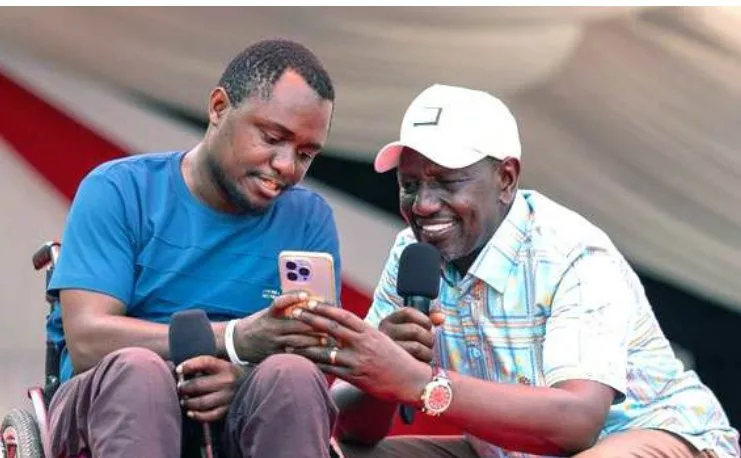
 President William Ruto engages a PWD during Nyota Fund distribution./PCS/HANDOUT
ABDALLA Ndalukari is a 41-year-old businessman and disability activist in Machakos County.
Tax exemption for persons with disabilities has
relieved him of the high cost of doing business and boosted his profits.
"We have received tax exemption as persons with disabilities. I run a tendering company in construction, and I don't pay taxes. This is a blessing," Ndalukari said.
The CEO of Hope Disability Network, who uses a wheelchair, said he is also a beneficiary of government waivers on the costs of assistive devices.
"Charitable organisations for PWDs enjoy waivers, courtesy of the national government. I benefit from the waivers, too. The waivers cover items like wheelchairs and crutches. We can afford the devices thanks to the waiver," Ndalukari said.
"The government, through the National Council for People with Disabilities, has helped us a lot."
Richard Chepkiyeny, a person with disability, is a fashion designer from Baringo County. He has successfully expanded his fashion enterprise through a grant from the National Youth Opportunities Towards Advancement(Nyota) programme.
“The grant has enabled me to improve my tailoring work, increase production and enhance business capacity,” he said.
The government has spent Sh7.947 billion to programmes implemented through the National Council for Persons with Disabilities in the last four years.
“Annual allocations increased from Sh1.904 billion to Sh2.117 billion over the period, while disbursement improved to 100 per cent of the approved allocation in the last two financial years,” NCPWD chief executive officer Michael Munene said.
“A substantial share of the resources administered through the council supports the cash transfer programme for persons with severe disabilities.
“The overall allocation should therefore be understood as financing for a broad government disability support portfolio, with a significant component transferred directly to cash transfer beneficiaries, alongside funding for the council's other disability programmes and services.”
Besides direct cash transfers, government support expanded across assistive devices, education, social protection, economic empowerment and employment.
Munene said since the Kenya Kwanza administration took power, 17,777 persons have received assistive devices and 12,105 learners awarded scholarships or bursaries.
In addition, 99 institutions received grants for infrastructure and equipment improvement to support inclusive education.
Cash transfer coverage increased from 38,118 beneficiaries to 63,960 beneficiaries by the last financial year.
Under economic empowerment, 365 PWD self-help groups received grants, 111 persons received tools of trade, 340 persons got start-up capital to establish or expand businesses, and 78 PWD enterprises benefited from LPO financing.
In addition, 2,104 PWDs were linked to affirmative action funding opportunities to establish or expand their businesses.
Munene said 6,566 job seekers with disabilities were registered on the NCPWD career portal and are linked to potential employers matched to their qualifications.
Under the Albinism Support Programme, 14,875 persons received sunscreen lotions, 1,926 got eye-care services, 3,780 received protective clothing, and 7,495 were facilitated to access cancer screening services.
Under the Autism and Related Developmental Disabilities Support Programme, 31,030 beneficiaries accessed therapy services, 11,172 received essential drugs, and 10,001 received incontinence products in the past four years.
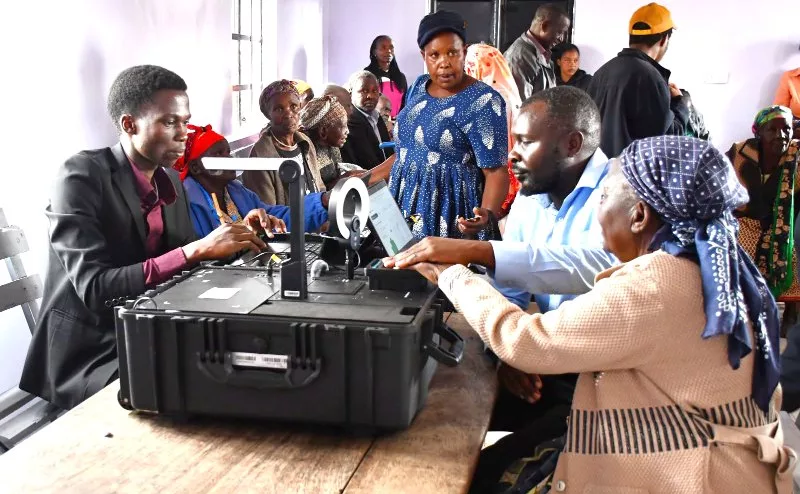
During the period, 330,970 persons with disabilities were newly registered with NCPWD.
“Registration serves as a gateway to disability-targeted government programmes and benefits by enabling eligible persons to be formally recognised and linked to appropriate support and opportunities,” the CEO said.
Social Protection Principal Secretary Joseph Motari told the Star a major milestone in support for PWDs under President William Ruto’s Bottom-Up Economic Transformation Agenda is strengthening of the legal framework through enactment of the Persons With Disabilities Act, 2025 and the National Disabilities Policy.
“Today, I approved the regulations that our drafters have come up with that will operationalise the Disabilities Act, which our President assented,” he said.
Motari said President Ruto is passionate about inclusion of PWDs and his administration has increased funding to programmes every year since 2022.
“The State Department for Social Protection is meant to touch the lives of the vulnerable people of this nation, including persons with disabilities,” the PS said.
The department monitors the welfare of PWDs through
reports from national government administration officers and social development
officers.
Motari said the government has reliable data on PWDs in its regularly updated national registry.
Disability will be one of the key themes of fourth National Social Protection Conference to be held in Nairobi on September 29, where the head of state will be the chief guest.
“A government that can dare to ignore people with disabilities is a government that says it can go with a section of the people and leave the others behind,” Motari said.
But some PDWs champions say the government’s efforts are inadequate. Nominated Senator Chrystal Asige faulted the government for failure to implement the Persons With Disabilities Act, 2025 she spearheaded, more than a year after Ruto assented it.
She said the law has important provisions, like tax exemption for parents and caregivers.
“They've been waiting for this support for decades. Finally, it was accepted in the PWD Act. But now, because there's no implementation, they're still looking around and asking me, senator, what's happening?” Asige said.
She said the government had taken too long to develop the regulations to facilitate implementation of the disabilities law and national policy.
In Garissa, PWDs chairman Aden Bille said their situation had deteriorated over the past year.
PWDs who previously benefited from various forms of assistance, including food, had increasingly been left without adequate support.
Bille said the reduction in assistance had left many persons with disabilities struggling to meet their basic needs, with some facing extreme poverty and vulnerability.
“Previously, we used to receive our fair share of assistance, including foodstuffs, which we would bring together and distribute among ourselves.
“But in the last one year, things have changed. We have not been getting these supplies, and this has left many of our members vulnerable,” he said.
He appealed to the government and development partners to restore and strengthenen such interventions, saying food assistance remained critical for PWDs who have limited sources of income and often depend on relatives and well wishers.
Bille also called for a stronger focus on economic empowerment, arguing that providing occasional relief assistance alone would not adequately address the challenges facing persons with disabilities.
He said many PWDs in Garissa are poor and require financial assistance to establish small businesses, acquire vocational skills and engage in sustainable income-generating activities.
The chairman further acknowledged the support provided through the National Fund for the Disabled of Kenya, particularly in the provision of assistive equipment, but said the programme needed to be expanded.
He added that PWDs receive various forms of equipment through the fund, which are distributed every two years, but said the equipment remains insufficient compared with the growing needs of the population.
Disability inclusion expert Sam Odawa welcomed enactment of the disabilities law and adoption of a new policy as important steps but called for more funding to support inclusion programmes.
“One thing that then I would point out is, do we have an increase in the budget?Because when you come up an Act and a policy, you must also match it with funding for disability inclusion,” he said.
Odawa also proposed appointment of more PWDs to senior government positions.
In July, Ruto promoted and redesignated
Government Spokesperson Isaac Mwaura as the Head of the Office of Diversity,
Inclusion and Disability Rights in the Office of the President. Mwaura lives
with albinism.
"It should not start and stop with Mwaura. There was a time we had a PS with disability.So, we would want to seeing more such PSs,” he said.
Odawa also called for a special census for PWDs and continued infrastructural changes that cater to persons with special needs.
“I like what is happening in the Nairobi CBD, where
the county government is laying cabros on the walkways so that persons with
disabilities can walk independently.
“Can we do that across the city? And, of course, we should extend that to other cities like Mombasa, Kisumu, Nakuru and Eldoret. Other counties should do the same.”