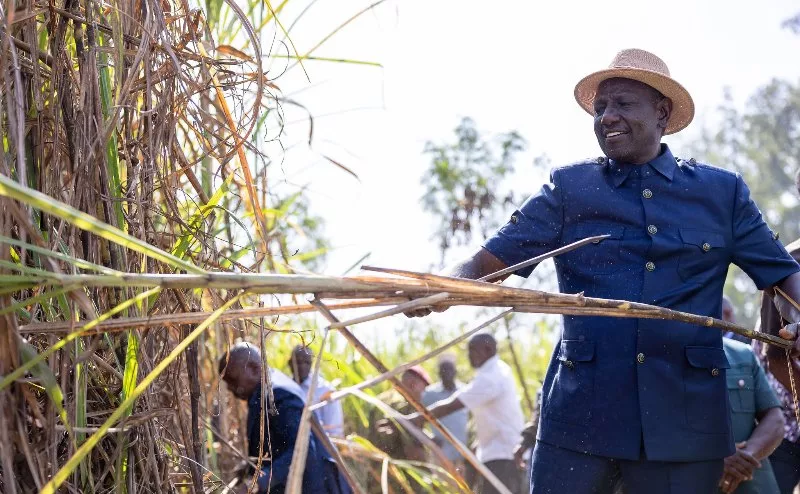
 President William Ruto cuts sugarcane at a farm in Mumias, Kakamega County, during the launch of a Sh150 million bonus for farmers supplying cane to Mumias Sugar Factory on January 20, 2025 /PCS
In Apokor village, Teso South, Violet Otwane is counting the months on her fingers.
By March next year, if all goes to plan, the three acres of sugar cane she has nursed through poor rains will be ready for harvest. After seven years of growing cane, Otwane is hoping the crop will finally deliver the reward she has waited for.
She will take it to Mumias Sugar.
For years, the economics of farming have been unforgiving. During her first five years in cane farming, Otwane says, poor harvests were compounded by the cost of fertiliser, with a 50kg bag selling for as much as Sh7,000.
“During the first five years, harvests were poor because I could not afford enough fertiliser. A 50kg bag had risen to Sh7,000,” she says.
“But everything changed when the government cut the cost of fertiliser to Sh2,500.”
The price of cane has also improved, rising from Sh3,600 per tonne last year to about Sh4,000 currently, she says.
“Sugar cane is our main cash crop here and many residents rely on it,” Otwane says.
About 900km away, a much bigger bet on Kenya’s sugar industry is taking shape.
At the Bura Irrigation Scheme in Tana River, Tana River Sugar Company is developing a 50,000-acre sugar cane estate expected to produce 1.2 million tonnes of cane annually. The project targets 120,000 tonnes of sugar a year, about 13 million litres of ethanol and 25 megawatts of electricity from bagasse.
Using canals operated by the National Irrigation Authority, the company is expected to create 3,000 direct jobs and provide a ready market for more than 10,000 smallholder cane growers around Bura.
Together, the two stories capture the scale of Kenya’s sugar gamble: smallholder farmers waiting for better returns while large investments seek to rebuild an industry that has struggled for years.
Since 2022, the Kenya Kwanza administration has pursued a broad reform programme under the Bottom-up Economic Transformation Agenda, focusing on lowering production costs, improving farmer returns, strengthening governance, expanding market access, promoting value addition and reviving state-owned mills.
Government Delivery Unit data shows national sugar production has nearly doubled to 815,454 tonnes from 472,773 tonnes in 2022, while cane acreage has expanded by 19.4 per cent to 715,693 acres.
The legal architecture has also changed.
The Sugar Act, 2024, which became operational in November 2024, re-established the Kenya Sugar Board and created a statutory framework to regulate and develop the industry. It also established a Sugar Arbitration Tribunal and provided for a sugar research and training institution.
The government has also turned to private capital to revive troubled state-owned factories.
On May 10, 2025, four mills — Nzoia, Chemelil, Sony and Muhoroni — were leased to private millers for 30 years. The leases aim to inject capital, rehabilitate factories, improve operations, restore cane intake, and increase capacity utilisation.
But for farmers, the real measure of reform lies beyond legislation, new management and factory activity.
It lies in the money left in their pockets.
“These reforms have produced some positive changes. In some areas, farmers have experienced better factory operations and more timely payment for cane,” says Michael Arum, a cane farmer in Kisumu and coordinator of the Sugar Campaign for Change lobby.
“However, it would be premature to conclude the reforms have already translated into higher and sustainable net incomes for the majority of sugar cane farmers.”
For Arum, the test is brutally simple: can a farmer grow cane, have it harvested when mature, deliver it, receive payment promptly and still make a reasonable return after meeting production costs?
Harvesting remains a major problem.
In parts of Nyando, farmers report having mature cane standing in their fields for extended periods because of difficulties securing harvesting and transport services.
“For a farmer, cane price on paper means little if mature cane cannot be harvested and delivered on time,” Arum says.
There is another pressure.
In April, the Kenya Sugar Board announced a reduction in the minimum cane price from Sh5,750 to about Sh5,500 per tonne.
“At a time when farmers are facing high production costs, farmers naturally ask whether the current price adequately reflects the cost and risk of producing cane,” Arum says.
“The question should therefore not only be what the miller pays per tonne, but what the farmer actually earns after production, harvesting and transport costs.”
Kenya Association of Sugar and Allied Products chairperson Atiang’ Atyang’ echoes the concern.
A cane farmer in Chemelil for more than 20 years and a former member of the Kenya Sugar Board’s Interim Sugarcane Pricing Committee, Atyang’ says the industry remains at a crossroads.
He blames cheap imports and alleged smuggling through the Uganda and Somalia borders for depressing local prices.
“Today, a farmer gets Sh5,500 gross per tonne, which comes down to about Sh3,700 after several deductions,” he says.
“The farmer down here has nothing to celebrate. We spend about Sh6,300 to produce a tonne of cane and then sell at Sh5,500 gross.”
Atyang’ also questions the leasing of state-owned mills, alleging some factories were handed to businessmen he says have failed to revive them. He says about 4,000 workers laid off from state mills are owed Sh2.7 billion in arrears.
The government, meanwhile, says it is determined to confront the structural problems that have held back the sector — from low productivity and ageing factories to high production costs, delayed farmer payments, institutional fragmentation, illicit sugar trade and climate-related vulnerabilities.
In July, Agriculture and Livestock Development CS Mutahi Kagwe announced an end to sugar imports. Farmers, however, say imports remain a concern.
“If local factories cannot sell their sugar, they cannot maintain a healthy cash flow; if their cash flow is affected, the farmer is ultimately affected through cane purchasing, harvesting and payment,” Arum says.
Western Development Initiative Association chairman Joseph Barasa says cheap imported sugar is flooding the market and making it difficult for local factories to compete.
He points to Kenya’s exit from the Comesa sugar safeguard mechanism in 2024 and increased exposure to cheaper regional sugar, particularly from Egypt and Uganda.
The government acknowledges the challenges.
Addressing the International Sugar Organisation summit in Kwale, Kagwe said the sector had for years suffered persistent structural problems and promised a “comprehensive, coordinated and far-reaching programme of reform”.
There are signs of recovery. Government figures show sugar production has risen sharply from the depressed 2023 level; official sector data recorded 832,000 tonnes in 2024.
But production figures alone will not settle the argument.
Back in Apokor, Otwane is waiting for March.
Her three acres will offer a much simpler verdict on the reforms than any government report: whether the cane standing in her field can translate into a better livelihood.
For Kenya’s sugar revival to be meaningful, the sweetness must eventually reach the farmer.