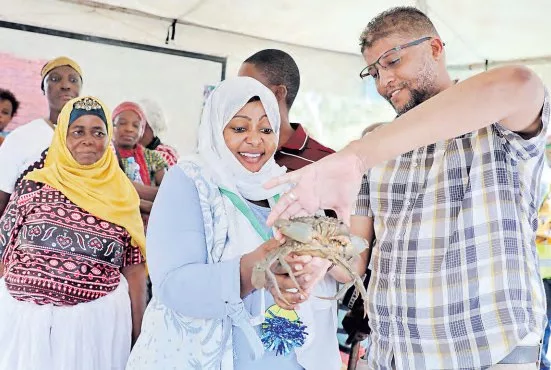
 Mombasa blue economy executive Kibibi Abdalla and Lamu’s fisheries executive Faiz Fankupi with a catch from the Jomvu Women in Fisheries group /CHARLES MGHENYI
In Jomvu, on the outskirts of Mombasa City, a group of women is quietly demonstrating what the blue economy can look like when local communities are placed at the centre.
For years, they survived by frying and selling fish bought from fishermen. Known as Mama Karanga, they made barely enough to support their families.
Today, the women are proud fish farmers, conservationists and ecotourism entrepreneurs.
The Jomvu Women in Fisheries Community-Based Organisation has ventured into mud crab fattening, a business once dominated by men.
Using cages installed in the mangrove-lined Mission Creek, they nurture mud crabs to market weight, selling them for between Sh900 and Sh1,400 per kilo.
The project has given dozens of women a reliable source of income while opening opportunities for youth employment.
Their transformation was made possible through funding from the Kenya Marine Fisheries and Socio-Economic Development (KEMFSED) project, which awarded the group Sh2.7 million to establish crab cages and construct a mangrove boardwalk for ecotourism.
The women have also planted more than 700,000 mangrove seedlings, restoring degraded coastal ecosystems while protecting breeding grounds for fish and crabs.
For generations, the waters along Kenya’s coastline have been more than a source of food. They have been a workplace, a livelihood and a way of life for thousands of coastal families.
However, in Mombasa, fishermen say that livelihood has been steadily disappearing.
At Old Harbour, Tudor Creek and Miritini, the routine of fishermen setting out in small boats at night and returning at dawn with their catch has changed dramatically. Many now return with little or nothing.
They blame the decline on changes to the marine environment.
Salim Amin, chairman of the Old Harbour, Tudor and Miritini Creek Beach Management Unit, says the impact was particularly severe for fishermen who depended on small traditional canoes.
“That time, we did not have these big boats. We used to have the old canoes. Therefore, we couldn’t venture deep into the waters.”
The old canoes are increasingly being replaced by motorised boats capable of travelling farther offshore.
Amin says this has opened opportunities for fishermen to access waters that were previously beyond their reach.
“We are now going to offshore fishing,” he says.
He is grateful for support from the State Department for Blue Economy and Fisheries, as well as programmes involving the World Bank.
As pressure on wild fish stocks grows, the government and development partners have increasingly promoted aquaculture.
Fish cage farming is one of the initiatives being explored. Amin says shrimp farming has attracted more than 20 groups.
Upon coming to power in 2022, President William Ruto’s administration put the blue economy at the centre of its Bottom-up Economic Transformation Agenda (Beta).
The President established the State Department of Blue Economy and Fisheries under the Ministry of Mining, Blue Economy and Maritime Affairs.
Sustained state interventions over the past four years are transforming a sector that was previously poorly regulated, underutilised and underfunded.
Fish production grew by 8.1 per cent from 173,741 tonnes in 2022 to 189,151 as of August this year, according to data from the Government Delivery Unit.
At least 1,263 common interest groups in the blue economy have been trained in entrepreneurship, financial literacy and resource management to boost incomes and savings.
The training has benefitted 212,033 individuals, who have received grants amounting to Sh3.3 billion.
The training and grants have enhanced inclusion especially in job creation for youths, women and most vulnerable persons in the target communities.
This year alone, 875 youths have been trained in deep-sea fishing.
The capacity building has equipped fisherfolk with modern skills to sustainably exploit offshore resources.
This has created safer livelihoods and reduced pressure on nearshore stocks while curbing illegal fishing, boosting national revenue and positioning Kenya as a competitive player in the regional blue economy.
The government has this year distributed 271 fishing boats to support the sector.
The Kenya Kwanza administration’s first intervention was to streamline the governance of the sector.
“We developed eight regulations, including a fish levy order, which were passed by both Houses of Parliament and gazetted,” Blue Economy PS Betsy Njagi told the Star.
Seven fisheries management and development regulations and the Fish Levy Trust Fund Order were gazetted on July 30, 2024.
“We have also come up with the National Blue Economy Strategy 2025-30 that was approved. We have done the Kenya Fisheries Policy, the Kenya Aquaculture Policy, and many other instruments that assist in governance of the sector. These instruments enable the players in the sector to thrive,” the PS said.
In addition to governance reforms, the Kenya Kwanza administration has invested in blue economy infrastructure development.
The national chairman of Beach Management Units (BMUs), Tom Guda, said Ruto is “the best President ever for fisheries” and that he “scores a straight A” in infrastructure development. BMUs are community-based institutions established to co-manage fisheries with government agencies.
“It's just four years but if you look at the massive investment the President has put into this sector, we just say he's the best. We have seen the development and modernisation of fish landing sites across the country,” Guda said.
PS Njagi said Lamu, Mombasa, Kilifi, Kwale and Tana River counties had only four modern fish landing sites constructed by the previous administration and some of them had stalled.
The Ruto administration completed them and built more.
“This government embarked on other new infrastructure projects at a cost of Sh1.5 billion that include fish landing sites that are modern with cold storage facilities, ice-making machines and processing areas that will be completed by end of September,” she said.
The Sh2.7 billion Shimoni Fish Port, built in partnership with the Kenya Ports Authority and the State Department for Transport, is complete. The facility includes a Sh1.4 billion national mariculture centre of excellence.
With the support from the Kenya Marine and Fisheries Research Institute, the centre of excellence is developing fish farming in the marine waters, including marine tilapia, shrimp and rabbit fish.
In the Lake Victoria region, the national government has completed three modern fish landing sites in Migori, Siaya and Busia in partnership with the county governments.
Nine more landing sites worth Sh1.5 billion are under construction in Kisumu, Siaya, Homa Bay and Busia counties.
Sylvester Kaywa, a fisherman in Lake Victoria and the BMUs chairman of Busia county, said the Kenya Kwanza government has built modern fish landing sites like Mulukhoba in Port Victoria.
“The entire fish value chain can be handled there, from production to preservation, processing and packaging.”
Erection of floodlights has enabled fishers to work for longer hours.
“The national government has also provided patrol boats to improve security for fisherfolk and for rescue operations,” Kaywa said.
PS Njagi said the government is investing more than Sh2 billion in search and rescue centres in the Lake Victoria counties for the safety of fisherfolk.
At the Coast, the government has given each of the five counties a rescue boat at a cost of Sh350 million. Similar boats are being procured for the Lake Victoria counties.
BMUs and the fisher communities at the Coast have received government grants worth Sh3.3 billion, benefitting more than 83,000 people in 1,265 groups.
“These communities identified various value chains within the blue economy, including ecotourism, fisheries and aquaculture. We have given them boats. You saw the other day the President handing over boats,” Njagi said.
The government has distributed 270 boats to the coastal fishing communities and 109 fish cages that include feeds and fingerlings.
“In Kwale, the KEMFSED project has supported many fisherfolk by giving them boats and other working equipment. This has helped them to engage in deep-sea fishing to get a bigger catch,” said Swaleh Kondo, the 25-year-old chairman of Bodo BMU in Msambweni.
“There have been major improvements in government support for BMUs but how each unit benefits depends on the effectiveness of its leadership,” he said.
The government is strengthening the 450 BMUs across the country through capacity building.
Njagi said at least 60 per cent of them have been assisted to form and register marketing cooperatives to improve resource management, market access and enhance the bargaining power of fishing communities.
Ruto has positioned Kenya on the map of the global blue economy. In June, Kenya hosted the first Our Ocean conference in Africa that brought together 7,250 delegates from 51 nations.
But some challenges remain in the sector. Kenya loses about Sh45 billion annually to illegal, unreported and unregulated (IUU) fishing across the Indian Ocean and inland waters.
The loss is not only financial but also biological. Sustained overfishing has driven a sharp decline in landings at some inland lakes. Annual landings at Lake Naivasha declined from 3,400 tonnes in 2019 to 1,050 tonnes in 2025, according to the Kenya Marine and Fisheries Research Institute.
At the Coast, Kenya continues to record cases of foreign, largely Chinese, vessels fishing in its waters. China is ranked as the worst-performing country on the IUU Fishing Risk Index, compiled by the Global Initiative Against Transnational Organised Crime.
Its distant-water fleet has been identified as a major driver of IUU trends off the Coast, including fishing without licences, fishing during closed seasons and the use of prohibited gear.
The Kenya Coast Guard Service (KCGS) enforces laws on fisheries and marine resources protection.
“Through day-to-day regular patrols, boarding and inspection of vessels, checking licences to ascertain compliance, detecting illegal fishing gear and taking appropriate enforcement action including prosecution of offenders,” KCGS director general Bruno Shioso said.
Some 667 arrests were recorded against 302 illegal-fishing incidents at the Coast and inland waters last year.
Kaywa, the Busia BMUs chairman, said the quantity of fish has gone down drastically in Lake Victoria. He attributed this to climate change, high population pressure leading to overfishing, use of illegal fishing gear and increased pollution.