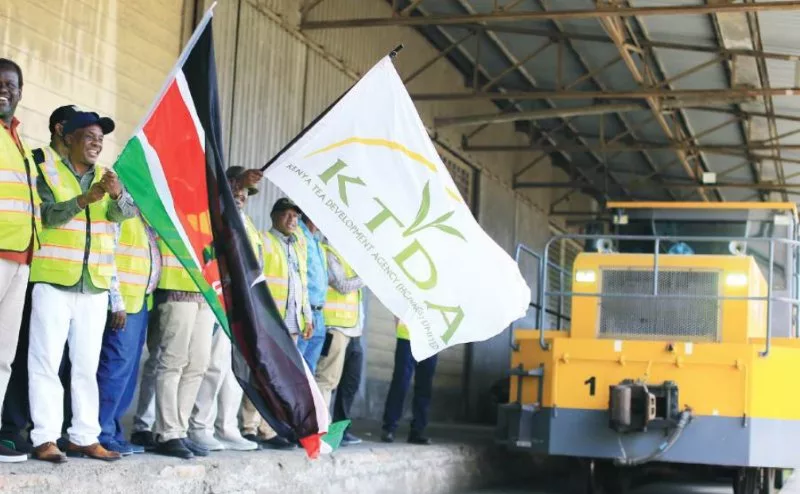
 Agriculture PS Kipronoh Ronoh flags off the first consignment of 99,000 tonnes of fertiliser at the Port of Mombasa /JOHN CHESOLI
Kennedy Kemboi is eagerly waiting for the
government's subsidised fertiliser to use on his seven-acre tea farm in Baraton,
Nandi County.
The cost of running the farm is Kemboi's biggest headache. "The price of green leaf per kilo has now risen to Sh26. I am able to pay the farm workers and remain with some money to meet my needs," he said.
The factory that buys Kemboi's tea pays him in two instalments, monthly and the famous "bonus" at the end of the year.
"Our factory is still servicing a Sh1.2 billion loan, which means farmers bear the burden. If the declared bonus is Sh20 per kilo, we end up receiving Sh12," he said. "We would be grateful if the government cleared the loan for us."
In Nyamache, Kisii county, tea farmer Teresa Moraa says the pay is still low. “We rely mostly on our tea for income but we are unhappy. We are unable to pay school fees for our children. Our factory directors should raise the pay to at least Sh50 per kilo,” she said.
Under the Bottom-up Economic Transformation Agendaof the Kenya Kwanza administration, tea is one of the priority value chains identified for major reforms in the agricultural pillar in order to increase export earnings and returns to tea farmers.
The industry has over the years faced a myriad of challenges that have hampered its full potential.
They include low farm gate tea prices, green leaf malpractices including tea hawking and falsification of weights, poor governance among institutions in the tea value chain, declining quality of Kenyan tea, high cost of production and fluctuating international tea prices.
Other industry problems are leading to the decline of tea prices at the Mombasa auction,resulting in unsustainable earnings of tea growers, low levels of value addition and product diversification, socioeconomic and geopolitical challenges in the major tea markets.
There are also low visibility of Kenyan tea in international markets, over reliance on a few export destinations for Kenyan tea and lack of transparency in price recovery mechanisms at the auction.
President William Ruto’s administration is implementing a raft of strategic interventions to revamp the industry.
The Tea Board of Kenya, the industry regulator, says the reforms are built around five outcomes, namely, higher production, better and more predictable farmer incomes, wider access to local, regional and international markets, creation of more jobs and stronger value addition and a larger contribution of the tea industry to the national economy.
To achieve these outcomes, the main interventions have included distribution of subsidised fertiliser to smallholder farmers, implementation of measures to lower the cost of packaging and value-added exports, support for factory modernisation, stronger market diversification,reforms intended to increase direct salesand policy measures to improve the share of value retained by growers.
Agriculture Cabinet Secretary Mutahi Kagwe told the Seventh African Tea Convention in Nairobi last week that the government is committed to building a tea industry that is productive, transparent, climate-resilient, commercially competitive and rewarding to the farmer.
“Tea is the backbone of many rural economies in Kenya. Hundreds of thousands of households depend directly or indirectly on tea for their livelihoods.
“When tea prices are stable and remunerative, families can educate their children, access healthcare, invest in their farms and contribute to local economic development,” he said.
Kagwe said the second priority is market diversification.
“Kenya’s tea has long enjoyed strong demand in
traditional markets, including Pakistan, Egypt, the United Kingdom, Sudan,
Afghanistan, the United Arab Emirates and other destinations.
“We value these markets and will continue to strengthen our commercial relationships with them. However, we must also expand our presence in new and high-growth markets,” he said.
The other priorities are value addition and product innovation, quality, safety and traceability, climate resilience and strengthening the tea auction and trade ecosystem.
TBK chief executive Willy Mutai told the Star the government’s interventions over the past four years have borne fruit.
The latest TBK figures show that green leaf payment to tea farmers has increased from an average of Sh35 per kilo in 2021 to Sh64 and Sh56 in 2024 and 2025 respectively.
The government target is to raise pay to at least Sh100 per kilo by next year through better quality, lower production costs, more value addition, more competitive selling channels and stronger farmer representation.
“Total tea production increased from 537 million kilogrammes in 2021 to 598 and 550 million in 2024 and 2025, respectively,” Mutai said.
“Export earnings increased from Sh136.5 billion in 2021 to Sh181.6 and Sh+186.9 billion in 2024 and 2025/ respectively.”
The government has spent Sh850 million on modernisation of machinery and equipment in 17 smallholder tea factories.
The top 10 counties that received the grants are Kericho (Sh248.6 million), Nyeri (Sh131.6 million), Bomet (Sh104.8 million), Nandi (Sh79.1 million), Murang’a (Sh62.1 million), Nakuru (Sh50.2 million), Trans Nzoia (Sh44.6 million), Nyamira (Sh36.6 million), Tharaka Nithi (Sh35 million) and Kirinyaga (Sh28.7 million).
Other interventions are the removal of value-added tax on all teas purchased from the factories for value addition through the Finance Act, 2023, to enhance the competitiveness of Kenyan tea in the local and international market and boost local consumption and the zero-rating of packaging materials for tea value addition through the Finance Act, 2025.
The government gave a Sh100 million grant to Ketepa, a reputable tea packer, to establish of a common user facility for value addition.
Since 2022, more than 650,000 smallholder tea farmers have received about 290,000 tonnes of subsidised fertiliser.
Other reforms are the gazettement of the Tea (Registration and Licensing) Regulations, 2026 and Tea (Levy) Regulations, 2026 to strengthen the regulatory framework governing the tea industry and promote its long-term sustainability.
The government has supported market development and promotion activities in traditional, emerging and new markets including Pakistan, Egypt, UAE, UK, Russia, Iran, North America, China, Hong Kong, Jordan, Saudi Arabia, Germany and Malaysia.
Under the Strategic Tea Quality Improvement programme, President Ruto’s government has enhanced the capacity of tea factories to improve their teas for competitiveness and better prices.
The government continues to sensitise farmers on quality guidelines for the tea industry.
Charles Otwori, chairman of Nyamira Professionals Association and a farmer, said tea growers are unhappy about their low earnings. “They blame the Kenya Tea Development Agency and the government,” he said.
KTDA manages 54 tea companies in which smallholder farmers are shareholders. The companies buy green leaf from the farmers. “Poor governance of the companies is the elephant in the room,” Otwori said.
Although the company directors are elected by farmers, “they are politicians. They are not really farmers, to be honest,” Otwori said.
Industry players acknowledge the many challenges facing the industry and agree with CS Kagwe and the regualator that the future of tea lies in value addition, good governance and enhanced marketing.
“How much tea can we grow, and how quickly can we sell it? That question built the industry we have. It will not build the one we need,” Robert Koech, the chairman of East Africa Tea Trade Association, told the seventh African Tea Convention in Nairobi last week.
“The value in tea is migrating into brands, into blends, into extracts and ready-to-drink formats, into traceability systems and sustainability credentials, and into the data that surrounds the trade as much as the trade itself.
“Too little of that value currently settles in
Africa, and almost none of it reaches the smallholder who picks the leaf.”
Thushara De Silva, who chaired the organising
committee of the tea convention, said Africa produces some of the finest teas
in the world, yet much of it is exported in bulk and subsequently blended, packaged,
branded and marketed in other parts of the world by other parties.
“We must ask ourselves a fundamental question: Why should Africa continue to capture only a small portion of the value created from African tea? We have the raw material. We have the farmers.
“We have the expertise. We have an increasingly sophisticated manufacturing and packaging sector. We have talented entrepreneurs and brands emerging across the continent,” De Silva said.
“What we need is a stronger ecosystem that allows African tea to travel further up the value chain.
“Value addition does not simply mean putting tea into a packet. It means developing brands, creating differentiated products, investing in packaging, understanding consumers, building distribution networks and ultimately owning the relationship with the consumer. This is where the future of African tea lies,” he added.
Kenya is one of the world’s leading tea-producing countries, particularly of CTC tea. Its tea is highly valued internationally for its colour, brightness and strength and plays an important role in blends consumed around the world.
But the farmers who grow the tea are yet to fully benefit from its value. If fully implemented, the reforms of the Kenya Kwanza administration will put more money in the pockets of the hundreds of thousands of smallholder farmers like Kemboi and Moraa.