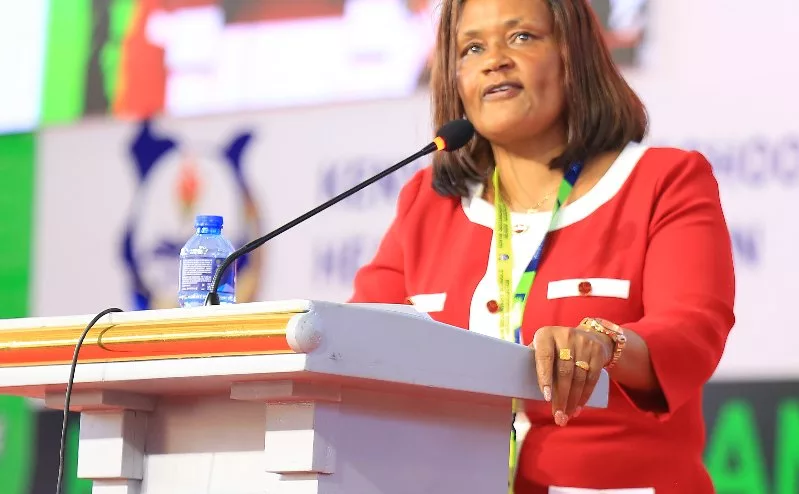
 TSC CEO Evaleen Mitei at Sheikh Zayed Hall in Mombasa on May 26, 2026 /FILE
“This recruitment exercise presents an opportunity to bridge the staffing gap and uplift education standards in North Eastern and other marginalised regions," Hussein said.
"Every child, regardless of where they live, deserves access to quality education delivered by an adequate number of qualified teachers.
He expressed confidence that equitable deployment of teachers would significantly improve learning outcomes, reduce the workload on existing staff and restore confidence in the public education system across the region.
IMAGINE a school with just the head teacher and one or two teachers. How do they cover the syllabus?
Schools aren’t just about imparting knowledge, so how do the two or three teachers meet not only the educational but also, and importantly, the other needs of their learners?
“Garissa is the most understaffed county. We have schools, especially in remote areas, with just the head teacher and one or two teachers," Lesayo Megiri, county director of the Teachers Service Commission, told the Star.
The crisis of teacher shortage is particularly severe in all arid and semi-arid counties. School boards of management (BoM) hire temporary teachers to cover the shortfall.
Beginning on July 1, this month, Northeastern counties are implementing a government affirmative action policy to directly recruit teachers from local colleges to meet staffing needs. It applies only to North East.
A survey by civil society organisation Usawa Agenda shows that one in 10 teachers in public schools are employed by BoMs, with arid and semi-arid counties having the highest numbers.
Mandera leads with 30 per cent BoM teachers, followed by Wajir (24.6 per cent), Garissa (22.5 per cent), West Pokot (22 per cent) and Narok (17.5 per cent). BoMs cannot hire on permanent and pensionable terms, only TSC can do that in public schools.
In comparison, Embu county has the highest number of permanent teachers at 94 per cent while West Pokot has the lowest at 62 per cent, the Usawa Agenda reports.
The Kenya Kwanza administration has made remarkable progress in addressing this crisis.
“The government has recruited a total of 100,000 teachers since September 2022, comprising 56,000 under permanent and pensionable terms and 44,000 serving as interns,” TSC chief executive officer Evaleen Mitei told the Star.
“The government committed to recruit 116,000 teachers before 2027. With 100,000 teachers already recruited, 16,000 additional teachers remain for the commitment to be fully achieved. No budget has yet been provided for the recruitment of the remaining 16,000 teachers.”
President William Ruto made an election promise to recruit at least 100,000 teachers in three years. Another 100,000 already-posted teachers are being retrained in subjects needing coverage in the competency-based curriculum and reskilled and promoted for their professional growth.
In the current 2026-27 financial year, the government has provided funding to convert 20,000 serving interns to positions on permanent and pensionable terms.
“This unprecedented investment has reduced teacher shortages in public schools, supported the transition to competency-based education, provided the initial teaching workforce required for Junior School, and expanded education access to the Kenyan child,” Mitei said.
A total of 10,000 permanent teachers were hired in the 2022-23 financial year. In 2023-24, the government recruited 46,000 interns. Another 20,000 interns were recruited in 2024-25. In that year, the 46,000 interns hired in the 2023-24 FY were converted to permanent terms.
In the last financial year, 2025-26, the government recruited 24,000 interns.
The massive recruitment has created employment opportunities for trained and registered teachers, and improved the teaching of science, mathematics, technical subjects, languages and other learning areas, Mitei said.
Junior school started nationally in January 2023 without an existing dedicated teaching workforce.
“Consequently, a significant proportion of the teachers recruited since 2022 were deployed to Junior Schools to facilitate implementation of the new curriculum,” the TSC boss said.
The 100,000 teachers were distributed across all 47 counties. “The commission allocated and deployed teachers based on identified staffing needs at county, subcounty, school and learning-area levels,” Mitei said.
The main considerations included the number of Junior School classes and the existing staffing gaps.
“Counties, subcounties and schools with the greatest staffing shortages received priority. This ensured that recruitment was directed to areas of greatest need rather than distributing an equal number of vacancies to every county,” the CEO said.
The top 10 counties that received the highest cumulative allocations were Kitui (4,276), Kakamega (4,270), Bungoma (3,806), Nakuru (3,656), Machakos (3,356), Makueni (3,252), Homa Bay (3,225), Kisii (3,206), Meru (3,204) and Narok (2,992).
These counties received comparatively higher allocations because of large numbers of public schools, high numbers of junior school classes, large learner populations, and significant existing staffing gaps.
“Higher allocation does not necessarily mean that a county is fully staffed. Several counties that received large numbers of teachers continue to record substantial shortages because their underlying demand is also high,” Mitei said.
The counties with some of the highest teacher shortages include Kakamega, Nakuru, Narok, Bungoma, Kilifi, Kitui, Makueni, and Machakos.
Kwale county has received 1,967 teachers in the past three years. County director of education Evelyn Kinaka said the shortage persists.
"We are still understaffed. We don't have enough teachers, especially in junior and senior schools. Primary schools are better off because now we do not have classes seven and eight," she said.
A total of 767 teachers have been sent to Garissa. "We appreciate the government's efforts to address the teacher shortage in our schools. But we are yet to get the adequate number of teachers we need,” TSC county director Megiri said.
As at July, the deficit in junior and senior schools stands at 84,573 teachers, according to the TSC.
The highest shortage is in junior schools, which have 106,230 teachers and need 60,313 more. Senior Schools have 131, 956 teachers and require 24,260 more.
In junior schools, the learning areas with some of the highest shortages include creative arts and sports, agriculture, pre-technical studies and mathematics.
Senior schools require teachers for specialised pathways and subjects that have historically had a limited supply of trained teachers, and teachers in new subject areas.
The learning areas with significant shortages include German, Mandarin, marine and fisheries, music and dance, metal work, aviation, woodwork, power mechanics, media technology, theatre and film, building construction and home science.
Other areas without enough teachers are electricity, sports and recreation, general science, computer studies and ICT, physical education and community service learning.
Evans Sibwoga, is a senior school parent in Kiambu county, which has received 2,759 teachers.
“In some learning areas, one teacher is responsible for several streams and multiple pathways, making it difficult to give learners the individual attention, continuous assessment, and personalised support that CBC requires,” he said.
Abdirizack Hussein, executive secretary of Garissa Kenya National Union of Teachers, praised the recruitment of more teachers to address the persistent staffing shortage in public schools across the country.
He said the Northeastern region has the worst teacher shortages due to insecurity and harsh working conditions that make it difficult to attract and retain teachers.
"It is not uncommon to find schools where the head teacher is the only teacher available. Such situations have greatly compromised the delivery of quality education and placed an unbearable burden on the few teachers serving in these schools," Hussein said.
He urged the TSC to ensure that once the recruitment process is complete, Northeastern receives its fair share of the newly recruited teachers.
"We appeal to the Teachers Service Commission to do justice to Northeastern during the posting exercise,” he said.
“The region should be prioritised because it bears one of the country's most severe teacher shortages. A substantial number of the newly recruited teachers should be deployed to remote and underserved schools where the need is greatest," he said.