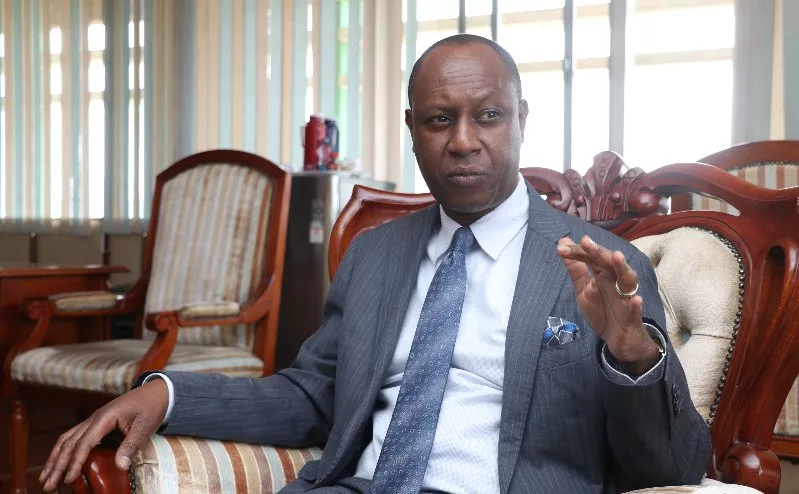
 State Department for Livestock Development Principal Secretary Jonathan Mueke speaking during an interview with the Star at his office, Kilimo House, on July 30, 2026 /LEAH MUKANGAI
Murang'a dairy farmer Ndung'u Muiruri sells 40 litres of milk daily.
Muiruri previously sold the milk to Murang'a County Creameries, an umbrella of 36 dairy co-operatives in the county.
"MCC paid us about Sh40 per litre, which is too low. Now, I sell a litre for Sh60 for wholesale and Sh70 for retail."
Muiruri, who is a dairy farm for more than 20 years, said the dairy sector has been struggling for years, as farmers grapple with the high cost of living that eats into their earnings.
He urged he government to focus on ensuring farmers access cheaper feed to boost production and improve their livelihoods.
"I buy feed from Murang'a town and sometimes they are adulterated and expensive. I am forced to supplement them with so many other things so the production doesn't reduce and that pushes the costs up."
In April during a tour of Murang’a, President William Ruto gave Kangari dairy co-operative a 10,000-litre milk cooler.
"We are grateful for the cooler but it's pretty much every farmer for themselves. We would be happier if the government subsidised animal feeds, so we can get quality ones at cheaper prices and get more returns," Teresiah Gichia, a dairy farmer from Githumu in Kandara subcounty, said
Gichia said she sells nine litres of milk daily at Sh46 per litre to Kangari dairy co-operative.
But Gichia said the produce should be fetching more than Sh50 per litre to enable farmers to recoup production costs and earn a profit.
Some years back Kenyan dairy farmers had no option but to pour fresh milk into ditches because there was no market.
Supermarkets ran promotions where buying two litres earned shoppers another free, yet thousands of litres still went to waste.
Today, the picture is dramatically different.
Kenya has overtaken Egypt to become Africa's largest milk producer, dairy exports have almost tripled, meat exports are surging and the government is betting that livestock can become one of the country's biggest economic success stories.
Officials say the turnaround is the result of reforms under the Bottom-Up Economic Transformation Agenda, which have shifted attention from simply increasing production to improving quality, expanding markets and investing in value addition.
"We have two presidential priority value chains—dairy and meat," Livestock Development Principal Secretary Jonathan Mueke told the Star.
"Our commitment was to double dairy production, increase exports and ensure most of our milk goes through formal processing. Previously only about 30 per cent of milk entered the formal market. Our target is 70 per cent."
The numbers tell the story of an industry on the rebound.
Kenya's annual milk production has increased from 4.6 billion litres in 2022 to 5.5 billion litres today, cementing the country's position as Africa's leading milk producer.
At the same time, dairy exports have risen sharply from Sh5 billion to Sh14.2 billion, while the value of formally marketed milk has continued to grow as more farmers sell through organised processors.
For many dairy farmers, the biggest difference has been the availability of reliable markets.
Years ago, milk frequently spoiled before reaching processors because farmers lacked cooling facilities.
Today, the government says 230 bulk milk coolers installed across the country are preserving thousands of litres every day, preventing losses estimated at about Sh8.5 billion annually.
President Ruto has directed the State Department for Livestock Development to procure another 650 coolers to further strengthen the dairy value chain.
The government has also introduced a quality-based payment system borrowed from India that rewards farmers for producing cleaner, higher-quality milk.
Instead of being paid solely on volume, farmers whose milk has lower bacterial levels and higher protein and butterfat content receive premium prices.
"Some farmers are now earning as much as Sh70 per litre because they produce better quality milk," Mueke said.
The policy is encouraging farmers to invest more in animal nutrition, hygiene and disease control while giving processors a more consistent supply of quality milk.
Vaccination has become another pillar of the government's strategy.
Millions of cattle have already been vaccinated against major livestock diseases, reducing disease outbreaks, improving productivity and giving international buyers greater confidence in Kenyan livestock products.
But while milk has become one of the biggest success stories, the government believes the greatest economic opportunity lies in meat exports.
Kenya currently exports about 85 per cent of its meat to Saudi Arabia and the United Arab Emirates, markets that continue to demand larger volumes of premium-quality meat.
Mueke said Kenya had previously struggled to compete because buyers questioned the country's disease control systems and could not verify the health history of exported animals.
That is beginning to change.
"Since we started the vaccination programme, our meat exports have grown by 87 per cent because buyers now have greater confidence in our products," he said.
The next phase of the reforms could prove even more significant.
The government has begun rolling out the Animal Identification and Traceability System, which will electronically identify livestock from birth to slaughter.
The system records where an animal was born, where it has moved, what medication it has received and where it is eventually slaughtered.
According to Mueke, the programme will not only strengthen disease surveillance but also help curb livestock theft and unlock lucrative export markets that have remained out of reach.
"We have trade agreements with Europe, China and the United States, but we have not been able to export meat there because we lacked a traceability system," he said.
He pointed to Botswana and Namibia, whose well-established traceability systems have enabled them to sell premium meat into Europe at significantly higher prices.
"We buy goats from our farmers for about Sh6,000 and sell them to Dubai for around Sh10,000. Botswana sells similar goats into Europe for about Sh24,000 because buyers trust their traceability system."
The government is also working with county governments to establish County Livestock Investment Companies across 21 arid and semi-arid counties to improve livestock production, strengthen marketing and increase pastoralists' earnings.
Officials estimate the initiative will benefit at least 15,000 livestock keepers in every participating county.
Infrastructure is another key pillar of the transformation.
The long-awaited Sh1 billion Isiolo regional abattoir has completed testing after nearly two decades of construction and is expected to become a major export hub for northern Kenya.
The facility can process 300 cattle, 100 camels and 1,000 sheep and goats during an eight-hour shift, allowing Kenya to export processed meat instead of relying largely on live animal exports.
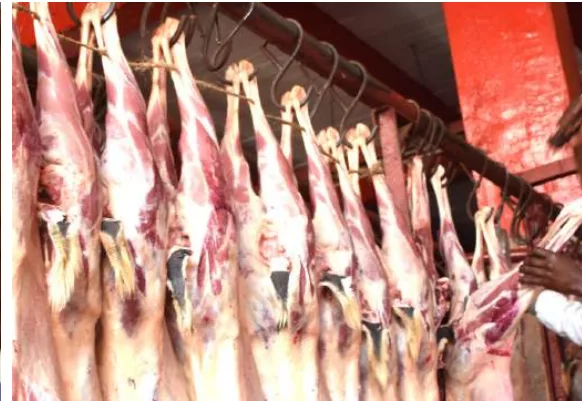
Isiolo Governor Abdi Guyo said the project marks a turning point for pastoral communities that have long supplied livestock without benefiting from value addition.
"For generations, our region has produced some of the finest livestock in Africa, yet our people remained poor because we exported live animals while others processed them and earned the profits," he said.
"If we are to lift our people out of poverty, we must begin creating value here at home."
Isiolo Butchers Association chairman Naftaly Kiambi described the project as one of the region's most significant investments, saying it would improve market access, expand value addition and stimulate economic activity throughout the livestock sector.
Beyond meat and milk, the government is also trying to revive Kenya's leather industry.
Although the country produces millions of hides and skins every year, less than half are processed locally, limiting the sector's contribution to the economy.
Industry PS Juma Mukhwana said years of cheap imported leather products weakened local manufacturing, leaving many hides and skins with little commercial value.
To reverse the trend, the government has completed the Kenanie leather industrial park in Machakos county and is inviting local and international investors to establish factories there.
The park offers ready-made industrial facilities and is expected to support leather processing, footwear manufacturing and export-oriented production.
The government is also promoting a Buy Kenya, Build Kenya’ policy under which locally manufactured leather products would be supplied to institutions including the police, Kenya Wildlife Service, Kenya Forest Service and the military.
A proposal is also under consideration to procure one million pairs of locally made school shoes annually.
Additional support is expected through 10 new common-user leather manufacturing centres that will replicate the successful Kariokor leather hub in Nairobi using funding from the Italian government.
Together with the Ewaso Ng'iro Tannery and Leather Factory in Narok county, officials believe the projects could transform Kenya from a raw hide exporter into a regional leather manufacturing hub.
The government now wants livestock to contribute 20 per cent of Kenya's GDP by 2028, nearly doubling annual meat production while creating thousands of jobs across dairy, meat, leather and export value chains.
For farmers who once watched milk spoil because there were no buyers, the transformation offers something many had almost given up on—confidence that livestock can once again become a reliable pathway to prosperity.