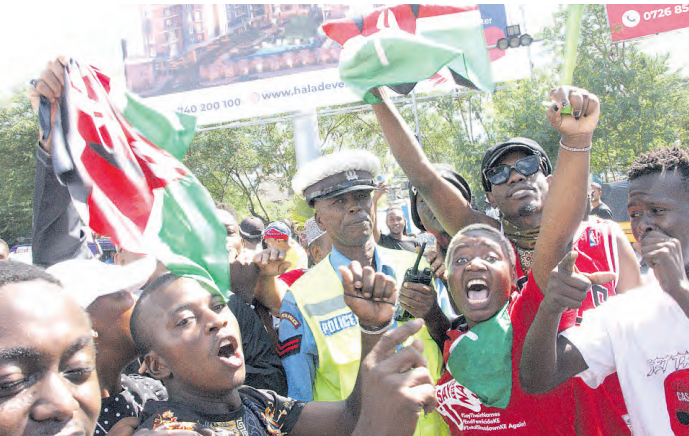
When a young man approached me to share his manifesto two weeks ago, one thing dawned on me: the generation that conquered the streets is now confronting an even more formidable adversary—the ballot box itself.
On social media, many Gen Z have expressed willingness to run for office. However, a maze of institutional, financial and educational barriers threatens to lock them out before they can even submit nomination papers.
The legal framework is surprisingly permissive. Any registered voter over 18 is constitutionally eligible for Parliament, Senate, governor or the county assembly.
Only the presidency, with its minimum age of 35, remains beyond reach for a generation whose oldest members turn just 30 in 2027.
But the constitution is merely the starting point. The true gatekeeping occurs at the Independent Electoral and Boundaries Commission, where aspirants must assemble clearance certificates from seven state agencies.
The Ethics and Anti-Corruption Commission scrutinises integrity. The National Cohesion and Integration Commission polices ethnic utterances. The Directorate of Criminal Investigations checks for criminal records. The Kenya Revenue Authority demands tax compliance. The Higher Education Loans Board requires a clean repayment record. A Credit Reference Bureau searches for defaults, and the Registrar of Political Parties verifies membership status.
For a generation born into the gig economy, saddled with student loans and navigating mobile lending, these hurdles are particularly punishing. Helb clearance is a nightmare for young graduates struggling to find stable employment. CRB blacklisting for defaults on Fuliza or M-Shwari can disqualify a candidate unless they clear the debt.
The academic prerequisite is equally exclusionary. For parliamentary, senatorial and gubernatorial seats, a university degree is mandatory, as reinforced by the High Court in June 2022.
This requirement narrows the field to a privileged minority, considering how many young people drop out before completion of their courses for various reasons.
Data points from individual institutions and parliamentary briefs reveal that tens of thousands of young Kenyans prematurely leave higher education annually, with more than 800,000 students currently flagged at risk due to systemic funding shortfalls.
Parliamentary education committee briefs indicate that approximately 843,623 university students risk dropping out due to a multi-billion shilling higher education funding deficit.
The MCA seat remains the only viable entry point for young aspirants without degrees.
The financial barriers are more deceptive. The IEBC offers a 50 per cent discount on nomination fees for youth, reducing a residential bid to Sh100,000 and an MCA seat to Sh2,500.
This appears generous until one understands the two-layer structure. Before reaching the electoral commission, aspirants must navigate party primaries, where internal nomination fees are separate, non-refundable and drastically higher.
A party's MP nomination fee can range from Sh100,000 to more than Sh250,000. Even for those who secure a ticket, the newly gazetted campaign spending limits for 2027 present another hurdle, with any spending more than Sh1 million now requiring an independently audited report.
The political consequences are already visible. The July Ol Kalou by-election saw 26-year-old Timothy Kamau ride a donkey to the IEBC offices to submit his papers.
His campaign symbolised youthful defiance, but a popular online presence is not a substitute for the party machinery and financial networks that the old guard commands.
The independent route offers escape from expensive party nominations but requires collecting voter signatures and navigating the Registrar of Political Parties, which insists on a three-month resignation period for former party members. This is demanding for young aspirants with limited resources.
Gen Z is willing. But the transition from protester to candidate is blocked by a bureaucracy that tests financial stability, educational attainment and institutional connections.
The path is littered with documents they cannot obtain, fees they cannot afford and qualifications they do not possess. The system does not need to ban youth from politics. It simply needs to make it impossible for them to enter.