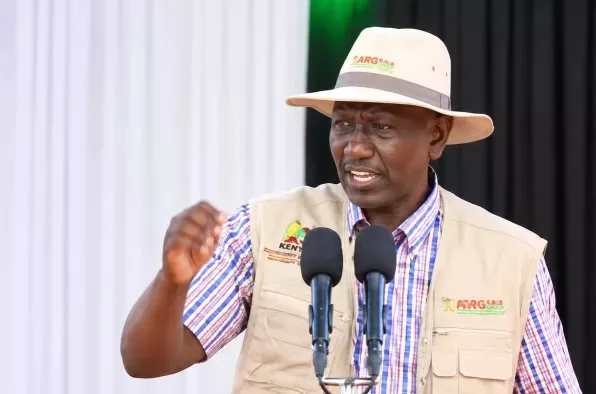
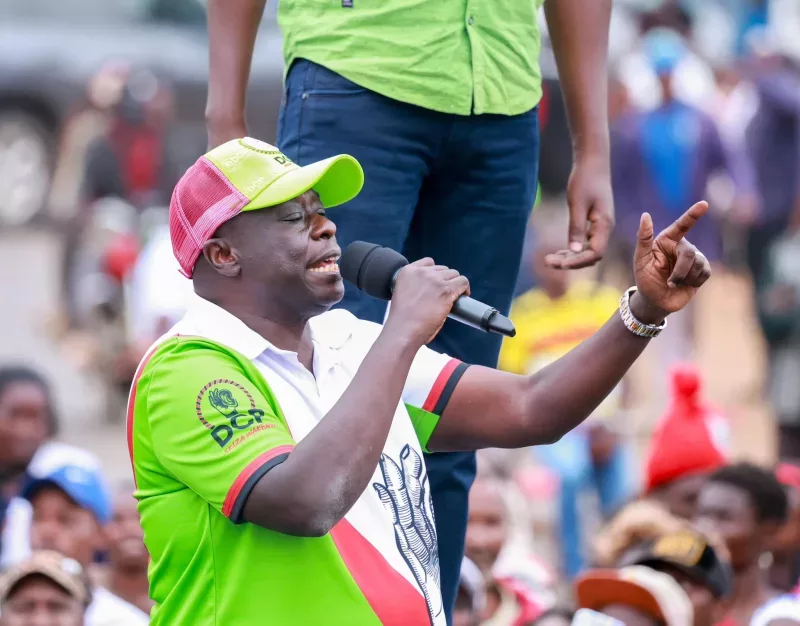
 DCP leader Rigathi Gachagua addressing a roadside rally.
 These days, it seems like every senior politician in this country has a political party of their own.
The evolution of multiparty democracy in Kenya has come with intrigues and betrayals that have given rise to the belief that one must have their own party, lest they be left hanging at the most critical moment by the typical tribal lords who control major political movements.
As far as history goes, former Prime Minister Raila Odinga was briefly left without a party in 2007, as that year’s election drew close.
Raila’s ODM-K co-principal and now Wiper leader Kalonzo Musyoka, using lawyer Dan Maanzo, fled with the registration instruments of their party, leaving Raila scampering for a new political vehicle.
As fate have would it, someone had cleverly registered a different strain of ODM and was only too happy to hand it over to Raila for an alleged small “convenience fee”.
In recent times, impeached Deputy President and now DCP leader Rigathi Gachagua has bemoaned the failure of the Mt Kenya region to enter into a coalition with President William Ruto in 2022, using a regional party of its own.
In his view, the “betrayal” unleashed on the Mountain by the President, represented by Gachagua’s impeachment, was only possible because Central was subservient to the real owners of the UDA led by Ruto.
Last week, however, Gachagua alluded to something that has become a fixture of Kenyan politics in recent times: the spectacle of tiny briefcase parties coming to the negotiating table and producing “co-principals” whose ultimate contribution is mostly negligible.
These co-principals are usually regional kingpins, or those of much lower status, who nevertheless saunter around bearing party registration with which they negotiate for prime positions in any upcoming administration.
Within the current Kenya Kwanza administration, several senior officials secured their positions through this method. The stellar cast includes Prime Cabinet Secretary Musalia Mudavadi, National Assembly Speaker Moses Wetang’ula, Senate Speaker Amason Kingi and Labour CS Alfred Mutua, among others.
All of them negotiated with Ruto and UDA ahead of the 2022 election. The jury is still out on whether they individually or collectively had a big enough impact on Ruto’s electoral performance to justify the positions they secured.
Earlier, there was another question of the validity of the co-principal tag in March 2018, when then Senator Wetang’ula was removed as Senate Minority leader and replaced by Senator James Orengo of Siaya. Wetang’ula had been appointed to the position as a co-principal of the Nasa coalition.
However, in the Senate, his Ford Kenya Party had only one elected senator - himself. It led Narok Senator Ledama ole Kina, as the removal of Wetang’ula was in progress, to quip that “a man who owns only one cow cannot be chairman of the cattle dip committee!”
Last week, while addressing the lamentations of small party owners in the Mt Kenya region - chiefly former Speaker Justin Muturi of DP and former Meru Governor Peter Munya of PNU - Gachagua retorted that he wouldn’t have time for people who came to the table “with two followers” or those whose political stamina didn’t match his own work rate. One may disagree with Gachagua on many things, but on this, I submit that he was spot on.
For several electoral cycles, the concept of multiparty democracy has been negated by the proliferation of small, hopeless political parties created solely for the negotiation of positions or for trading.
There are two broad groups here. The first encompasses those who form parties for speculation, which may include the folks who recently reserved the Linda Mwananchi name although they have no known connection to the movement bearing that name.
This first lot deploys the hyena philosophy in politics, believing that as long as politicians will need parties, having them on standby for sale is a fantastic business.
When the post-referendum Orange wave picked up in 2005, and the victorious NO side, symbolised by a ripe orange, realised they needed to transition into a political party.
Far-sighted speculators had long conceived of the party idea and registered different variants of orange. To their credit, such a speculator saved Raila’s day by availing a second Orange party.
The second group involves actors who form and register political parties used to extract concessions from bigger formations.
Because politics is notoriously tribal by mobilisation, leaders of large parties have come to accept that to access and influence certain regions, they must do so via parties owned by sons and daughters of those regions. They purport to have the said regions in their pockets.
Like Gachagua, I detest this latter group immensely, even if Gachagua’s own DCP is just a giant version of these briefcase operations, by its very nature it is a Kikuyu-heavy movement.
The problem with this group is that it perpetuates the sustenance of tiny political organisations that lack in ideology and principle.
Besides, it creates “co-principals” whose real value remains low, but who are known to waltz around political circles carrying massive egos and huge self-entitlement.
If you ask me, the number of registered political parties shouldn’t exceed five, largely because there is no major ideological divide, even if we had 500 of them.
It speaks to mistrust within our political sector, and the rise of the “trader mentality” driving nearly everyone entering politics to have their own party and become a co-principal somewhere.
The net effect is that with every passing day, more and more individuals are trying to register political parties, many of them quite removed from the aspirations of the larger population.
In 2007, Raila ran a powerful campaign with just one party, ODM, albeit with a cast of powerful politicians from different regions assembled in the Pentagon, the party’s almighty top organ.
Before that, in 2002, despite being a coalition party, Narc ran nominations and presented candidates in its name at the election, from which it emerged victorious. In both cases, that unity was the fuel that powered the party in each case.
President Ruto is currently engaged in negotiations with the rather weak post-Raila ODM. It is still too early to identify his co-principals from the ODM side, because the party has become a cacophony of sounds, where everyone seems to be talking at the same time.
But the usual signs of trouble are already there for the discerning eye. They include the unending demands for zoning of certain areas in their electoral agreement, as well as the “bare minimum” angling for the DP (co-principal) position. Like all else, this too shall end in tears.
The overarching philosophy of every party should be that if it can’t produce a presidential candidate of its own and have candidates in a majority of electoral seats countrywide, it has no business in the field.
This is why Gachagua makes a lot of sense when he asserts that he will not be engaging in talks with small contraptions bearing the names of political parties because, ultimately, they access juicy positions by false pretences.
Many so-called co-principals whose only claim to fame is registering party wouldn’t be able to stand their own ground without the larger parties they extort for positions.
Let the people decide and kill hopeless political movements to save us from this madness!