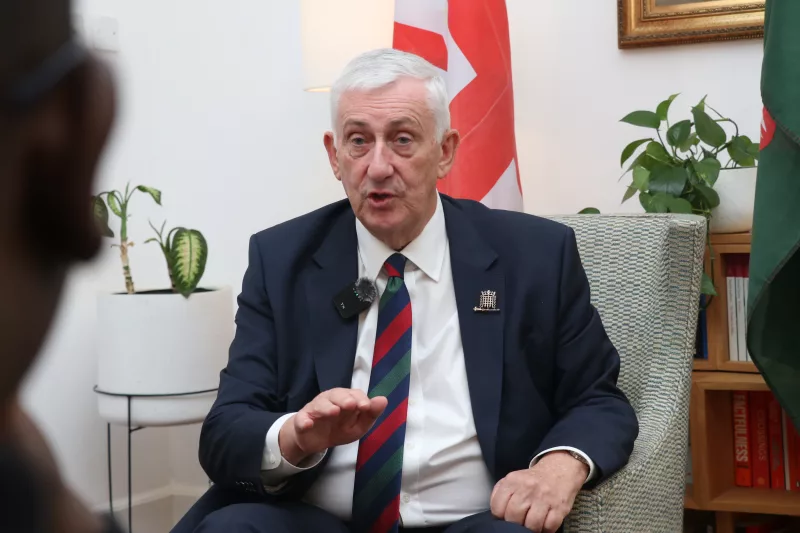
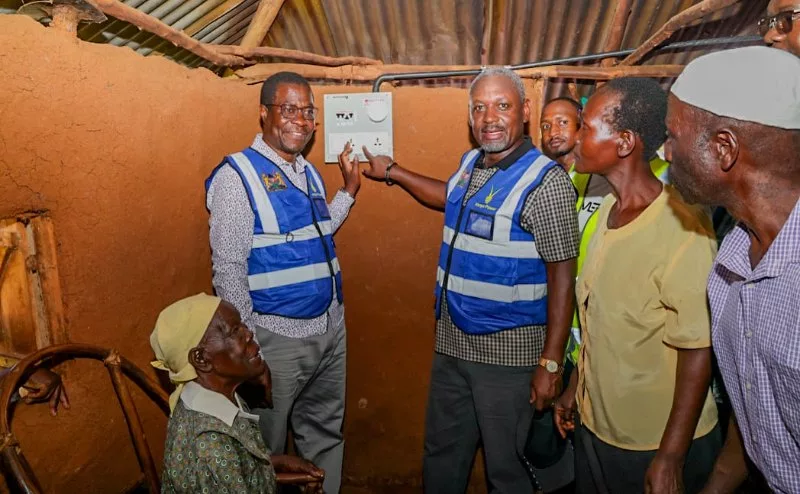
 Energy CS Opiyo Wandayi during the commissioning of five prioritised Last Mile Connectivity Projects (LMCP) to underserved communities in Rarieda constituency
For years, darkness came early to Imbaya village.
When the sun went down, residents turned to kerosene lamps and solar lights to illuminate their homes.
Walking outside at night was risky, while seeking medical attention after dark could become a race against time.
Now, electricity lines have reached homes that for years remained off the national grid, bringing light into compounds, powering televisions and radios and opening the door to new businesses.
The transformation is part of a Sh2.2 billion electricity expansion programme in Siaya county targeting about 25,000 households in the current financial year.
For Jairus Oyamo, a resident of Imbaya, the biggest change is the sense of security that has come with the lights.
He recalled a time when darkness made even basic activities hazardous.
“Schoolchildren walking in the morning were being mugged, and cattle were being stolen as early as 8pm,” he said.
“You could not pursue thieves because the village was completely dark.”
Now, he said, residents can move around with greater confidence and access medical care at night.
“We have lights everywhere and we are grateful. We can visit hospital anytime because boda bodas can easily move at night,” Oyamo said.
For Maureen Achieng, electricity has transformed life inside the home.
Residents previously depended on solar power, which she said was expensive to maintain, or kerosene lamps that sometimes caused fires.
“Previously, paraffin lamps used to cause fires in our houses, and the solar system was expensive to maintain. But with electricity, we can buy tokens for as little as Sh50, and they can last us a whole week,” she said.
Colleta Odhiambo said residents had waited for years to experience what many urban households take for granted.
“At first we were in darkness, but now we are shining since CS Wandayi became a minister. Here in Imbaya we are seeing lights everywhere,” she said.
Alice Adhiambo said criminals who once operated under the cover of darkness were now more exposed.
“The village was dark before but for now we can see everything and those criminals are now fearful because they’ll be seen if they try their bad behaviour,” she said.
She said theft cases had reduced, although wiring costs remained a challenge for some households.
For Pamela Nyamita, moving from kerosene lamps to electricity feels like starting a new life.
“The day we received this miracle I thanked God because we have been in darkness,” she said.
“Before this we were using lamps but it was risky because they could burn things in the house. This new life is much better.”
The benefits are also beginning to stretch beyond homes.
In Gangu, Ruth Otieno plans to use her new connection to start a posho mill, providing a service residents previously travelled elsewhere to access.
“I am truly thankful to the government. My plan now is to buy a posho mill to set up here so I can serve the community and help people access milling services nearby,” she said.
In Luanda Komolo, Richard Owino said electricity connections had previously been too expensive for many families.
“My neighbour was asked for Sh10,000 just for the drop line, and another neighbour further up was quoted Sh70,000 for a single pole,” he said.
Under the current programme, residents only need to wire their homes before connection.
“We received the main electricity connection for free. We only paid to wire our own homes,” Owino said.
Nicholas Gwadi, who coordinates Last Mile initiatives in Siaya, said rural electricity coverage had increased significantly, with several schemes at different stages across the county.
Rarieda has 17 schemes, Bondo 19, Alego 23 and Ugenya 18, he said. The county is targeting electricity coverage of about 60 per cent by the end of the year.
Gwadi, however, urged residents to be patient, saying not every household could be connected at once.
He also raised concern over vandalism, including theft of electricity meters and cutting of conductor wires.
Energy and Petroleum CS Opiyo Wandayi said Sh2.2 billion had been allocated this financial year to connect about 25,000 households across Siaya.
For residents of Imbaya, Gangu, Luanda Komolo and Ruma, however, the figures only tell part of the story.
The real measure is what happens after sunset: a child studying under an electric bulb, a patient travelling to hospital without fear of a pitch-black road, a family watching television together, a phone being charged at home.
And perhaps, for Otieno, a posho mill finally humming in a village where darkness once brought economic activity to a standstill.
After years of waiting, the lights are finally coming on.
Instant analysis
Siaya’s rural electrification drive shows how access to power can transform far more than household lighting. For residents, electricity is improving security, easing access to healthcare, reducing reliance on costly and risky kerosene lamps and creating opportunities for small businesses. The planned connection of 25,000 households could therefore have a wider economic impact if new power users are supported to turn electricity into productive ventures. However, vandalism and the cost of internal wiring remain obstacles. The programme’s success will ultimately depend not only on expanding the grid, but ensuring newly connected communities can afford to use electricity and convert access into lasting improvements in livelihoods.