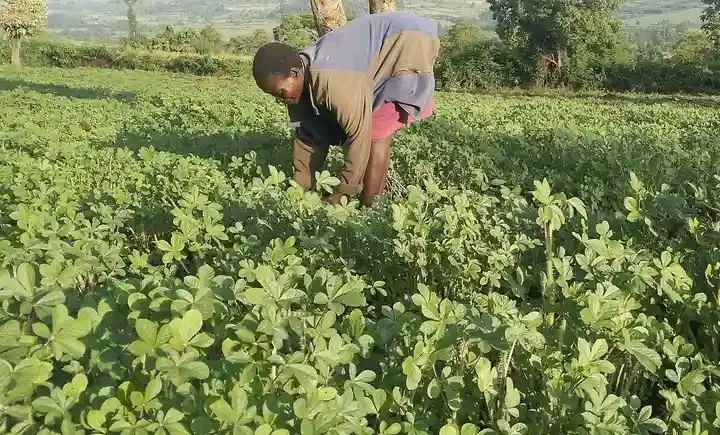
 Farmer tends to her vegetables./FILE
 Smallholder farmers across Eastern Africa are set to have a stronger voice in agricultural policies, markets and investment decisions under a new approximately Sh129.4 million project aimed at transforming the region’s food systems.
The Farmers’ Organisations for Transformation of Agri-Food Systems (GIZ-FO Hub) project, supported by the German development agency GIZ, will strengthen farmer organisations so they can better represent producers in national, regional and global policy processes.
The project targets the Eastern Africa Farmers’ Federation (EAFF) and its members in 10 countries, representing more than 25 million smallholder farmers, fishers, breeders and pastoralists.
EAFF President Elizabeth Nsimadala said farmers should no longer be viewed simply as beneficiaries of government and development programmes but as key actors in Africa’s food systems.
“Our vision is to have a cohesive and prosperous farming community,” Nsimadala said, adding that the federation’s strategy is focused on making smallholder agriculture a rewarding investment opportunity.
The need for stronger farmer representation comes against a backdrop of the critical role played by small-scale producers in food production. The Food and Agriculture Organization (FAO) says family farms employ about two-thirds of Africa’s population and work 62 per cent of the continent’s agricultural land.
Yet many farmers continue to face limited access to markets, finance, information and decision-making platforms.
Nsimadala said the project would help address this imbalance by building the technical and financial capacity of farmer organisations to participate effectively in policy discussions.
“Farmers and farmers’ organisations are usually at the periphery. We are always looked at as beneficiaries of handouts. Yet collectively, we are the largest private sector actor and the largest producers of food globally,” she said.
The initiative comes as African countries implement the third phase of the Comprehensive Africa Agriculture Development Programme (CAADP), following the Kampala Declaration, which puts farmers at the centre of efforts to transform food systems.
EAFF will work with farmer representatives to strengthen their participation in monitoring implementation and holding governments and other actors accountable.
The federation also wants farmers to benefit more from the African Continental Free Trade Area by tackling non-tariff barriers that make it difficult to move agricultural products across borders.
These include differing standards, certification requirements and border procedures. The African Development Bank says more than 80 per cent of commodities traded across African borders are agricultural products, but differences in standards and certification remain major technical barriers to trade.
Nsimadala said Africa also needed to reduce its dependence on imported food by investing more in local production.
She said Africa’s food import bill has risen to more than Sh12.94 trillion ($100 billion) a year, despite the continent having the land, farmers and markets needed to produce more food locally.
EAFF plans to promote aggregation through cooperatives and farmer organisations, allowing producers to combine their output and access larger markets. It also plans to hold biannual investment forums to bring together farmers, governments, investors and other stakeholders.
Climate change will also be a major focus, with farmer organisations expected to strengthen their participation in climate policy, including national climate plans and global climate negotiations.
Nsimadala said farmers were bearing the brunt of increasingly frequent climate shocks, including prolonged dry spells and extreme rainfall.
The project will also prioritise women and young people, with EAFF targeting 40 per cent women and 30 per cent youth participation.
Nsimadala said lack of collateral, particularly land ownership, was preventing many young people from accessing agricultural finance. She called for lenders to consider alternatives such as farmers’ production records and forward contracts.
EAFF’s eGranary platform, which currently has more than 250,000 farmers, is also being used to link producers to input, service and output markets.
Kennedy Okoech, senior technical adviser at GIZ, said the project would place farmer organisations at the centre of agricultural transformation by supporting policy participation, evidence generation and climate resilience.
“We are placing the farmer organisation at the apex to represent farmers and ensure that farmers’ voices are heard,” he said.
Instant analysis
A new Sh129 million project is seeking to give smallholder farmers across Eastern Africa a stronger voice in agricultural policy, markets and investment decisions. Supported by GIZ and implemented through the Eastern Africa Farmers’ Federation (EAFF), the initiative will strengthen farmer organisations representing more than 25 million producers across 10 countries. The project will focus on policy advocacy, climate resilience, access to markets and finance, and participation in AfCFTA opportunities. It will also prioritise women and youth, while promoting farmer aggregation and investment forums. The initiative seeks to shift farmers from being viewed as beneficiaries to active partners in transforming Africa’s food systems.