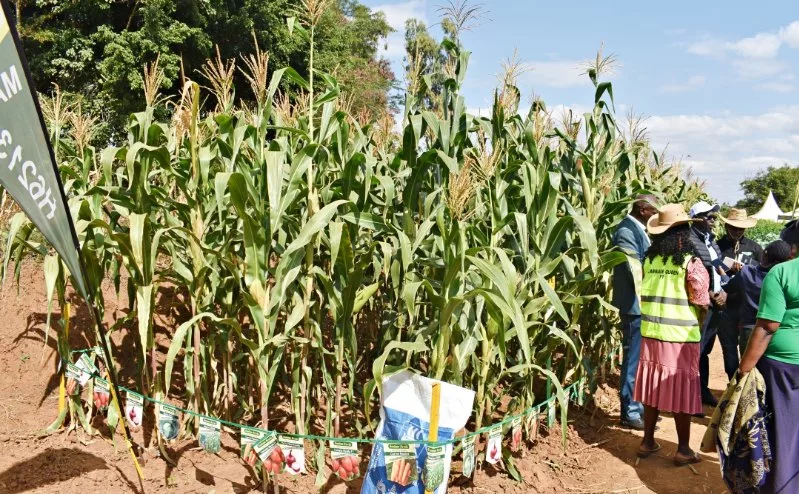
 A maturing drought tolerant maize crop at the demonstration plot./FILE
 Farmers have been urged to seize the upcoming short rains by planting certified, early-maturing and climate-resilient seed varieties that can mature within the shortened rainfall period.
Kenya is expected to record below-normal harvests this year after prolonged drought and poor seasonal rains caused widespread crop failure in several parts of the country.
This has prompted renewed calls for farmers to adopt climate-smart farming practices ahead of the September-December short rains.
The warning comes as the Kenya Meteorological Department forecasts that August will remain predominantly dry across most parts of the country.
Warmer-than-average temperatures are likely to worsen crop moisture stress, reduce pasture availability and increase water demand for livestock, particularly in the arid and semi-arid lands (ASALs).
Head of Public Service Felix Koskei said the poor performance of recent rainy seasons, driven largely by climate change, had significantly affected agricultural production.
However, he stressed that Kenya still has the capacity to produce enough food if farmers embrace improved technologies and certified seeds.
“We faced a challenge this year because of crop failure caused by drought and climate change,” Koskei said during a meeting of Principal Secretaries at the Kenya Agricultural and Livestock Research Organization (Kalro).
“However, Kenya has the capacity to produce enough food if farmers use the right seeds, apply the appropriate technologies and plant at the right time.”
He urged farmers to seize the upcoming short rains by planting certified, early-maturing and climate-resilient seed varieties that can mature within the shortened rainfall period.
Koskei said the government was implementing measures to cushion both farmers and consumers from the effects of reduced agricultural production.
“We may have less than normal harvests, but the government has taken steps to ensure farmers are taken care of as well as consumers in the market,” he said.
According to the National Drought Management Authority (NDMA), drought conditions have worsened in several Asal counties following successive poor rainfall seasons.
Declining pasture and water resources have forced increased livestock migration, while household food security has deteriorated in many pastoral areas.
Even in some high-potential agricultural zones, uneven rainfall distribution and the early end of the rainy season affected crop establishment and reduced expected yields.
The Kenya Meteorological Department says August will bring little relief.
Near-average to below-average rainfall is expected only in parts of the Highlands West of the Rift Valley, the Lake Victoria Basin, the Central and Southern Rift Valley, and sections of the Coast.
Most other areas, particularly the Asal counties, are expected to remain sunny and dry.
Intermittent cool and cloudy conditions, with occasional light rainfall, are expected over the Central Highlands, including Nairobi. While these conditions may help conserve soil moisture, they could also slow the drying of harvested crops.
Warmer-than-normal temperatures across the country are expected to increase evaporation and soil moisture loss, leaving crops under greater moisture stress and raising livestock water requirements.
Kalro Director General Dr Patrick Ketiem said the changing climate had made it necessary for farmers to shift to crop varieties that can withstand shorter and less reliable rainfall seasons.
“Our advice to farmers is to adopt certified, early-maturing and drought-tolerant varieties that are suited to their agroecological zones,” he said.
Ketiem encouraged farmers to seek technical guidance before planting to ensure they choose the most suitable seed varieties for their local conditions.
He said Kalro had developed a range of climate-smart crop varieties and livestock breeds and was expanding access to these technologies through its Mkulima Shops, where farmers can obtain certified seed and scientific advice from researchers.
The institution is also developing a digital farmer database to provide location-specific recommendations based on factors such as soil type, crop choice and farm size. This will enable farmers to receive timely advisories from scientists.
In the August Agrometeorological Monthly Bulletin, Paul Oloo from the Meteorological Services told farmers to take advantage of the prevailing dry conditions to harvest, properly dry and safely store mature crops such as maize and beans to minimise post-harvest losses.
“Where crops are still in the field, conserve soil moisture through mulching and other appropriate practices, and irrigate where possible. In areas receiving occasional rainfall, regularly monitor crops for pests and diseases and ensure harvested produce is adequately protected from moisture,” he said.
Oloo further told livestock keepers to provide adequate water, supplementary feed where pasture is limited, and shelter during cool periods and from daytime heat.
“Farmers are also encouraged to keep following weather updates and guidance from agricultural extension officers to support timely farm decisions,” he said.
INSTANT ANALYSIS
Agricultural experts say that, with climate variability becoming more frequent, timely weather information, certified seed and climate-smart farming practices will be critical in helping farmers reduce losses and improve production during the coming short-rain season.