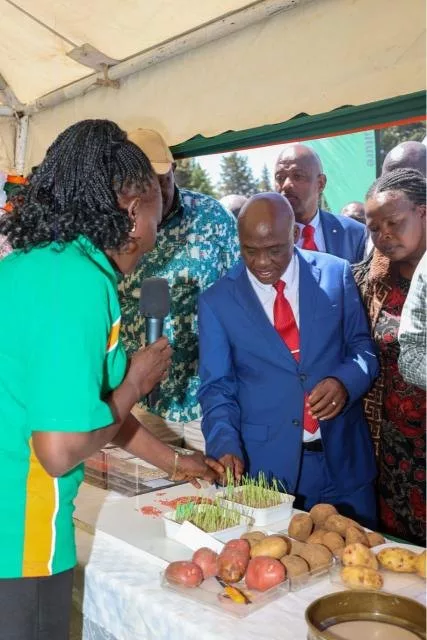
 Agriculture Principal Secretary Dr Paul Rono visits KALRO exhibitions during the commissioning of the KALRO-Marindas Seed Potato Centre in Molo, Nakuru County.
 Agriculture Principal Secretary Dr Paul Rono, Kuresoi North MP Alfred Mutai and Nakuru County Deputy Governor David Kones during the commissioning of the KALRO-Marindas Seed Potato Centre in Molo, Nakuru County./HANDOUT.
 Farmers in Kuresoi, Molo, Njoro and other potato-growing areas of Nakuru County are set to benefit from easier access to certified potato seed following the commissioning of a new seed multiplication centre in Molo.
The Kenya Agricultural and Livestock Research Organization (KALRO)-Marindas Seed Potato Centre will help address the persistent shortage of quality seed, which has been identified as one of the major constraints to potato production in Kenya.
Agriculture Principal Secretary Paul Rono said demand for certified potato seed remains high, but current production is unable to meet the needs of farmers.
“The demand is huge and KALRO, which is in charge of seed propagation, multiplication and research, is only able to meet one per cent of the demand,” said Rono.
He spoke during the commissioning of the KALRO-Marindas Seed Potato Centre in Molo, Nakuru County.
Rono said Nakuru has favourable soils, altitude and climatic conditions for potato production, making it an ideal location for expanding seed production.
He said the government plans to turn the 630-acre Marindas facility into a centre of excellence for potato seed production, research and farmer training.
“Going forward, this will be a centre of excellence for production of potato, and this land will now be converted into agricultural research land,” he said.
The PS said part of the facility would also be used for research on livestock, including sheep and dairy cattle, as well as farmer training.
He, however, warned people who have occupied portions of the government land to vacate.
“I have given instruction to KALRO, the county government of Nakuru and the administration to make sure that this land remains government land for agricultural research, specifically for potato,” said Rono.
He said the government would fence the facility to protect it from further encroachment and ensure it is fully utilised for agricultural research and production.
The government also plans to establish a farmer training centre at Marindas, where farmers from across the country can learn improved farming practices.
Rono said the facility would also host last-mile fertiliser distribution centres and an aggregation facility for agricultural products, including potatoes, coffee and avocados.
He added that Nakuru will host this year’s World Potato Day celebrations in October, providing an opportunity to showcase the centre to potential investors and partners.
Principal Secretary for the State Department for Industry and Investment Juma Mukhwana said the government would work with partners to establish a value-addition facility at the centre.
He said the government is also developing a county aggregation and industrial park at Egerton University in Njoro, which is about 70 per cent complete.
Mukhwana said the government wants to move manufacturing closer to farmers and producers instead of concentrating industries in major cities.
He encouraged farmers and private investors to explore small-scale processing enterprises, including yoghurt and potato crisps.
“We want to bring the industrial parks closer to the producers. Let's not say that manufacturing is the government's job. The government's job is to be a good referee and to make good policies,” he said.
Mukhwana said value addition could enable Kenyan agricultural products to access markets across Africa and beyond.
Kuresoi North MP Alfred Mutai described the facility as a game changer for potato farmers, saying some had abandoned the crop because of difficulties accessing quality seed.
He said farmers have in the past travelled as far as Meru to obtain potato planting material, adding to their production costs.
“But with the seed multiplication facility here in Kuresoi, farmers will now have easy access to the seeds and they will also get to learn more from the researchers and agriculture officers on good agronomical practices to enhance potato production,” said Mutai.
KALRO Director General Patrick Ketiem said the centre would help transform the potato value chain by addressing one of the biggest challenges facing farmers, access to certified seed.
“Potato farmers today are weakened not by lack of land or market, but by limited access to certified seeds. The majority of our farmers plant seed saved from the previous season because certified seed is either unavailable, unaffordable or inaccessible,” said Ketiem.
He warned that repeatedly recycling seed from one season to another accelerates the build-up and spread of pests and diseases, including bacterial wilt, viruses and nematodes.
This, he said, compromises seed quality, reduces yields and ultimately cuts farmers' incomes.
Ketiem said the Marindas centre has about 630 acres, providing significant potential to bridge the seed production gap.
“Our target for every season is about 300 acres under a rotational programme to control the build-up of soil-borne pests and diseases,” he said.