Former Deputy
President Rigathi Gachagua's controversial push for six-piece voting is rapidly
reshaping Mt Kenya politics, attracting allies to the Democracy
for Citizens Partywhile triggering strong pushback from
opposition leaders.
Critics warn the strategy threatens Kenya's multiparty democracy because it calls for blanket voting for all six electoral candidates fielded by a single coalition - president, governor, senator, woman representative, MP and MCA. It rejects examination of individuals’ track records and promises in favour of blinkered acceptance of all candidates fielded by one side or party.
Borrowing from President William Ruto's successful 2022 campaign model, Gachagua is urging voters to elect DCP candidates in all six elective positions in the 2027 general election.
He has also suggested smaller parties fold up and merge with his party.
The campaign has already begun reconfiguring political alignments across Mt Kenya. While a number of leaders are warming up to DCP or considering dissolving their parties to join Gachagua, others insist the region should remain politically pluralistic.
Political analysts say the debate has exposed a widening ideological divide within the so-called united opposition over the best strategy to unseat Ruto.
Speaking to the Star, The New Democrats (TND) Party leader Thuo Mathenge described Gachagua as the region's most influential figure and endorsed his efforts to unite the Mt Kenya region behind a single political vehicle.
"As things stand today, Gachagua is the most popular political leader in the region,” he said. “Our priority is to unite the region, and if that means dissolving TND or forming a coalition with DCP, we are ready because unity is bigger than individual parties."
Mathenge, who has declared interest in the Nyeri gubernatorial seat after unsuccessfully contesting in 2022, said political unity would strengthen the region's bargaining power at the national level.
"If dissolving TND or joining Gachagua helps consolidate the region's unity, I am ready and nothing will stop us," he said.
Kipipiri MP Wanjiku Muhia also defended the strategy of having a single strong party, saying DCP has emerged as the region’s dominant political force.
"DCP is today the largest and most popular political party in the Mt Kenya region,” she said.
“It has the structures, the leadership and the goodwill of the people. If we truly want to liberate our region from UDA and reclaim our political voice, then we must elect DCP leaders from MCA to president.
“Divided votes have weakened us before; united votes under one party will strengthen our bargaining power nationally."
She said fragmented voting has historically weakened Mt Kenya's influence in national politics and that six-piece voting would create a united leadership speaking with one voice.
Kitutu Chache South MP Anthony Kibagendi on Wednesday cautioned Gachagua against what he described as attempts to dominate smaller parties within the opposition coalition.
Kibagendi accused the DCP chief of sidelining and menacing fellow coalition principals, warning he could undermine unity of the opposition alliance.
The opposition has not settled on a presidential candidate.
"We come from
smaller communities and feel intimidated by your approach. While we have great
respect for you, we want to participate in coalition negotiations as equal
partners, with every party and community accorded the same respect and voice,"
Kibagendi said.
The MP reminded
Gachagua that a number of smaller parties had been in the opposition long
before he was forced to exit government through impeachment, saying they would
not tolerate being treated as junior partners within the coalition.
"We were already in the opposition when you were still in government. Be mindful of how you engage with other leaders. We are ready to work with the people of Mt Kenya, but that should not be taken as an opportunity to undermine or take advantage of us," Kibagendi said.
Political analyst and MCA aspirant Edwin Mwangi said Gachagua's confidence has been inflated following DCP's victory in the Ol Kalou parliamentary by-election on July 16.
He said Mt Kenya’s regions react differently to political issues, saying political democracy must be respected at all costs.
"Gachagua is trying to build a complete political ecosystem,” he said. “He knows winning State House alone is not enough. You need governors, MPs, senators and MCAs to implement your agenda and protect your administration politically."
Other parties should be given space to grow politically, he said.
The former DP has urged opposition parties in the region to step up grassroots
mobilisation, saying DCP will continue expanding.
Speaking at his Wamunyoro residence in Nyeri on Wednesday, Gachagua said he supports the growth of all opposition parties but insisted DCP would not slow its own activities because others were less active.
“Our sister PLP leader Martha Karua, the iron lady, is working hard and we respect her and her party. And we encourage all other parties to popularise themselves,” he said.
DCP’s growing influence within the opposition has caused concerns by Democratic Party leader Justin Muturi, PNU’s Peter Munya and Democratic Empowerment Party leader Lenny Kivuti.
Following the Ol Kalou victory, Gachagua declared DCP the region's preferred political vehicle and announced plans to field candidates across all 47 counties.
"We are targeting to have 20 governors, 20 senators, 145 Members of Parliament, 24 woman representatives and over 1,450 MCAs in the 2027 general election," Gachagua said.
He also predicted the complete collapse of support for Ruto’s UDA party in Mt Kenya, claiming the head of state won’t win a single seat after he betrayed the community by directing his impeachment as DP.
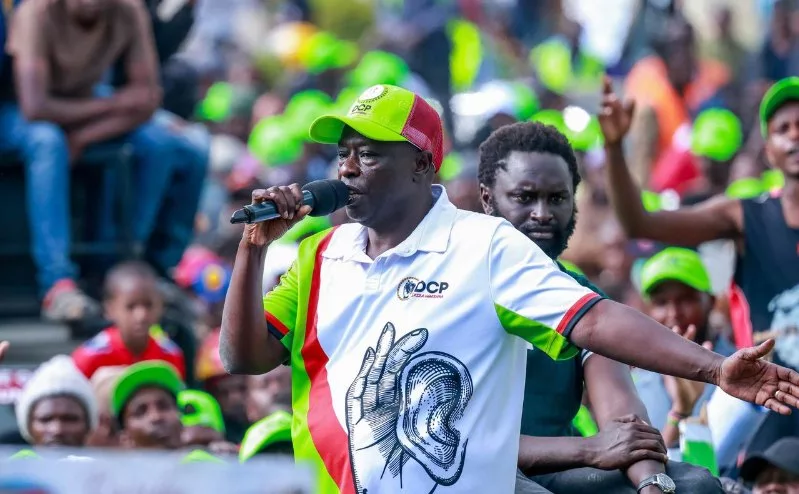
"Next year, you look for me in September. UDA will not get a single seat in the mountain. Not an MCA, not a member of Parliament, not a woman representative, not a senator, not a governor, not president. You can take that to the bank," he declared during a recent rally.
Former Nyeri Town MP and political analyst Ngunjiri Wambugu has emerged as one of the strongest critics of the six-piece campaign, arguing that it undermines Kenya's constitutional multiparty system.
Speaking during an interview, Ngunjiri said the people from Mt Kenya should be left to assess and elect leaders they deserve without having candidates imposed upon them by anyone.
"Gachagua's call for six-piece voting is a threat to democracy. The people should not be dictated to on which party to support."
He accused Gachagua of attempting to impose his political will instead of allowing democratic competition.
"Gachagua should not command or dictate to the people. That behaviour is what caused him to get impeached," he said.
Wambugu further warned that the strategy risks alienating opposition partners whose support will be needed to challenge Ruto in 2027.
"When I said Gachagua wanted to become the only political leader in Mt Kenya, many thought I was just hating on him,” Wambugu said. “Today, [Jeremiah] Kioni, Munya, JB [Muturi], Martha [Karua] and Nderitu [Muriithi] are saying exactly the same thing. He took dictatorship to government and was impeached. Now he has brought it to the opposition."
He said successful coalitions are built through dialogue, consensus and mutual respect and not political directives.
Gachagua's push to unite the entire Mt Kenya region under a single political party has also been rejected by his coalition partners, who insist that political diversity remains essential to building a strong opposition coalition.
Muturi, Munya and Kivuti on Tuesday jointly rejected Gachagua's appeal for their parties to dissolve and join DCP.
Speaking on behalf of the trio, Munya said the DCP leader lacked both the legal and moral authority to determine the future of independent political parties.
"We call upon honorable Gachagua to embrace structured dialogue, consultation and respectful engagement among all like-minded political parties," he added.
He emphasised that lasting political alliances are built on equality, trust and respect for institutional independence and autonomy.
Munya said political parties cannot invest resources in building their structures while simultaneously being encouraged to dissolve them.
"We cannot pretend to be growing our parties while simultaneously locking out others to own specific regions."
Jubilee deputy leader Kionihad called the proposal for one dominant party in Mt Kenya inconsistent with Kenya's constitutional order.
"I heard someone saying that in this region we will only have one party. That is a very retrogressive statement."
Kioni said democracy thrives when parties compete freely and voters choose among competing ideas.
"Every political party should be allowed to campaign and convince wananchi. Building one strong opposition should never mean killing other political parties."
The Service Party leader and Laikipia East MP Mwangi Kiunjuri also opposed merger and six-piece voting proposal, accusing Gachagua of attempting to suppress political pluralism.
"We have
always chosen our leaders based on their ability to serve us, not based on
political parties. That is why we have no problem with people forming new
parties," Kiunjuri said.
He dismissed the argument that a single political vehicle would automatically guarantee development or effective leadership.
"You cannot just come up with a party and expect people to vote for you,” Kiunjuri said. Kenyans should vote for leaders who deliver results, not those hiding behind party names."
Party of Democratic
Unity leader Isaiah Gichu said the six-piece campaign risks undermining
political competition and constitutional freedoms.
"When leaders
insist that voters elect candidates from only one party, they discourage
healthy political competition,” he said.
“Such politics can
easily become dictatorial because loyalty to the party begins to outweigh
competence, accountability and independent thinking. That is dangerous for a
constitutional democracy."
He said opposition unity should be founded on mutual respect among parties rather than pressure to dissolve or merge into a single political outfit.