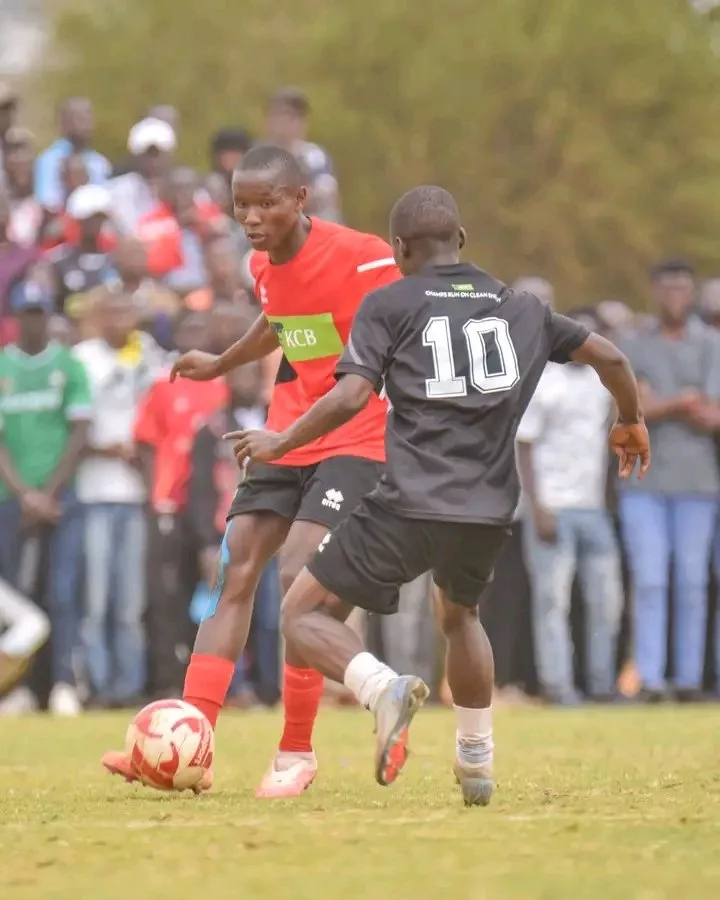
 Part of the action involving St Mary's Yala and Kakamega School/HANDOUT
There is a perfectly good reason to celebrate the 2026 Kenya Secondary Schools Sports Association national games.
The championships at M-Pesa Foundation Academy in Thika produced a parade of worthy winners and offered another glimpse of the extraordinary sporting talent being developed in Kenya’s schools.
Kakamega School’s Green Commandos reclaimed the boys’ football crown after beating St Mary’s Yala 3-2 in extra time, while St Joseph’s Girls, Kitale won the girls’ title after edging Nyakach on penalties following a 1-1 draw.
There was plenty more to celebrate. Chesamisi Boys were crowned national boys’ volleyball champions after defeating ACK Chepsaita 3-1, while Kesogon Mixed Senior School ended Kwanthanze’s reign by beating Soweto Academy 3-0 to claim the girls’ title.
In netball, Andersen Girls emerged champions after defeating Bukokholo 49-37, ending the reign of 2025 champions Oyugi Ogango Girls. Butula Boys took the boys’ rugby Sevens crown after overcoming Cardinal Otunga Mosocho, while Kinale Girls successfully defended their national title by beating Kimobo Girls 19-7.
Basketball 3×3 also produced new champions, with Agoro Sare taking the boys’ title and Ikutha Girls winning the girls’ crown.
Each of these schools deserves recognition, and so do the coaches, games teachers, parents and administrators who invested countless hours preparing their teams. Behind every medal is a young athlete who trained before and after lessons, travelled long distances, endured disappointment and returned to compete again.
However, the 2026 games have once again exposed a problem Kenyan school sport can no longer afford to dismiss as an occasional embarrassment. Age cheating and document falsification remain a serious threat to the credibility of competition.
The disqualifications surrounding the national championships were a warning that this is about more than isolated administrative mistakes. Tenwek High, Ruthagati Boys and Mwira Secondary were among the teams affected by eligibility disputes. At the same time, other schools came under scrutiny during verification at the county and regional levels.
These cases should not be viewed simply as teams losing matches or trophies. They represent opportunities taken away from genuine students.
School games are supposed to be one of Kenya’s great talent-identification systems. It gives a young athlete from an ordinary background the chance to be noticed by a coach, earn a scholarship, join an academy or eventually represent the country.
That pathway depends on one simple principle: everyone must be allowed to compete on equal terms. When an ineligible player is fielded, that principle is broken.
When a birth certificate is altered, a registration record manipulated, or a player's identity misrepresented, the damage extends far beyond a school tournament. Another young athlete may have lost a place that should have been theirs.
That is the real cost of cheating. Kenya has built much of its sporting tradition through schools. Many of the athletes and players who have gone on to represent the country began their journeys on school fields and courts. That makes integrity not an administrative detail, but the foundation of the entire system.
The government, the Ministry of Education and KSSSA therefore deserve credit for moving towards stronger verification, biometric checks and closer scrutiny of student records. But the reforms must go further. Verification should begin before county championships, not when teams have already reached the national stage.
Every athlete should have a single, secure digital record that follows them from county competition through regional and national championships. That record should be linked to official education documents so that names, dates of birth, admission details and other relevant information can be authenticated before a player is cleared.
There should also be clear eligibility regulations and transparent appeal mechanisms. Genuine administrative errors must be distinguished from deliberate fraud. But where deliberate falsification is established, the punishment must be meaningful.
And responsibility must rest with the adults. Young players should not carry the blame for decisions made by coaches, teachers, administrators or officials. If an adult deliberately manipulates a player's eligibility, that adult should face the consequences.
Schools, too, must confront an uncomfortable truth: no trophy is worth compromising the integrity of education and sport.
As the champions prepare for the Federation of East Africa Secondary Schools Sports Association Games in Morogoro, Tanzania, the authorities must use the lessons from Thika to build a cleaner and more credible system.
Let the next generation compete in a school-games system where every player is eligible, every opportunity is genuine, and every trophy is beyond question.