A few weeks ago, I was sitting in the Malindi Airport departure lounge when a group of people, speaking in what sounded to me like North American accents, descended on the terminal.
Dressed in solid-coloured T-shirts bearing church logos and Bible verses for the men, long maxi skirts and loose-fitting capri trousers for the women, and well-worn trail sandals for everyone, I guessed they were missionaries of some sort. They certainly looked better prepared to save souls than to make fashion statements.
My attention kept drifting back to the group from my book. I asked myself why, in 2026, more than 200 years after the Protestant and evangelical missionary wave of the 18th and 19th centuries, these people were still coming here. In that era, missionaries were stalking horses for colonialists. But what do they gain from being here now?
They cannot surely still be relying on the "unreached people" framework to justify their presence. That staple of 20th-century Western missiology is outdated and ignores the reality of modern Africa. If nothing else, it requires an impressive level of geographical optimism to believe that Kenya, where churches seem to occupy every available street corner and half the television channels, remains somehow spiritually undiscovered.
In fact, some might argue that Africa is now the global heartland of Christianity. It has more churchgoers than the West, dynamic local leadership and its own rapidly expanding missionary movement, with Africans increasingly travelling to evangelise secularised Europe and North America.
The presence of foreign evangelists in Africa is increasingly about what they can learn and take back home. Many Western churches appear to be struggling under the weight of secularisation and ageing congregations.
I can only presume they are here to study the resilience and vitality of African Christianity before returning home with fresh ideas for reviving congregations that now struggle to fill the front pew.
Then there is the range of legal, financial and logistical privileges granted to these people by our governments. Most churches and religious NGOs enjoy income tax exemptions and many foreign missionaries are support-funded, meaning their salaries are deposited into bank accounts in their home countries by overseas donors.
While Kenya taxes resident individuals on global income earned locally, enforcing tax collection on money that never passes through a Kenyan bank account is notoriously difficult. Many missionaries also rely on Double Taxation Agreements that allow them to pay income tax solely in their home countries.
So, while they are not entirely immune from taxation, successive Kenyan governments have provided substantial institutional advantages that make living and operating here considerably easier and cheaper than for the average foreign professional. Promises of heaven come with a fairly attractive tax planning package.
Under Category A of the East African Community Customs Management Act, missionaries are classified alongside diplomats for relocation purposes. When establishing residence, they are exempt from customs duties and taxes on personal effects, household goods and a personal vehicle imported within the permitted period.
Meanwhile, a Kenyan returning home after years abroad often discovers that patriotism does not qualify for quite the same customs discount.
Because Kenya remains a deeply religious, some might say brainwashed, society, holding a Class I missionary permit also functions as an informal certificate of good character. It often provides seamless access to local communities, smooth approvals from administrators and readily opens doors in schools, prisons and hospitals.
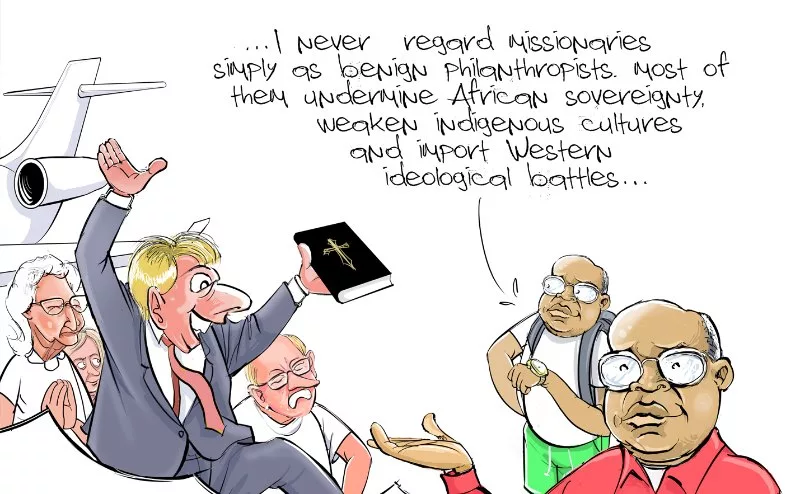
I have read and seen enough to never again regard missionaries simply as benign philanthropists. Instead, I believe most of them are psychological and systemic actors who undermine African sovereignty, weaken indigenous cultures and import Western ideological battles under the banner of religious salvation.
Just look at the wealthy right-wing evangelical organisations, particularly from the United States, that have channelled millions of dollars into African countries, including Kenya. Much of that funding has gone towards “lobbying” politicians and promoting highly punitive legislation, including reinforcement of anti-LGBTQ+ laws, which, by the way, the original missionaries brought with them in the first place.
To my mind, foreign missionaries appear to be treating Africa as an unregulated laboratory for social engineering, using local populations to fight culture wars that they are steadily losing back home.
It is ironic that a continent once described as needing to be "saved" now seems to be expected to save not only Western Christianity, but also Western politics.