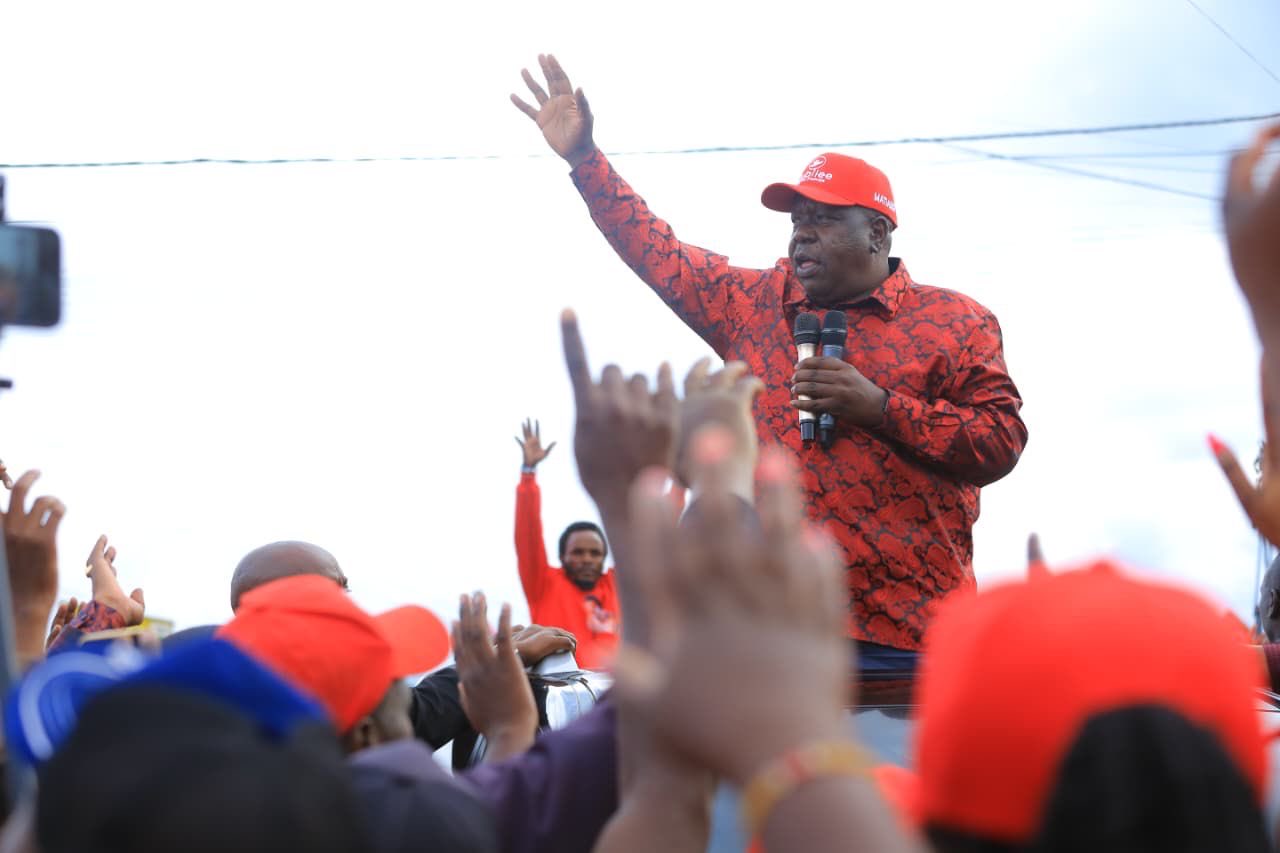
Former Interior CS Fred Matiang'i is a great guy, but he has failed to garner momentum, declared an online user recently in social media.
The Jubilee Party, according to the user is “drowning us with its crinkum crankum,” referring to an old 17th century introduced to Kenyan parlance by Embakasi East MP Babu Owino to inaccurately describe what is not happening within and outside the party.
Neither was the online user even closely remote in his other observation that DCP is “taking over the mountain like we never thought.”
The online user then concluded, noting that Matiang’i’s “vague rhetoric of give ‘me a job and I'll fix this country in the best way I know how...’is not working,” adding that in Kenya, “political seats are seriously sought not given on a golden platter.”
The online user then wraps all this up in a parting shot to say “no wonder Matiang'i's infantries are gatekeeping at Sifuna's rallies for they envision better prospects there.”
He puts his pen down and calls all this “bitter truth” coming from ostensibly supporter or admirer like of the former CS.
To be sure, these are not comments made by someone with an axe to grind against Matiang’i. Far from it. The online user explicitly identifies himself as a supporter, which means any serious candidate would be wise to pay attention to sentiments like these and even reach out to such voices to allay concerns.
That is a matter for the Matiang’i campaign to handle. Analytically speaking, however, several counter‑observations are worth noting.
First, successful campaigners often operate behind the scenes, away from the noise of public expectation.
This is not because they are concealing anything untoward, but because premature disclosure of strategy is the surest way to hand opponents the very tools needed to dismantle that strategy. Sometimes obfuscation is the best strategy.
Second, it is unwise to second‑guess an astute campaigner surrounded by advisers who have lived through every major presidential contest since the dawn of multi‑party politics. Experience matters, and those with it rarely telegraph their next steps.
Yes, Baba had all that and was not sworn but more so the reason is that a leading opposition candidate in 2027 will know better about what pitfalls to avoid.
Third, Matiang’i himself—though not a traditional politician—is a man whose instincts, intellect and execution capacity have been repeatedly demonstrated in public service. His unorthodox style is not a weakness; it is part of the architecture of his approach.
Yes, that can be frustrating to some who are unaccustomed or may not understand how these strategies work, but what matters in the end is brilliant execution no different than the incumbent himself accomplished in 2022.
Except, the victor this time would have not only brilliantly executed, but, when the victory is achieved, he will rise to the occasion and deliver on their promises and more to finally transform the country in the third and final liberation.
Fourth, the 2027 landscape is unlike any we have seen. There is no presidential candidate from the mountain. The incumbent faces deep unpopularity there. Matiang’i carries the legacy of Uhuru’s political constituency, and a significant portion of the Agikuyu community increasingly treats him as one of their own.
As for the claim that Gachagua has “taken over the mountain,” the facts and mood on the ground do not support that conclusion.
Even he understands the limits of that narrative, which is why a negotiated arrangement—one that could see him supporting the former Interior CS—remains plausible.
Should that occur, many of the anxieties voiced by the online user would dissipate almost instantly.
Fifth, other 2027 dynamics—deliberately left out here—further tilt the terrain in Matiang’i’s favour.
The Linda Mwananchi movement, under Nairobi Senator Sifuna’s stewardship, will ultimately have to decide whether it is a vehicle for change or an inadvertent enabler of a second term for the incumbent.
That choice will shape the race and they know where they will align.
Meanwhile, Matiang’i continues to build momentum quietly: strengthening networks, consolidating regional goodwill, engaging key stakeholders discreetly and allowing the groundwork—not theatrics—to speak for itself.